
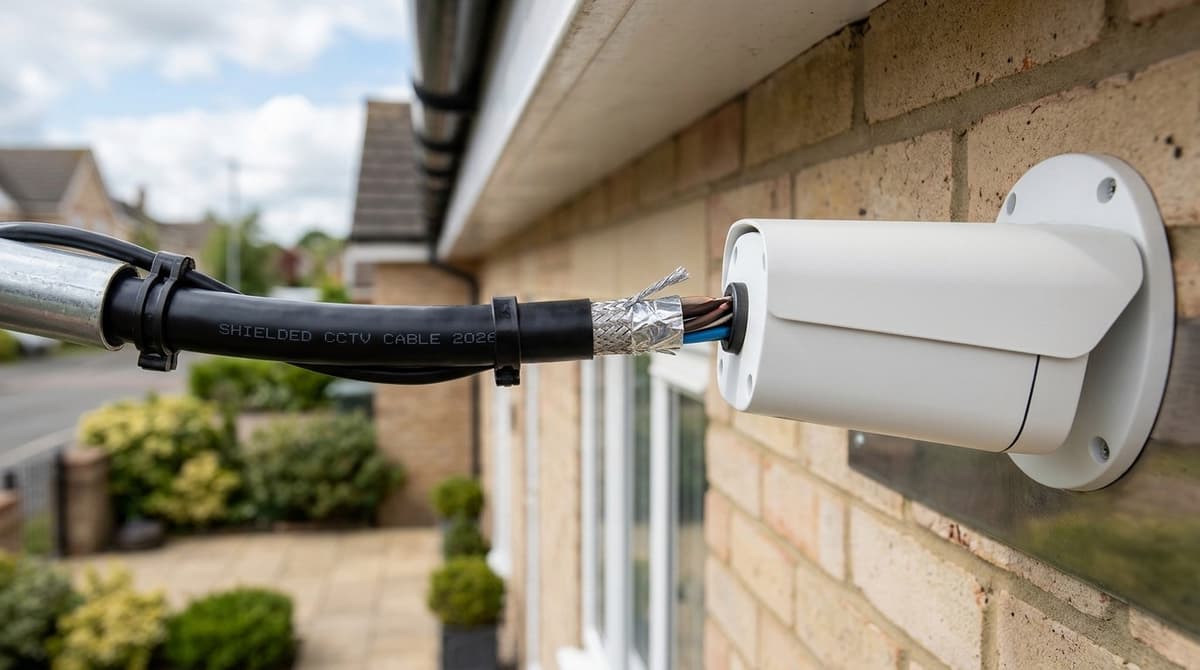
Most UK CCTV runs don't need shielded cable: for ordinary office, home and corridor routes, standard UTP does the job. Shielding earns its extra cost only near strong interference sources such as motors, variable frequency drives and generators, and only if the screen is properly earthed at termination, because a poorly grounded shield can perform worse than plain UTP.
Do you need shielded CCTV cable, or is UTP enough?
Shielded (STP/FTP) cable is for electrically noisy routes, while unshielded UTP is enough for ordinary office, home and corridor runs. US cable makers sell both shielded and non-shielded variants so installers can mitigate EMI where it matters. That is industry practice rather than a UK standard. For a fuller breakdown, see our CCTV camera wire guide.
Before you pull cable, check the route for these triggers:
- Motors
- Generators
- Lighting runs
- Dense cable bundles
If none of these apply, shielding adds cost and termination effort for little gain.
Terms worth untangling
STP and FTP are the shielded constructions, and UTP has no screen. A search for "shield cctv" is ambiguous, so to be clear, here it means screened network cable, not a camera brand or app.
Two practical points
Shielding and weatherproofing are separate choices. Some US makers list outdoor flooded and direct-burial shielded designs, so shielded cable outdoor is a construction option rather than a default.
A screen also only helps if the connectors match it. A metal-housed plug such as our Shielded RJ45 Cat5e Pass Through 8P8C Plug is designed for terminating STP cable on CCTV IP runs. If the noisy route also feeds camera power, the Camera Power Supply Guide for UK CCTV Buyers 2026 covers the supply side.
Where does shielded cable help in a UK building: mains, lifts, plant rooms?
Shielded cable earns its cost where data runs pass close to heavy electrical noise: switchgear, motor areas, plant rooms and lift shafts. Elsewhere, plain routing discipline usually does the job.
What follows is general installer guidance, not a quotation from a standard. The basic rule is to keep data cable away from mains cable. Required segregation depends on the cable types and the installation, so check it against BS 7671 and the relevant BS EN cabling standards rather than a rule of thumb. This section gives no separation distances for that reason.
Lift shafts
A vertical shaft is a cable-rating question as much as a noise question. Whether a cable is suitable for a vertical run, such as a riser or fire-performance rating, is a separate decision from shielding. A riser-suitable cable can be unshielded, and a shielded cable is not automatically suitable for a shaft. Specify each on its own merits and confirm both with your installer.
Shielding versus re-routing
Moving the run away from the noise source is often cheaper than shielding it. A different cable path costs some extra cable and containment, whereas shielding means dearer cable and correctly terminated screens throughout.
If you do shield, the screen only helps when it is continuous end to end. Our shielded RJ45 Cat5e pass-through plug has a metal housing for STP cable, and the earthing arrangement should be decided by your electrician.
Fitting should be done by your own electrician or an independent NSI or SSAIB installer. We sell the equipment and do not install it.
Why does shielded CCTV cable sometimes make things worse? Earthing and termination mistakes
A shield that is unterminated or earthed badly can pick up interference like an antenna or create a ground loop, so shielded CCTV cable only helps when the shield is continuous end to end and earthed deliberately.
Outdoor runs raise the stakes, because a long shielded cable outdoors collects more induced noise and gives a loop more chances to form. These are the usual faults, offered as general guidance rather than a rule for every site:
- Mixed components: shielded cable fed into unshielded jacks or patch panels leaves a gap in the screen at each one.
- Broken joints: a coupler or junction box that doesn't carry the shield through cuts the run in two.
- Uncontrolled earthing: bonding the shield at several points, such as at the camera housing, a metal bracket and the switch, can create a loop. Decide on the earthing point and follow the equipment manufacturer's instructions.
- Mismatched plugs: STP cable on an unshielded or plastic-bodied RJ45 plug leaves the screen with nothing to connect to.
Terminating is where many of these start. The Shielded RJ45 Pass-Through Plug for Cat5e STP Cable costs £0.07 and has a metal shielded housing. Its pass-through design lets you check the conductors before crimping, and it has gold-plated contacts and supports T568A and T568B wiring, so it suits both Fast Ethernet and Gigabit runs.
It is a Cat5e connector, so use it with Cat5e STP cable and don't treat it as a Cat6 part.
Temporary rigs are re-terminated more often, which makes broken screens more likely, and our guide to site CCTV hire vs buy in the UK helps decide which suits a short job. For earthing, have your own electrician or an independent installer confirm the arrangement.
Shielded cable outdoors, RF-sensitive sites and PoE load: what changes?
Shielding only changes noise rejection; it does not make cable weatherproof, change your PoE budget or cope with MRI-room RF.
Outdoor runs
A screen around the pairs says nothing about how the outer jacket copes with rain, soil or sunlight. Windy City Wire's CCTV cable range treats outdoor flooded and direct-burial shielded designs as separate constructions from ordinary shielded cable. When you buy shielded cable for outdoor use, read the jacket's stated rating and burial suitability rather than the word "shielded". The camera end is a separate decision, and our dome versus turret comparison covers it.
Screened cable also needs screened terminations to stay continuous, such as our shielded Cat5e RJ45 pass-through plug with its metal housing.
PoE load
Shielded cable draws power from the switch exactly as unshielded does, so the budget maths in our PoE switch sizing guide applies unchanged. Size the switch from the cameras, not the cable.
RF-sensitive sites
The extreme case is an MRI suite. The SAFEVIEW patient CCTV system for a 1.5T scanner pairs a shielded camera enclosure with fibre optic technology. That is background, not a product we sell. It shows that where RF is the main hazard, designers move off copper altogether.
Wired versus wireless
Shielding applies only to wired Ethernet, so it is the route for electrically noisy buildings with motors, generators or dense cable bundles. A wireless camera has no cable to screen. If interference is your worry, wired is the honest answer.
How to choose and terminate shielded cable: a buyer's checklist
Survey the route, reroute away from noise if practical, and specify STP or FTP end to end only when you cannot.
- Survey the route. Look for motors, generators, lighting runs and dense cable bundles, which are common sources of interference and the usual reasons to choose shielded over unshielded cable.
- Reroute if practical. Moving the run away from the source is usually cheaper than screening it.
- If you cannot reroute, specify STP or FTP end to end. The screen must be unbroken through the connectors and patch panels. One unshielded plug or panel port breaks it.
- Have a qualified electrician or installer earth it. The earthing arrangement is their call on site.
- Test the link after termination. Check the screen's continuity as well as the pairs, because a link can pass data and still have a floating screen.
For Cat5e shielded cable, the Shielded RJ45 CAT5e pass-through 8P8C plug has a metal shielded housing and gold-plated contacts, and it suits IP cameras, NVRs, switches and patch panels. Pass-through plugs help conductor alignment, but following the datasheet or installation guide's termination steps still matters.
Trade-offs and fit
STP is stiffer and costs more per metre than UTP, so it is harder to pull round tight bends. UTP remains fine for most runs.
Shielded cable is worth the extra cost in plant rooms, lift lobbies, and industrial or commercial sites. A typical domestic install rarely needs it.
If you are speccing a mixed job, Shop at cctvmaster.co.uk for shielded RJ45 connectors, or ask about trade pricing.
Related products
Related products from our own range:
- TruLAN Cat6A F/FTP Outdoor Cable for CCTV, PE Sheath — Connectix TruLAN Cat6A F/FTP outdoor cable: foil-shielded pairs cut interference; heavy-duty PE sheath suits ducts, outdoor runs and CCTV links.
- CAT6 RJ45 Ethernet Cable 30m – Shielded LAN Lead — CAT6 shielded Ethernet cable with gold-plated RJ45 connectors, 30m, LSZH jacket. Perfect for CCTV, routers, PCs and high-speed networks.
- Shielded RJ45 Connector, Cat6 Pass-Through 8P8C — Shielded RJ45 connector for Cat6 cable, with a metal housing against interference. Pass-through design lets you check wire order before crimping.