
camera power supply
Camera Power Supply Guide for UK CCTV Buyers 2026
To size a 12V CCTV power supply, add up the current (in amps) that each camera draws, then choose a supply rated comfortably above that total, either as one…
On this page
- What does a CCTV power supply do, and which type does my camera need?
- How many volts does a CCTV camera need?
- Powering a PoE camera without a PoE switch
- How do I size a 12V CCTV power supply?
- Use the maximum, not the idle figure
- Mixed systems
- Should I use one PSU box or a power supply per camera?
- Sizing a camera power supply for 8 or 16 channels
- A single-camera option
- How do I wire a CCTV power supply safely in the UK?
- Mains side
- Low-voltage side
- Common faults
- Placement
- When is battery backup worth the cost?
- Two different jobs
- Sizing and upkeep
- A note on "uninterrupted power supply for filming"
To size a 12V CCTV power supply, add up the current (in amps) that each camera draws, then choose a supply rated comfortably above that total, either as one central unit or as several distributed ones. The qualification is that this only applies to 12V DC cameras: PoE cameras take their power from the switch, NVR or injector over the network cable, so they never count towards the 12V budget. Get the sizing wrong and an undersized supply can cause the power fluctuations that interrupt recording.
What does a CCTV power supply do, and which type does my camera need?
A CCTV power supply converts 230V UK mains into the low voltage a camera is designed for, and yes, every camera needs electricity. Which type you need depends on how the camera is built.
Security Camera King lists three routes:
- 12V DC: HD-over-coax cameras (HD-TVI, AHD, CVI) and some standalone IP cameras.
- PoE: IP cameras fed from a PoE switch, an NVR with PoE ports, or an injector.
- 24V AC: some PTZ domes.
If you are still weighing a wired system against a standalone unit, our CCTV vs security camera buyer's guide shows how that choice changes the power route.
How many volts does a CCTV camera need?
Read the rating plate or datasheet, because there is no universal figure. Match the voltage, the connector and the polarity. CCTV Camera Pros warns that a 12V camera on a 24V source will almost always destroy its board.
For 12V cameras, our 12V 3A CCTV power supply with UK cable costs £6.89. It uses a 5.5mm × 2.1mm barrel plug, centre positive, which suits most HD-over-coax and standalone IP cameras that take local DC input.
Powering a PoE camera without a PoE switch
A single-port PoE injector does this. It plugs into mains and puts power onto the network cable running to the camera, so you don't need a PoE switch or a PoE-capable NVR. Check the camera's stated power draw against the injector's output on both datasheets before buying.
How do I size a 12V CCTV power supply?
Add up the rated current of every 12V device on the supply, then pick a supply whose amp rating is comfortably higher than that total.
Power is volts multiplied by amps, so a 12-volt, 1-amp supply delivers 12 watts, as Teledyne explains. You can work purely in amps, because every device on a 12V rail shares the same voltage and the currents simply add. The longer walkthrough is in our guide to 12V CCTV power supply sizing and amps.
The fill-in-the-blanks version:
N cameras × [datasheet amps per camera] + [other 12V loads] → compare with [PSU rated amps]
The left side must come out lower than the supply's rating, with headroom to spare. Take every figure from the datasheet for that exact model.
Use the maximum, not the idle figure
As general guidance rather than a manufacturer rule, size against the highest current on the datasheet. That means IR illuminators lit and any heater or motor running, not the daytime idle draw. Draw peaks at night and in cold weather, which is when an undersized supply struggles.
Mixed systems
PoE cameras are budgeted against the PoE power of the switch or recorder feeding them, so leave them out of this sum. Only the 12V cameras and any other 12V accessories count here.
Once you have a total, a single unit such as our 12V 3A CCTV Power Supply with UK Cable (£6.89) uses a 5.5mm × 2.1mm centre-positive barrel plug. Check that your camera's input matches before you buy.
Should I use one PSU box or a power supply per camera?
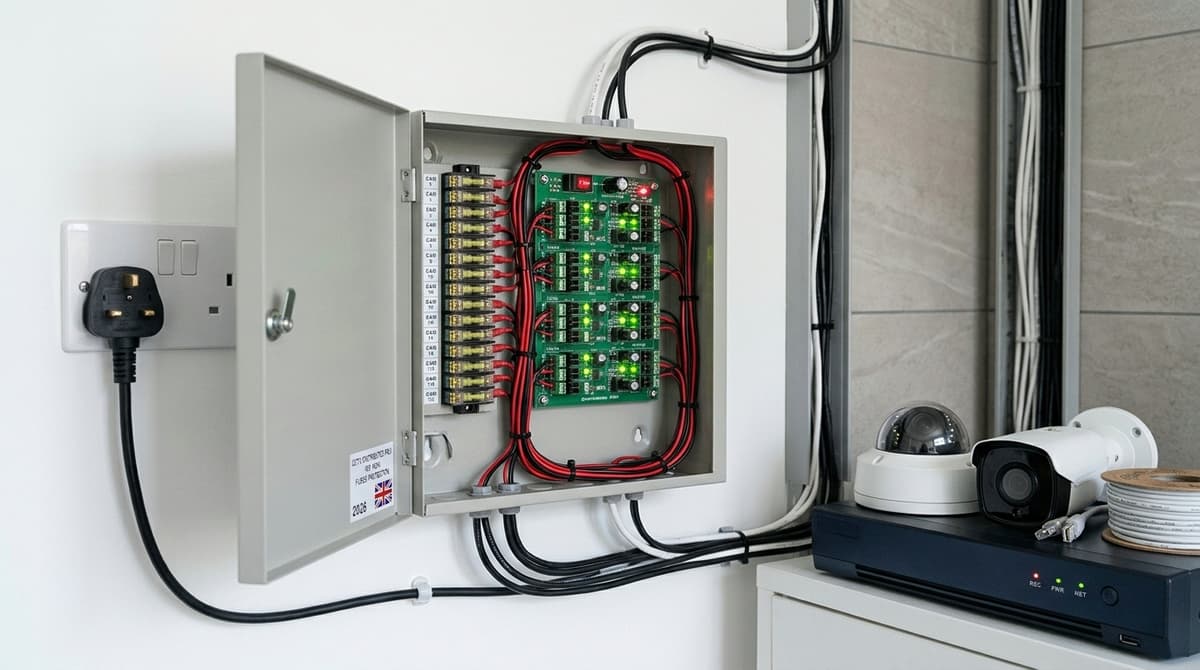
Use one central PSU box for 4-, 8- or 16-channel systems wired to a single cabinet, and per-camera adapters for small or spread-out sites. The right choice comes down to what a fault costs you, how far the cable runs and how tidy you need the install to be.
| Per-camera or per-cluster adapters | Central PSU box | |
|---|---|---|
| Failure impact | One fault takes down one camera (or one cluster) | One fault can take down every camera on the box |
| Cable and voltage drop | Short DC run from adapter to camera | The full 12V run travels the cable, so long runs lose more voltage at the far end |
| Tidiness | Many adapters and mains sockets near the cameras | One mains feed and one unit to maintain, beside the recorder |
Long runs matter most with a central box. Check each camera's minimum input voltage on its datasheet and size the cable accordingly, or move to local adapters for the furthest cameras. If you are still choosing models, our CCTV Bullet Camera Guide for UK Buyers 2026 is a sensible starting point before you size the power.
Sizing a camera power supply for 8 or 16 channels
Add up the current draw of every 12V camera, taking each figure from its datasheet, and choose a supply or distribution box rated above that total. For an 8-channel or 16-channel system, the sum runs over 8 or 16 cameras, and the box needs at least that many outputs. Watts are volts multiplied by amps, so a camera listed in watts converts easily.
IP cameras on PoE draw power through the NVR or switch instead, so they do not need this supply.
A single-camera option
Our 12V 3A CCTV power supply with UK cable uses a 5.5mm outer, 2.1mm inner barrel plug with centre-positive polarity. That plug fits pre-made camera leads, and a pigtail adapter converts it to bare wires for cable runs. The live price is on the product page, and your own electrician or installer should fit it.
How do I wire a CCTV power supply safely in the UK?
Leave the 230V mains connection to a qualified electrician working to BS 7671, and test the low-voltage output yourself before connecting any camera.
Mains side
Fixed or spur connections to the 230V supply are work for your own electrician under BS 7671. CCTV Master sells the equipment but does not fit it. If you want a fitter, choose an independent installer registered with NSI or SSAIB.
Low-voltage side
Most analogue HD cameras take 12V DC, while some PTZ models want 24V AC, so confirm the input on the camera's specification first. Our PTZ buyer's guide covers how those power requirements differ.
To check a camera power supply before use:
- Confirm the plug is centre-positive and matches the camera's socket. Our 12V 3A CCTV power supply with UK cable, listed at £6.89 including VAT, uses a 5.5mm × 2.1mm barrel with centre-positive polarity.
- Set a multimeter to DC volts, power the supply with nothing attached, and touch the red probe to the inner pin and the black to the outer sleeve.
- Proceed only if the reading matches the camera's rated voltage and the sign is positive.
If you use a pigtail lead to reach screw terminals, identify the positive conductor with the meter before connecting. Never assume the stripe or sleeve means positive.
Common faults
The usual culprits are:
- Undersized supply: watts are volts multiplied by amps, so a 12V 1A unit delivers 12W. Add up every camera's stated draw and keep the supply comfortably above that total.
- Voltage drop: long, thin cable runs lose voltage on the way to the camera, which can cause reboots or dim IR.
- Wrong voltage: a 24V AC camera on a 12V DC unit will not behave.
- Loose connectors: these cause intermittent dropouts that look like camera faults.
Placement
Mount supplies in a dry, ventilated cabinet. Read the IP rating on the supply's datasheet before it goes anywhere exposed, and don't assume a plug-in adapter is weatherproof.
When is battery backup worth the cost?
Battery backup is worth it where a mains cut at the wrong moment defeats the system's purpose: a business, a high-risk site, or any 24/7 recording requirement.
Two different jobs
- UPS on the recorder, switch and router: This suits PoE and network systems. The PoE switch feeds the cameras, so a UPS that covers only the NVR leaves it recording nothing, because the cameras have already gone dark. The router needs cover too if you want remote alerts during an outage.
- 12V battery-backed PSU: This suits HD-over-coax cameras on 12V DC. It backs up the camera line directly, and the recorder needs its own cover.
Sizing and upkeep
Runtime is battery watt-hours ÷ load watts. Take the battery's capacity from its datasheet, and get each device's draw from its specification page.
Batteries age and need replacing, so budget for that as a running cost, not a one-off purchase. If a site has no mains at all, a solar-plus-battery setup is the off-grid idea to explore.
A note on "uninterrupted power supply for filming"
That phrase is a production-power query, covering cameras on shoots, not CCTV. For surveillance, the approach is the one above: cover the NVR, the switch and the router.
Frequently asked questions
what is cctv power supply
A CCTV power supply converts 230V UK mains into the low-voltage supply a camera is designed for, so yes, a camera needs electricity. That is usually 12V DC for HD-over-coax and some standalone IP cameras, PoE from a switch, NVR or injector, or 24V AC for some PTZs.
What power supply do i need for cctv camera
Match the voltage on the camera label, then add up the amps of every 12V camera on the supply: camera 1 + camera 2 + … = total amps. Choose a supply rated above that total with headroom. Our 12V 3A CCTV Power Supply with UK Cable has a 5.5mm × 2.1mm centre-positive plug and overload, short-circuit and overvoltage protection. Price and availability are shown live on the product page.
How many volts are in a CCTV camera?
HD-TVI, AHD and CVI cameras, along with some standalone IP models, typically run on 12V DC. PoE cameras are powered through the network cable by the switch, NVR or injector, and some PTZs use 24V AC. Always confirm the figure on the camera's label or datasheet.
how to connect camera power supply
Confirm the camera takes 12V DC, then push the supply's 5.5mm × 2.1mm barrel plug into the camera's DC input. Polarity must be centre positive. Plug the mains lead into the socket last. If several cameras share one supply, their combined amps must stay within its rating.
Do PoE cameras need a separate power supply?
No. A PoE camera takes power over its Ethernet cable from the switch, NVR or injector, so it does not count towards your 12V amp total. You only need to size the 12V supply for the cameras that use a DC barrel input.
Shop this topic
- camera
- power
- supply
Written by
CCTV Master Editorial Team
CCTV Master's guides compare the cameras and recorders we stock on the specifications that matter, with every figure checked against the manufacturer's datasheet before publication.
Related reading
- Outdoor PoE Camera Guide for UK Sites (2026)poe camera outdoor
- CCTV Bullet Camera Guide for UK Buyers 2026cctv bullet camera
- PoE Switch for CCTV 2026: Choose the Right Onenetwork switch power over ethernet
- 12V CCTV Power Supply: Sizing & Amps 202612v cctv power supply
- Hikvision Camera Guide UK: Choosing the Right Serieshikvision camera
- Hikvision AcuSense Explained: How It Works (2026)hikvision acusense camera