
cctv bullet camera
CCTV Bullet Camera Guide for UK Buyers 2026
A CCTV bullet camera is a cylindrical, fixed-direction camera, usually with built-in infrared, and it suits covering a set area at longer range, such as a…
On this page
- What is a CCTV bullet camera, and where does it earn its place?
- Fixed or varifocal: how do you choose by mounting height and distance?
- A sequence to follow (general guidance, not a manufacturer rule)
- Night vision on a bullet: IR range, or the move to colour night modes?
- IP67, IK ratings and exposed UK walls and eaves
- Matching the rating to the position
- The datasheet decides
- Bullet camera mounting: wall, pole, corner and hidden cable runs
- Wall mounting with a junction box
- Pole and corner mounting
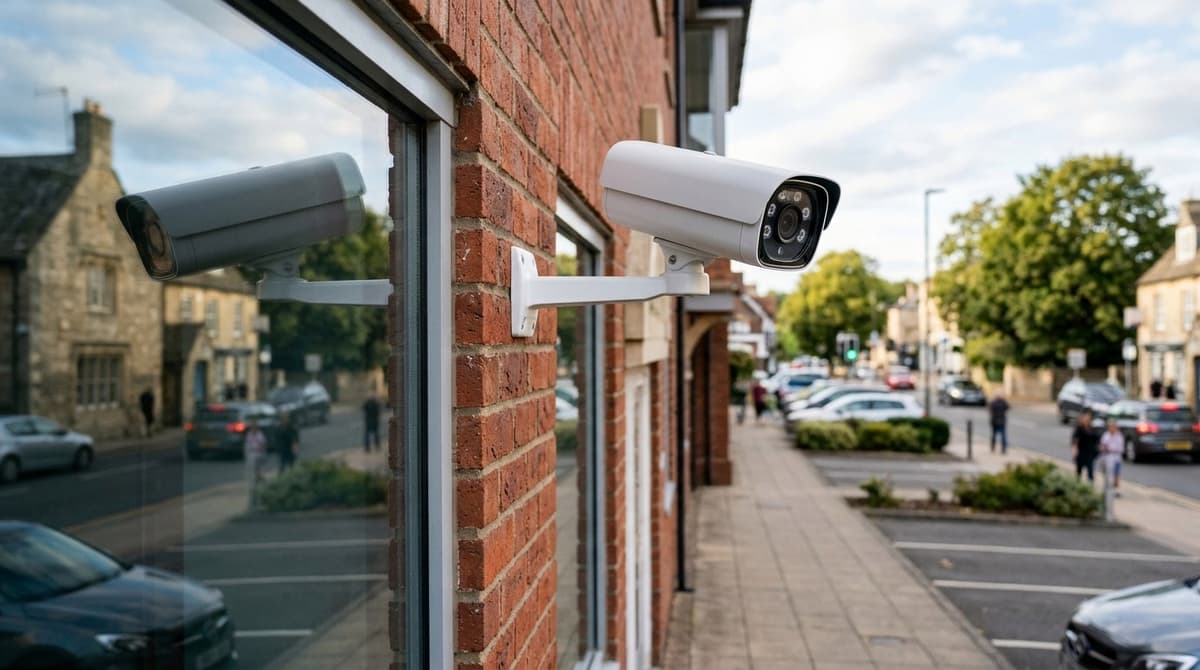
A CCTV bullet camera is a cylindrical, fixed-direction camera, usually with built-in infrared, and it suits covering a set area at longer range, such as a yard, car park edge or building perimeter. Its body has room for a larger lens, but the right model depends on three things: how high you can mount it, how far away the target is, and whether the wall or eaves will take a tidy cable run. Get those right and the lens type, night mode and mounting base will affect your footage more than the headline resolution on the box.
What is a CCTV bullet camera, and where does it earn its place?
A CCTV bullet camera is a cylindrical, fixed-direction camera, usually with built-in infrared, that is easy to see and easy to aim at one defined area. That infrared is what gives most bullets their night vision.
The shape does real work. Axis notes that a bullet body can take a larger lens, which helps over longer distances, and its own range runs from the affordable fixed-focal M20 series to the varifocal P14 series. That makes bullets a sensible pick for car parks, roads and building perimeters, where reach and a visible deterrent matter more than discretion.
"Housing" in this context just means the camera body. The mounting base is a junction box, such as the Hikvision DS-1280ZJ-XS-B at £17.39 including VAT, which gives the cabling a protected route in behind the camera.
If you're choosing a bullet for a house rather than a commercial site, our guide to 4K CCTV Cameras for UK Homes covers resolution in detail.
Fixed or varifocal: how do you choose by mounting height and distance?
Choose a fixed lens when the mounting point and subject distance are settled and short; choose varifocal when either could still change on site.
A fixed lens has fewer variables, because the view is set at manufacture and nothing needs adjusting at the top of a ladder. Axis lists its M20 series as three "affordable fixed-focal" bullet cameras. The trade-off is that if the bracket ends up higher than planned or the gate sits further away, the only fix is a different camera.
A varifocal lens lets you tune the field of view once the camera is mounted. Axis lists its P14 series, seven products, as varifocal multi-purpose bullets. That makes varifocal the safer pick when the final mounting height or target distance is uncertain, for example when the fixing point depends on a fence or wall that isn't finished.
A sequence to follow (general guidance, not a manufacturer rule)
- Name the target: the gate, the driveway or the fence line.
- Measure the distance from the intended mounting point to that target, and note the height.
- Choose the lens. Go fixed if both figures are settled, and varifocal if either is provisional or one camera must cover a range of distances.
I haven't given a lens-to-metre table, because the right match depends on the sensor, resolution and detail you need. Check each model's datasheet for its lens range.
Plate capture is a separate requirement. Don't assume a bullet camera reads number plates unless its spec record says so, and use our ANPR guidance instead. For how lens choice fits into a whole multi-camera layout, the Commercial CCTV Camera Guide for UK Sites (2026) is the place to continue.
Night vision on a bullet: IR range, or the move to colour night modes?
For most night vision CCTV camera jobs, built-in IR is still the default, while white-light colour modes are the 2026 trend, and both need careful aiming. Bullet housings usually carry their own infrared illuminators, per Axis, so the camera lights its own scene in black and white.
IR has three practical weaknesses:
- Nearby surfaces: a wall, fascia or soffit close to the lens bounces IR back and washes out the picture.
- Spiders: webs across the lens or illuminator glow brightly at night and can trigger false motion alerts.
- Rain: drops close to the lens flare under IR, which can hide a subject.
Colour night modes use visible white light to keep colour at night, which helps with clothing and vehicle identification. We have no datasheet figures to back a range or lux claim for them, so treat any marketing number with caution.
White light brings a legal angle. A lamp that sweeps neighbours' windows or public space is a nuisance and a UK GDPR and ICO privacy concern. Our UK CCTV law pages cover signage and DPIA-style assessment.
Read the IR range and low-light claims on the datasheet, and treat them as best-case. They are measured in clear conditions. If you need to follow someone across a yard after dark, our UK PTZ CCTV camera buyer's guide covers that different tool.
IP67, IK ratings and exposed UK walls and eaves
IP67 means dust-tight and able to withstand temporary immersion, while IK10 is the highest impact grade. Neither guarantees a camera will survive years of British weather or a determined attack.
Under IEC 60529, the 6 in IP67 means no dust ingress and the 7 means protection against temporary immersion, tested at 1 m for 30 minutes. It says nothing about UV ageing, salt air, or cable joints made outside the housing. Powerful water jets are covered by separate codes, so IP67 alone doesn't certify them.
IK10 under BS EN 62262 is a 20 joule impact on the housing. It does not cover a bracket being levered off, a cable being cut, repeated blows or a sprayed lens. Treat it as impact resistance, not a vandal-proof guarantee.
Matching the rating to the position
- Under the eaves, out of reach: the overhang shelters the camera from direct rain, so IP67 is there for wind-driven rain and condensation. IK10 matters less when an attacker needs a ladder.
- Low walls within reach: pay for IK10, then protect the weak points around it. Keep cable out of sight, for example in a junction box such as the Hikvision DS-1280ZJ-XS-B at £17.39, which offers cable entry options. Check camera compatibility on the product page.
- Corners facing the weather: driven rain finds every gap, so point cable entries downward and leave a drip loop.
The datasheet decides
A rating belongs to one exact model code. It does not carry across a range, a different resolution variant, or to the bracket and junction box. Read the IP and IK figures on the datasheet for the model you are buying. Cabling for outdoor PoE runs is covered on our outdoor PoE page.
Bullet camera mounting: wall, pole, corner and hidden cable runs
On a wall, fit a junction box behind the camera so the cable joints and connectors sit out of sight and out of the weather. Pole and corner mounts need more care, because the right adaptor depends on the exact camera model.
Wall mounting with a junction box
The Hikvision DS-1280ZJ-XS-B (black) and DS-1280ZJ-XS-W (white) are aluminium alloy junction boxes made for Hikvision mini bullet cameras. Both take cable from the bottom or the side, suit indoor and outdoor use, and leave space inside for cable joints and connectors. Pick the colour that matches your camera's housing finish so the box looks like part of the camera.
Bottom entry suits a cable rising from below, while side entry suits a run along the wall in trunking. Either way, the connector stays inside the box instead of hanging loose. Each product page shows the current price including VAT and live availability.
Pole and corner mounting
Poles and corners are where bullet cameras most often get fitted with the wrong parts. A pole mount needs a rigid fixing, since any sway shows up as shaky footage, and a corner mount needs a bracket that clears both wall faces and leaves room for the cable.
Dedicated pole or corner adaptors are separate parts. The junction box details don't list any, so check an adaptor against your exact camera model before ordering. If you're still deciding whether a bullet suits the site at all, our CCTV vs security camera buyer's guide covers the choice. We sell the equipment only, so have your own electrician or an independent installer do the fitting, working from the camera's datasheet or installation guide.
Frequently asked questions
What is a bullet camera in CCTV?
A bullet camera is a cylindrical, fixed-direction CCTV camera, usually with built-in infrared, that is easy to see and easy to aim. It suits directional coverage over longer distances. The right choice depends on mounting height, target distance and whether the wall or eaves will take a tidy cable run.
What type of CCTV camera is bullet?
Bullet is a fixed-direction camera type: it points where you aim it and stays there. Its form factor accommodates larger lenses, which is why it is used for longer distances. Axis notes that bullet ranges run from affordable fixed-focal to varifocal series, so lens choice is the key decision.
What is the best CCTV bullet camera?
No single model is best for every site. Match the lens to the distance, fixed-focal for a set view or varifocal where you need to adjust the field of view. Then check the night mode, IP and IK ratings, and mounting. Base the decision on mounting height, target distance and cable route, not headline resolution alone.
What is the price of a Bullet CCTV camera?
Camera prices vary with lens type and series, since ranges span affordable fixed-focal to varifocal models, so we can't give one reliable figure. A fixed cost to budget for is mounting: our Hikvision DS-1280ZJ-XS-B junction box for bullet CCTV cameras in black is £17.39.
What is a bullet camera junction box for?
The junction box acts as the mounting base and keeps cabling organised. The Hikvision DS-1280ZJ-XS-B is for Hikvision mini bullet cameras and is built from aluminium alloy for durability. Its cable entry options allow flexible routing depending on the installation environment, which helps protect cables and keep wiring tidy.
Sources & references
- cctv
- bullet
- camera
Written by
CCTV Master Editorial Team
CCTV Master's guides compare the cameras and recorders we stock on the specifications that matter, with every figure checked against the manufacturer's datasheet before publication.
Related reading
- Outdoor PoE Camera Guide for UK Sites (2026)poe camera outdoor
- CCTV for Warehouses UK: Zone-by-Zone Camera Planningcctv for warehouse
- 4 Camera CCTV System: Price & Setup 20264 camera cctv system
- 4-Camera CCTV Kit: Real Coverage Limits4 camera cctv kit
- CCTV Camera Offline: Fix No Videocctv camera offline no video
- CCTV Camera Bracket Fitting Guide 2026cctv camera bracket