
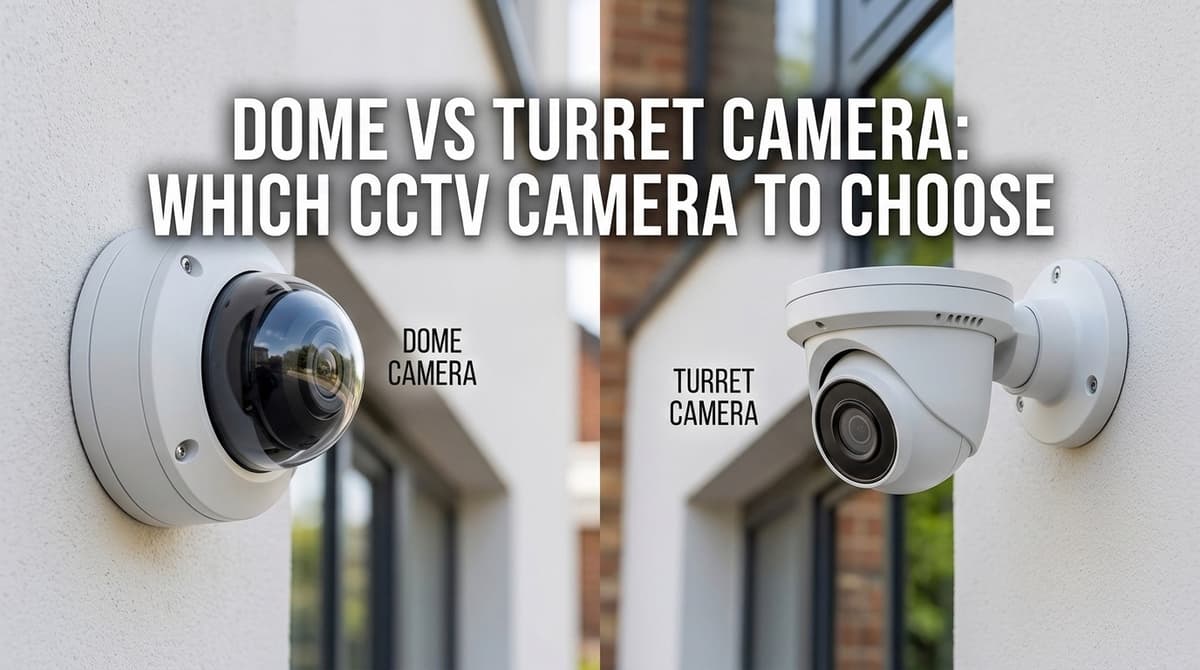
Choose a dome where the camera is within reach of hands, such as ceilings, low walls and public-facing spots, because its clear cover protects the lens. Choose a turret where it sits out of reach on an exterior wall or soffit and you want easy aiming without IR glare, since there is no glass cover to bounce the infrared light back into the image. The housing and mounting position decide this, not image quality, because a dome and a turret can share exactly the same sensor.
Dome vs turret camera: what differs?
Read more: CCTV kits
No, they aren't the same: a dome camera has a clear cover over the lens, while a turret leaves the lens uncovered on a ball-and-socket mount.
That mount is the practical difference. A turret, often nicknamed an "eyeball" camera, has its base fixed first, then you twist and tilt the lens to frame the scene. Clearway steers dome cameras towards indoor and discreet use, and turrets towards outdoor and night-time work. eufy gives the night-time reason: with no dome in front of the lens, there is no infrared halo.
Retailers use these labels loosely, so don't rely on the product title alone. A listing can call a camera a dome while its specification describes a turret, and resolution and lens size say nothing about the housing style.
Look at the photos and datasheet for a clear cover over the lens. If there is one, it's a dome. If the lens sits in an exposed ball, it's a turret.
Ceiling, wall or soffit: which surface are you fixing to?
Ceilings suit domes, which sit flush and look down; walls and soffits suit turrets, which can be angled outwards after fixing. This is general installer guidance, so check the fixing instructions in the datasheet or installation guide for your exact model.
A turret's ball joint lets whoever fits it correct the aim once the base is screwed down. That matters on a soffit or wall, where you can't always judge the view until the camera is powered.
- uPVC soffits and fascias: Fix into the rafter ends or a backing board behind the panel, not the thin soffit panel alone. Eaves on a typical house are within reach of a ladder, which also makes them easy for others to reach, so consider what the camera can see of its own mounting.
- Brick or render: Drill and use wall plugs sized for the screws. Render is not a structural fixing, so the plug needs to bite into the masonry behind it.
- Plasterboard ceilings (offices): Use proper plasterboard fixings, or a noggin or backing plate above the board for anything you don't want to sag.
- Suspended tile ceilings: Don't hang a camera from the tile itself. Use a tile support or bridge that spans the grid.
Your own electrician or an independent installer does the fitting; we sell the equipment only. Series and model selection is covered in our Hikvision camera guide for the UK.
For an exposed wall or soffit position, the Rain & Sun Shield for Turret/Dome cameras (270x220) is designed to cut rain and glare interference on outdoor cameras. Follow its product installation instructions for where to position it and which fixings to use.
How high, how exposed? Vandal risk, reach and IK ratings
Put a dome where people can reach the camera, and keep a turret for positions out of arm's reach. That is general guidance, not a rule, and the datasheet should settle any close call.
A dome's cover hides where the lens is pointing and typically makes the housing harder to tamper with. A turret's lens is open and adjustable, so anyone who can reach it can knock it out of aim or simply cover it with a hand.
Reading the two ratings
- IP (ingress protection): covers dust and water under BS EN 60529 / IEC 60529. A rating such as IP66 means dust-tight and protected against powerful water jets.
- IK (impact protection): covers knocks under IEC 62262 / BS EN 62262, on a scale that tops out at IK10.
An IP rating says nothing about impact. A camera can be IP66 and still be easy to smash or twist off its bracket.
IK ratings differ from model to model, so no figure is quoted here. Check IK on the datasheet before you buy, and don't assume a dome is vandal-rated just because it has a cover. A domed shape is not an IK rating.
Lens angle and IR reflection: what changes indoors and out?
Turrets avoid dome-cover IR reflection altogether, and mounting position sets the angle: ceiling domes look steeply down, while wall or soffit turrets look more face-on.
IR bounce off the cover
A dome puts a clear cover in front of the lens. At night the camera's own infrared can reflect off that cover and back into the lens, showing as a halo, glare or white-out around the centre of the image. Rain droplets or cobwebs on the cover scatter the light in the same way. A turret's open design has no glass dome in front of the lens, so there is no night-vision halo.
As general guidance rather than a measured figure, the problem is worst in tight corridors and close to ceilings or walls, where a nearby surface throws light straight back. Outdoors, a hood helps keep rain off the housing. Our CCTV rain and sun shield, 270x220, is made for turret and dome cameras and is listed as helping reduce glare and rain interference.
Viewing angle
A ceiling dome looks down at a steep angle, so you tend to capture the tops of heads. A turret on a wall or soffit at an entrance sees people more face-on as they approach.
Field of view depends on the lens, not the housing. A shorter focal length gives a wider view and a longer one a narrower, more distant view. Take the horizontal field of view from the datasheet for the exact model, and don't assume one model's figures apply to another.
Can dome cameras see 360°?
No. A dome's housing is round, but the camera sees only what its lens covers. Any rotation of the lens module during mounting just sets where it points. True 360° coverage needs a dedicated fisheye or multi-sensor camera, which is a different product.
Which camera for a hallway, shop ceiling, rear garden, car park or loading bay?
Use domes indoors or wherever the camera is within reach, and turrets or bullets where it sits high outdoors and needs aiming once fixed.
| Location | Choose | Why |
|---|---|---|
| Hallway | Dome on the ceiling | Low reach and a short subject distance, so modest IR is enough. The cover also keeps fingers off the lens. |
| Shop ceiling | Dome | Hard to tamper with, and it blends in among ceiling fittings. |
| Rear garden | Turret or bullet on a high wall or soffit | Fix the base first, then angle the lens at the boundary by eye. |
| Car park entrance | Turret on a high pole or wall, or a bullet for range | Height keeps it out of reach. A bullet is the usual pick when the view is long. |
| Loading bay | High turret or bullet with a shield; dome if reachable | A shield helps with rain and low sun. A dome suits spots that vehicles or staff can knock. |
Turrets have no glass dome in front of the lens, so the IR glare that plagues covered cameras is less of a worry. DTiQ also notes you can adjust the angle without opening the casing.
Plate capture at a car park entrance depends on the lens and its distance to the plate, not the housing. An ANPR job needs a lens chosen for that, whichever form factor you pick.
For the outdoor rows, check each camera's datasheet for its IP rating and IR range before you buy. For loading bays and exposed walls, the Rain & Sun Shield for Turret Dome CCTV Cameras 270x220 is made for turret and dome cameras and helps shield them from direct rain and sunlight. Follow the product's installation instructions for mounting, and leave the fitting to your own electrician or an independent installer. You can browse the wider range at CCTV Master or ask about trade pricing.