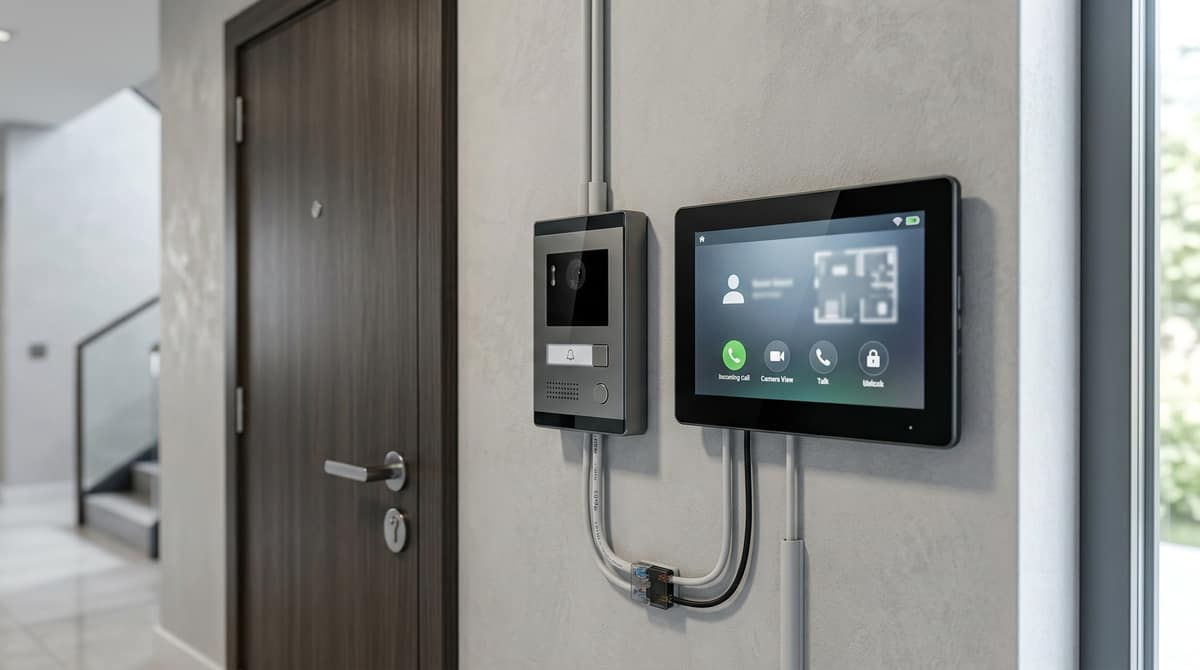
Choose an IP apartment intercom when the building already has, or will get, a network backbone and you want door entry, CCTV, access control and smartphone answering on one platform. Choose 2-wire when you are reusing an existing riser and want the least disruption to residents. "2-wire" is not a single standard, though: cable requirements, distances and compatible devices vary by manufacturer.
Check the datasheet before you decide that the existing cable can be reused.
An apartment intercom links a door-entrance panel to a screen or handset in each flat, so residents can see, speak and unlock. Flat intercom systems broadly follow the same chain, though the details vary by brand and model.
The parts (general guidance)
- Door station: the weather-exposed panel at the entrance, with a camera, speaker, microphone and a keypad, name list or card/fob reader.
- Indoor monitor or handset: the unit in each flat that receives the call. Video monitors show the visitor; audio handsets only carry voice.
- Power supply: feeds the door station, monitors and lock. Requirements vary by model, so check the datasheet.
- Door release: an electric lock or strike on the door that the system triggers.
- Wiring or network: conventional cabling or IP. Some wired systems, such as Aiphone's GT series, use two wires for audio and two for video, so never assume one will work on an existing two-conductor riser. Compatible IP door stations can carry power and data over one PoE cable, so check each model's power requirements.
The call flow
- The visitor selects a flat on the door station.
- The flat's monitor rings and shows the visitor.
- The resident answers and talks.
- The resident presses the release button, which opens the lock.
To buzz someone into your apartment, answer the visitor's call and press the door-release button, if your installed system supports it. The label on that key varies by model, so check your monitor's manual.
Smartphone answering and access records
Many current systems extend this to phones. The Aiphone multi-family page describes two-way video verification before entry, plus custom QR-code permissions for planned visitors and deliveries. Comelit's EZ-ULTRAMUG CCTV kits, as listed by GoKeyless, lets residents see, talk and unlock from a smartphone. The same listing says a ViP Master Lifetime License is required and sold separately, so budget for software licences, not just hardware.
Modular door stations
Larger buildings can build the door station from modules in a frame. The Hikvision DS-KD-ACW2 surface-mount frame for two modules is on our site, and the live product page shows the current price. It is only the housing, so check the datasheet for compatible modules. Your own electrician or installer fits the kit, as we sell equipment rather than install it.
IP vs 2-wire: what actually differs?
IP door stations carry power and data over one PoE cable, while legacy 2-wire systems use dedicated low-voltage cable per station. Check each model's power requirements and datasheet before specifying.
Compatible IP door stations can carry power and data over one PoE cable, whereas a legacy 2-wire system uses dedicated low-voltage cable per station. Check each model's power requirements before specifying. Where a manufacturer source doesn't confirm a cell, the table says to check the datasheet.
|
IP intercom |
Legacy "2-wire" analogue |
| Cabling topology |
Network cable back to a switch (check datasheet) |
Dedicated low-voltage run per station (check datasheet for conductor count) |
| Power route |
Some IP door stations support PoE, subject to the model datasheet |
Model-dependent (check datasheet) |
| Video quality |
Model-dependent (check datasheet) |
Model-dependent (check datasheet) |
| Scalability |
Model-dependent (check the station limit on the datasheet) |
Set by the system's station limit (check datasheet) |
| Remote or app answering |
Aiphone IXG is IP-based with a smartphone app |
Aiphone lists its analogue GT range with a mobile app too, so confirm per model |
| CCTV and access-control integration |
Network-based, so integration may be possible (check datasheet) |
Model-dependent (check datasheet) |
Per Aiphone's residential intercom page, the IXG is an IP network-compatible video door entry system with a smartphone app, and the GT is an analogue system with a colour video monitor. That page gives no station capacity for either range here. Confirm station limits, PoE and voltage drop calculator, video resolution and relay count on the manufacturer's datasheet before specifying.
Don't take "2-wire" literally
Aiphone describes its analogue GT range as "two wires for audio and two for video". That is four conductors, so a system sold or remembered as "2-wire" may not be strictly two. Don't assume the GT, or any other analogue system, will work on an existing two-conductor riser.
Before choosing, have your electrician or installer survey the existing cable. They should count the conductors at the door station and at one flat, check continuity along the riser, and note whether any pairs are spare. That survey decides whether you can reuse the cable or need a network cable run for IP.
Use the same survey to record handset compatibility, lock power requirements and, for IP, the PoE switch budget. Keep labour and any software licences as separate cost lines from the hardware.
How do power, wiring and CCTV integration compare?
Compatible IP door stations can carry power and data over one PoE cable, whereas 2-wire systems rely on a central supply and the existing riser; check each model's power requirements. Either way, check how the electric lock is powered, as it may need its own supply.
Power
For IP, add up every PoE-fed device and compare it with what the switch can deliver:
(door stations × draw each) + (indoor monitors × draw each) + (any PoE-fed lock draw) ≤ switch PoE budget, with headroom
Take each draw from the device datasheet and the budget from the switch's total PoE rating, not the per-port figure. Our PoE Switch for CCTV sizing article covers the method in full. A lock that isn't PoE-fed needs a dedicated PSU, and 2-wire systems add a central power supply.
Cabling
IP means structured cabling, with a switch per floor if the riser is long. 2-wire can often reuse an existing riser, but confirm this against the model's installation guide, because old cable condition varies.
As general guidance, not a product spec, plan Ethernet runs to stay within 100 m. Our Cat6 article covers cable choice.
CCTV integration
An IP door station can sit on the same network as the NVR and access control, but compatibility is model-dependent. Confirm in the datasheet whether a given door station supports the protocols your NVR needs before ordering, rather than assuming it will. Your own electrician or installer fits the kit.
An apartment intercom system costs more than its hardware: cabling, switching, labour, licences and maintenance all count towards the five-year total.
The cost lines to price
- Door stations at each entrance, plus indoor monitors for each flat.
- Frames for surface or flush mounting.
- PSUs and locks, which are what make an apartment intercom system with door release work.
- Cabling and containment between entrance and flats.
- PoE switches, if the system is IP-based.
- Labour from your own electrician or installer. CCTV Master sells equipment and does not fit it, so get that quote separately.
- Licences and cloud fees, plus maintenance.
Licences are the line people miss
A Comelit EZ-ULTRAMUG listing states that a ViP Master lifetime licence is required for the system to operate and is sold separately. Price it as its own line, not as part of the kit. If a system is cloud-based, ask the supplier whether there is a recurring fee and what happens to features if you stop paying.
Frames: a small, checkable anchor
Our Hikvision DS-KD-ACW2 surface-mount frame is a two-module intercom housing, and its live product page shows the current price. Hikvision range's DS-KD-ACF3 is the flush-mount equivalent for three modules, commonly used in apartment buildings and office entrances. Both are mounting frames only, so the modules, monitors and lock hardware are further lines.
A specification checklist before you request quotes
Use this checklist to link the cost lines above to the survey of the building. It is illustrative and contains no kit price.
- Cable run: count the conductors available from entrance to each flat. A 2-wire bus and an IP system need different cabling, so this decides which architecture is practical.
- Handsets: check whether the existing handsets are compatible with the new door station, or whether every flat needs a new monitor.
- Lock power: confirm the lock type and its PSU requirement, since this is what delivers door release.
- PoE budget: compatible IP door stations can carry power and data over one PoE cable. Check each model's power requirements on its datasheet against the switch budget.
- Labour and licences: get your electrician's written quote and any licence or cloud terms as separate lines.
Five-year TCO = hardware + cabling/switching + labour + (annual licence or cloud fee × 5) + maintenance.
A lifetime licence is a one-off, so it sits in hardware rather than being multiplied by years. Fill each term from live product pages and your installer's written quote. No single apartment intercom system cost figure fits every building. For trade pricing on larger runs, shop at CCTV Master or ask us.
Retrofit or new build: which scenario favours IP or 2-wire?
Reuse working 2-wire risers in small blocks, choose IP with PoE where cabling is unusable, and design new builds as IP. Decision depends on cable condition and handset compatibility.
Reuse a working 2-wire riser in small blocks, choose IP with PoE where the cabling is unusable, and design new builds as IP. The three scenarios below are illustrative, not real installs. We hold no first-party project data for this article.
Scenario A: small converted block, working riser
Keep the 2-wire cabling, replace the door station, and check the handsets before anything else. Two risks decide whether this works: cable condition and handset compatibility. Test insulation and continuity on every riser pair, and confirm the door-release circuit still switches the lock.
Check the conductor count too. Aiphone's GT analogue system is described as using two wires for audio and two for video. That is a four-conductor arrangement, so do not assume it is compatible with an existing two-conductor riser. An old audio-only riser may not carry video either.
An app layer is possible only where the handset allows it. Some retrofit modules wire into an existing compatible audio handset and add smartphone calling, but check licensing first. One Comelit smartphone kit listing states that a lifetime licence is required and sold separately.
For the door station, a surface-mount frame such as the Hikvision DS-KD-ACW2 (a two-module housing) avoids chasing into the wall. Check the datasheet for compatibility with your handsets, and see the live product page for current pricing.
Scenario B: larger retrofit, no usable cabling
Go IP with PoE and a switch on each floor. Compatible IP door stations can carry power and data over one PoE cable, but check each model's power requirements. New cable runs mean disruption and drilling through shared areas. In return you get a system that can be integrated later. Aiphone's IP-based IXG range, for example, is described as built around a smartphone app for apartment complexes (see Aiphone's multi-family overview).
Add up each station's PoE draw from its datasheet and size every floor switch with headroom.
Scenario C: new build
Design for IP from day one. Specify containment with spare capacity, and leave spare switch ports. Put the intercom on the same cabling and switching as the CCTV and access control, ideally on its own VLAN. Retrofitting any of this later can cost more than sizing it right at first fix.
Survey checklist before you order
Record five things per block: the conductor count in each riser, the make and model of every handset, the lock type and its power supply, the PoE budget of each switch, and any app licence. Price licences and labour as separate lines from the hardware, because they sit outside the kit cost.
Your own electrician or installer fits the kit, so use each product's datasheet or installation guide to plan the work. Browse PoE switches, cable and brackets at cctvmaster.co.uk, or ask about trade pricing.
Compliance for recording door stations
A door station that records video brings UK GDPR and the ICO's video surveillance guidance into play. Put signage in the shared areas it covers. Identify the organisation that actually decides why and how the recordings are processed, because that organisation is the data controller. Then set and document a retention period.
Related products from our own range: