An intruder alarm system's "grade" — Grade 1 to Grade 4 under EN 50131 — states how determined a burglar it's built to resist, and it's the figure insurers commonly ask about, so settling on grade before choosing wired, wireless or hybrid saves rework later.
Most UK homes are specified at Grade 2, and many insurer discounts are pegged to a Grade 2 or Grade 3 system, but grade is a design and testing standard, not a brand or a price tag — a cheap panel and an expensive one can both be genuinely Grade 2, or neither can be.
What the grades actually mean
Grade 1 covers low-risk properties where intruders are assumed to have little knowledge of alarm systems and only basic tools. Grade 2 assumes a burglar with some knowledge and common tools — this is the level most domestic insurers reference and the level our Pyronix EURO46 Grade 2 Hybrid Alarm Kit is built to.
Grade 3 and Grade 4 step up for higher-risk commercial premises where intruders may have detailed knowledge and specialist equipment; they're rarely specified for ordinary domestic use.
The grade is a resistance rating, not a quality score — a Grade 2 system properly installed and maintained can outperform a poorly sited Grade 3 one, so ask what grade a kit is certified to before comparing anything else.
Choosing grade before wired vs wireless
Decide the required grade first, because it narrows which control panels and detectors are eligible — only then does wired-versus-wireless become the real choice. The Pyronix Enforcer V11 Kit 5 Wireless Alarm System and the Texecom Premier Elite 64W Wireless Alarm Kit KIT-1002 both target residential and small commercial installations while using wireless zone expansion rather than cabling throughout.
| Kit |
Panel |
Zones |
Notes |
| Pyronix EURO46/S-KIT |
EURO-46 V10 |
8 wired, wireless-expandable |
Grade 2 hybrid, includes 3 PIR detectors, external and internal sounders |
| Pyronix Enforcer V11 Kit 5 |
V11 panel, built-in WiFi |
66 |
Wireless, shock sensors, perimeter coverage |
| Texecom Premier Elite 64W (KIT-1002) |
Ricochet wireless |
32–64 |
PIRs included |
| Texecom KIT-1003 Premier Elite |
64-W LIVE |
up to 64 |
SmartKey fobs, PetWise mode |
A hybrid panel like the EURO46 suits a retrofit where some cabling already exists — its 8 wired zones cover the core, with wireless modules added for awkward rooms or later extensions. A fully wireless kit such as the Enforcer or either Texecom Premier Elite kit suits a clean installation or a property where running cable isn't practical: the Enforcer's shock sensors are built around perimeter protection, while the Texecom kits lean on Ricochet's mesh networking to keep every wireless PIR in reach of the panel.
Insurance and installation
Insurers typically reference the alarm's certified grade rather than its brand name, but the discount on offer, and whether it applies at all, depends on the individual policy — check your insurer's own wording rather than assuming a Grade 2 system automatically qualifies. The EURO46 is built to Grade 2, though meeting that grade on paper is only part of what an insurer checks; how the system is installed and commissioned matters too.
CCTV Master sells this equipment as installer-grade kit at public prices — installation itself is carried out by the customer's own electrician or alarm installer, and each product's datasheet or installation guide sets out the wiring and zone configuration needed to commission it correctly. Orders placed before 4pm are dispatched the same working day.
What is an intruder alarm system, and how does it differ from a "burglar alarm"?
An intruder alarm system detects unauthorised entry using sensors, a control panel and a sounder or communication link. "Burglar alarm" and "intruder alarm" describe identical equipment; the latter is the formal term used in insurance policies and standards.
An intruder alarm system is a network of sensors, a control panel and a sounder or communication link that detects unauthorised entry into a property, as Avigilon's intrusion alarm guide and Gallagher's definition both set out. The everyday term is "burglar alarm"; "intruder alarm" is the wording used across insurance policies, British Standards and installer paperwork, which is why both searches tend to lead to the same products.
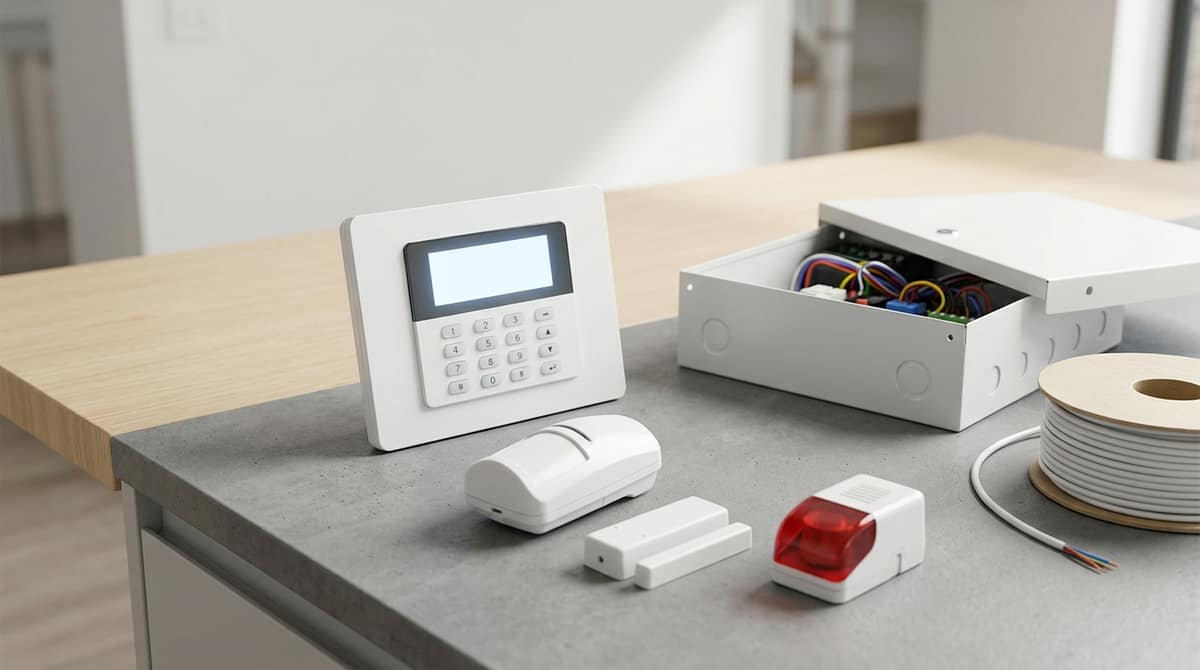
The components stay consistent regardless of which name is used. A typical kit is built around a control panel (the brain that arms, disarms and processes zone inputs), detectors such as passive infrared (PIR) sensors or door/window contacts, a keypad for user access, an internal sounder to alert occupants, an external sounder or bell box to warn off an intruder outdoors, and — optionally — an app or monitoring-station link for remote alerts.
The Pyronix EURO46 Grade 2 Hybrid Alarm Kit illustrates this structure concretely: it pairs an EURO-46 V10 metal control panel with 8 wired zone inputs, an LCD keypad with a built-in proximity reader, a Deltabell-E external sounder, a Twin Alert internal sounder, and three MEQ Blue PIR detectors for motion coverage. That's the full chain — detection, control and audible response — in one Grade 2 kit, and it's a useful reference point when comparing a complete intruder alarm system against a single standalone detector sold on its own.
It's worth being clear about what this layer does and doesn't cover. An intruder alarm system detects and announces a breach at the perimeter or inside a room; it doesn't record footage or provide visual verification the way CCTV does. Many UK buyers pair the two, using the alarm for detection and cameras for evidence, but they remain separate systems with separate specifications, standards and installation requirements.
Intruder alarm system grades explained (Grade 1–4)
The EN 50131 standard defines four security grades — Grade 1 to Grade 4 — reflecting how sophisticated an intruder the system is designed to resist, from casual opportunists to determined professionals with detailed knowledge of alarm technology. Grade isn't a marketing label; it's a design classification that shapes which control panel, detectors and sounders a competent installer will specify for a given risk level.
The four grades at a glance
| Grade |
Risk profile |
Typical use |
| Grade 1 |
Low risk — intruders with little knowledge of alarm systems and limited equipment |
Low-value domestic settings with minimal risk assessment |
| Grade 2 |
Low-to-medium risk — intruders with some knowledge and a basic toolset |
Most UK homes and small commercial units |
| Grade 3 |
Medium-to-high risk — intruders familiar with alarm systems and equipped with sophisticated tools |
Higher-value premises and commercial sites with a defined threat |
| Grade 4 |
High risk — professional intruders with the resources to plan and execute an attack in detail |
Sites where security is the primary concern, such as high-value or high-sensitivity premises |
Grade 2 is the level most UK homes and small businesses ask for, balancing genuine intruder resistance against sensible cost and complexity — it's also a common baseline in an insurer's or landlord's risk assessment, though the exact requirement always comes down to the individual policy or tenancy.
What Grade 2 looks like in real hardware
One Grade 2 product anchors this in practice rather than theory.
The Pyronix EURO46 Grade 2 Hybrid Alarm Kit is a Grade 2 hybrid system built around the EURO-46 V10 control panel, with 8 wired zone inputs expandable via wireless modules, an LCD keypad with a built-in proximity reader, an external sounder, an internal sounder and 3 PIR detectors — a full residential or small commercial kit rated to a defined grade rather than an unrated consumer alarm. Grading applies to the system as a whole: a panel, its detectors and its sounders all need to meet the stated grade for the installation to genuinely comply, which is why a complete kit like this is a more reliable starting point than mixing an unrated detector into an otherwise-graded setup.
Key takeaway: grade is a spec, not a superlative — it describes the level of intruder the equipment is built to resist, so match the grade to the actual risk assessment for the property rather than defaulting to the highest number available. For most domestic and small commercial installs, Grade 2 kit — as sold in our Grade 2 hybrid and wireless alarm kits — covers the requirement without over-specifying for a threat level the property doesn't face; if insurance or a tenancy agreement specifies a grade, check the wording of that policy directly rather than assuming a fixed industry rule.
How does the grade affect home insurance discounts?
Insurers typically specify a minimum grade—commonly Grade 2 or 3—as a condition for discount eligibility, though this varies by insurer and policy, so check your own documents before relying on it.
Insurers that require an alarm for a discount usually name a minimum grade — commonly Grade 2 or Grade 3 — in the policy wording, and eligibility depends on that grade being met and, in many cases, kept under a maintenance contract. The grade itself is a certification standard describing how resistant the system's components and design are to attack and false alarms, not an insurance metric on its own; the insurer decides what it accepts.
No published, comparable discount percentages exist across insurers, so treat any figure you see elsewhere with caution. The only reliable step is to read your own policy's alarm clause or ask your insurer directly what grade, and what monitoring or maintenance arrangement, it actually specifies before you buy anything.
Two other details tend to sit in the same clause as the grade:
- Whether the alarm must be monitored by an Alarm Receiving Centre, or a self-monitored/app-alerted system is acceptable
- Whether a maintenance contract is a condition of the discount continuing, not just a one-off installation requirement
The practical takeaway: buy to the grade your insurer's policy actually specifies, since that's what decides value, not the highest grade you can find. Fitting a Grade 3 system to a low-risk semi buys resistance most policies won't ask for and won't pay you back for; fitting below the stated grade can leave a claim disputed or a discount void regardless of how well the kit performs day to day. The Pyronix EURO46 Grade 2 Hybrid Alarm Kit is a Grade 2 hybrid kit, which may satisfy the requirement some residential policies quote — but whether an installed system meets your particular policy's conditions depends on that policy and how the system is installed, so confirm the exact wording with your own insurer before ordering. CCTV Master sells the equipment; the fitting and the insurance conversation both sit with the customer and their installer or broker.
Wired, wireless or hybrid: which suits your property?
Choose wired for a new-build or full renovation where cabling is straightforward, wireless for a retrofit or rented property where you can't chase walls, and hybrid where you want a wired core with room to add wireless devices later. Each approach suits a different stage of a property's life, and the right choice usually comes down to how much cabling access you actually have.
Wired: best when the walls are already open
A wired intruder alarm system routes every detector back to the control panel on cable, which gives a stable, interference-resistant backbone — but it demands access to walls, floors or a loft void during a first-fix. This suits new-build properties and full rewires, where an electrician is already lifting floorboards for other first-fix work.
Hybrid: a wired core with wireless expansion
A hybrid panel like the Pyronix EURO46 Grade 2 Hybrid Alarm Kit gives you a wired backbone that can grow with wireless comms modules, rather than locking you into one method. The kit is built around the EURO-46 V10 panel with 8 wired zone inputs, an LCD keypad with a built-in proximity reader, an external sounder and 3 PIR detectors as standard, and it's rated Grade 2, suiting residential and small commercial protection. Because the wired zones are expandable using wireless modules, it isn't a pure wired panel; it's better described as a wired core designed from the outset for wireless expansion, which suits a part-renovated property or a building extended in phases. A complete kit like this differs from buying an individual detector: the panel, keypad, sounder and PIRs are matched and boxed as one specified system, which is the practical distinction worth knowing before you start pricing parts separately.
Wireless: best where you can't run cable
Wireless suits retrofits, listed buildings and rented properties where chasing walls for cable isn't possible or permitted. Two catalogue options illustrate the range available: the Pyronix Enforcer V11 Kit 5 includes a built-in WiFi V11 panel, covers up to 66 zones and comes with shock sensors for perimeter protection on doors and windows.
The Texecom Premier Elite 64W KIT-1002 is built around Texecom's Ricochet wireless mesh, is rated Grade 2 for UK residential and commercial installations, and scales from 32 up to 64 zones with PIR detectors included in the kit.
| Approach |
Best fit |
Grounded example |
| Wired |
New-build, full renovation |
Panel-to-detector cabling run during first-fix |
| Hybrid |
Part-renovated or phased extension |
EURO46 panel: 8 wired zones + wireless module expansion, Grade 2 |
| Wireless |
Retrofit, rental, listed building |
Enforcer V11 (66 zones, WiFi) or Premier Elite 64W (32–64 zones, Ricochet) |
Whichever route you're weighing up for an intruder alarm system installation, matching the panel's expansion path to how the property will change is the key decision — not just the zone count on day one. Shop the panels and kits at CCTV Master or ask about trade pricing if you're specifying for multiple sites.
Related products from our own range: