
facial recognition access control
Facial Recognition Access Control UK 2026
Yes, facial recognition door terminals are legal in the UK for staff access, but they process biometric data, which UK GDPR treats as special category data…
On this page
- What makes facial recognition access control accurate? FAR, FRR and the 1:1 vs 1:n split
- What the listings do state
- 1:1 versus 1:n
- How do you stop someone tricking facial recognition? Liveness detection explained
- Flat-image checks versus depth sensing
- What our terminals say
- Is facial recognition access control legal in the UK? A UK GDPR and ICO checklist
- Which facial recognition terminal suits which door?
- What should an installer check before ordering?
- Related products
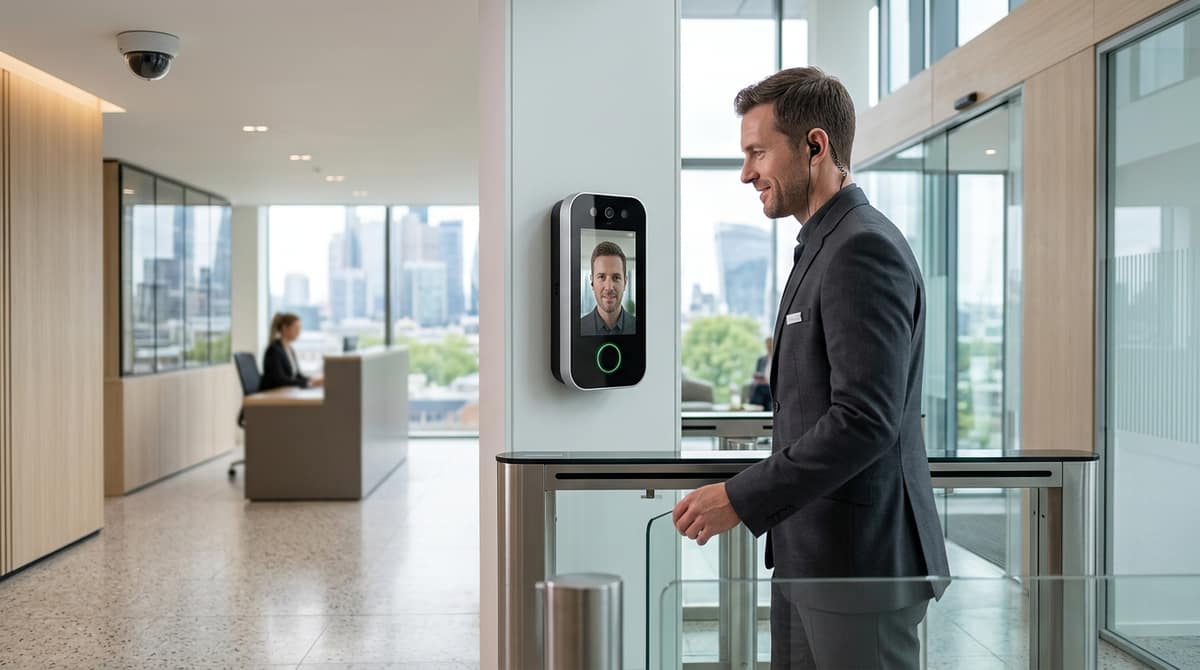
Yes, facial recognition door terminals are legal in the UK for staff access, but they process biometric data, which UK GDPR treats as special category data when it is used to identify someone. That means you need to settle three things before you order: how accurate the terminal is at the threshold you will run it, whether it can resist a photo or screen held up to the camera (liveness), and a completed DPIA that justifies using faces rather than a less intrusive credential. A door terminal that checks one person at a time is a different proposition from a CCTV watchlist system, and the buying questions differ accordingly.
What makes facial recognition access control accurate? FAR, FRR and the 1:1 vs 1:n split
Accuracy comes down to two error rates, FAR and FRR, which are linked by the match threshold you set.
- FAR (false accept rate): how often the system lets in someone who isn't enrolled.
- FRR (false reject rate): how often it turns away someone who is.
As general guidance, raising the match threshold cuts FAR but raises FRR. Lowering it does the reverse. A server-room door and a staff entrance won't want the same setting.
None of the product listings below states a FAR or FRR figure, so we quote none. When you compare terminals, ask the manufacturer for FAR and FRR at a stated threshold and on a stated test population. A bare "99% accurate" claim without those two conditions tells you nothing.
What the listings do state
The listings give speed and capacity rather than error rates:
- Our 7" Facial Recognition Access Controller lists a 360-position face algorithm and 0.35s detection.
- The Hikvision DS-K1T342MFWX-E1 lists recognition in under 0.2 seconds.
- The Dahua 2MP unit lists 0.35s and 50,000 users.
1:1 versus 1:n
The Salto blog draws the line this way. It describes 1:1 matching, verifying a person's identity, as typical of access control, and 1:n matching, searching a large database, as the mode associated with mass surveillance. That split is Salto's own framing: it calls the 1:1 mode 'face recognition' and the 1:n mode 'facial recognition', and notes that the two names are often used interchangeably.
Don't assume a door terminal works only one way. A face-only door has no claimed identity to check against, so the terminal compares the face with the templates enrolled on it; a face-plus-card mode checks the face against the one template linked to that card. Ask the manufacturer which modes a terminal supports.
This also answers "Can CCTV do facial recognition?" Whether a camera system can depends on the analytics in the camera, recorder or software, so check the specification. A door terminal checking staff is not a watchlist system.
How do you stop someone tricking facial recognition? Liveness detection explained
A terminal with no presentation-attack defence can be fooled by a printed photo, a phone screen or a mask. Liveness detection exists to close that gap by checking that a real, present face is in front of the lens.
Flat-image checks versus depth sensing
A 2D, algorithmic approach judges the same flat image the camera captures, so the software has to spot a fake from the picture alone. Depth-based liveness adds a physical measurement of the face. Vendors describe it this way:
- Verkada describes a 3D iToF sensor with infrared and depth detection, aimed at deterring photo, video and mask attempts.
- Alocity describes 3D face verification with liveness detection to help prevent spoofing from photos, videos or masks.
- Alcatraz says the liveness detection on its Rock reader means a photo or mask won't work.
These are the vendors' own descriptions of the technique, not a rating of our range.
What our terminals say
- Our product page for the Dahua 2MP Face Recognition Access Control 7" LCD (DHI-ASI7213YO-V3-T0) lists liveness detection as included. It doesn't say whether the check is 2D, infrared or depth-based, so ask Dahua which before relying on it for a high-risk door.
- Our listing for the Hikvision DS-K5604-Z(H) states deep learning recognition with anti-spoofing, designed to reject printed photos or screen images. It doesn't name the method either, so confirm it in Hikvision range's datasheet before ordering for a high-risk door.
For anything protecting valuables or sensitive areas, make liveness a written requirement and ask for the datasheet wording before you buy.
Is facial recognition access control legal in the UK? A UK GDPR and ICO checklist
Yes. Facial recognition isn't banned in the UK, but face templates used to identify someone are biometric data and need extra care under UK GDPR. This is general guidance, not legal advice.
The ICO's biometric recognition guidance is the reference to work from.
A door terminal that matches a face to an enrolled user is processing special-category data. Work through these points before it goes live:
- Lawful basis plus an Article 9 condition. You need both. The ICO says explicit consent is likely to be the most appropriate condition, but you must offer a suitable alternative to anyone who declines, and where there is a power imbalance, as between employer and staff, you should consider carefully whether relying on consent is appropriate at all. Decide which condition fits and record why.
- DPIA before deployment. The ICO says using a biometric recognition system is highly likely to trigger the requirement for a DPIA. Its summary is blunter: complete a DPIA before you use a biometric recognition system. Complete it before the terminals are fitted, not after.
- A non-biometric alternative. Offer a card or PIN route. The Hikvision DS-K5604-Z(H) includes an RFID card reader, so a fallback is practical. The Dahua 2MP unit is listed with IC card and password unlock as well as face, and the Hikvision DS-K1T342MFWX-E1 with card and PIN.
- Retention, deletion and access controls. The Dahua unit is listed at 50,000 users and the DS-K5604-Z(H) at 50,000 face templates (the DS-K1T342MFWX-E1 holds 1,500 faces), so set a rule for removing leavers and expired visitors, and restrict who can export or view templates.
- Signage and privacy information. Tell staff and visitors that facial recognition is in use, what for, and how long data is kept.
- A named data controller. Document which organisation decides why and how the data is processed. Any cloud or software supplier handling templates on your behalf needs a written processor arrangement.
Your own electrician or installer fits the hardware, but these obligations stay with the site operator.
Which facial recognition terminal suits which door?
Match the terminal to the door's user count and approach distance: the Hikvision DS-K5604-Z(H) has the longest stated range and the largest card capacity here.
| Model | Screen | Capacity | Range | Notes |
|---|---|---|---|---|
| 7" Facial Recognition Access Controller | 7", 1024×600 | not stated | not stated | 0.35s; DC12V 1A; £248.40 |
| Dahua DHI-ASI7213YO-V3-T0 | 7", 1024×600 | 50,000 users, faces and cards | 0.3–1.0m | 2MP WDR, liveness; £496.79 |
| Hikvision DS-K5604-Z(H) | 7" touchscreen | 50,000 faces, 100,000 cards | 0.3–3m | Mifare, Wiegand, anti-spoofing; £205.62 |
| Hikvision DS-K1T342MFWX-E1 | 4.3" touchscreen | 1,500 faces, 3,000 fingerprints, 3,000 cards | 0.3–1.5m | Face, fingerprint, card, PIN; under 0.2s; £278.09 |
The Dahua unit costs £496.79 and lists 0.3–1.0m, which suits an entrance where one person stands at the reader. The Hikvision DS-K5604-Z(H) stretches to 0.3–3m and 100,000 cards, and at £205.62 it is also the lowest-priced unit here. If you are adding face recognition to an existing card system, check its Mifare and Wiegand support against your controller first.
The compact 4.3" DS-K1T342MFWX-E1 holds 1,500 faces, so it suits a smaller workforce, and its fingerprint, card and PIN options give staff a non-face route in. The £248.40 7" controller's listing gives no capacity or range, so get those from the manufacturer before you specify it for anything beyond a small user list.
For how face terminals compare with fingerprint and card readers, see our biometric access control guide.
Pick on user count and range first, then on price; liveness or anti-spoofing matters most on doors where a printed photo is a realistic risk.
What should an installer check before ordering?
Check five things before ordering: power supply, mounting height, lighting at the door, integration outputs and how long enrolment will take. We sell kit only, so your electrician or installer fits it using the datasheet and installation guide.
- Power: the 7" Facial Recognition Access Controller (£248.40) runs from DC12V 1A. Size the supply to deliver at least that, with some headroom. If the lock draws from the same supply, add its load.
- Mounting: the Dahua DHI-ASI7213YO-V3-T0 product page gives a 1.4m lens-to-ground reference and a 0.9–2.4m user height range. Check both against the people who will use the door. In a busy doorway, our 7" controller recognises the largest face first, and its maximum face size is set on the web.
- Lighting: a backlit door, such as a glazed lobby or a door facing low sun, is an accuracy risk. The Dahua unit lists WDR and an auto fill light, so compare those with the real conditions at the door.
- Integration: the Hikvision DS-K5604-Z(H) offers Wiegand, door control and alarm I/O, plus TCP/IP for system integration. Confirm that matches your lock and panel.
- Enrolment: allow time to register everyone, and decide who keeps the template list up to date.
Check the datasheet for outdoor suitability before ordering. The DS-K1T342MFWX-E1 datasheet on our listing states IP65; the other listings give no IP rating, so confirm it before fitting one at an exposed door.
Shop at https://cctvmaster.co.uk or ask about trade pricing. Orders placed before 4pm are dispatched the same working day.
Related products
Related products from our own range:
- Dahua 2MP Face Recognition Access Control 7" LCD — Dahua DHI-ASI7213YO-V3-T0 2MP face recognition access control with 7" LCD display, 0.35s recognition speed, supports 50,000 users. £496.79.
- DS-K5604-Z(H) Face Recognition Terminal 7-inch — Hikvision face recognition access control terminal with 7-inch touchscreen, deep learning accuracy, 50,000 face templates and RFID card reader. £205.62.
- 7" Facial Recognition Access Controller | 0.35s Detection — 7″ LCD facial recognition access controller with 0.35s face detection speed and 360-position algorithm. £248.40.
- Hikvision DS-K1T342MFWX-E1 Face Recognition Access Control — Hikvision DS-K1T342MFWX-E1 is a multi-biometric face recognition access control terminal with 4.3-inch touchscreen, facial recognition under 0.2 seconds. £278.09.
This article was researched and written by CodeNest's AI SEO content engine.
