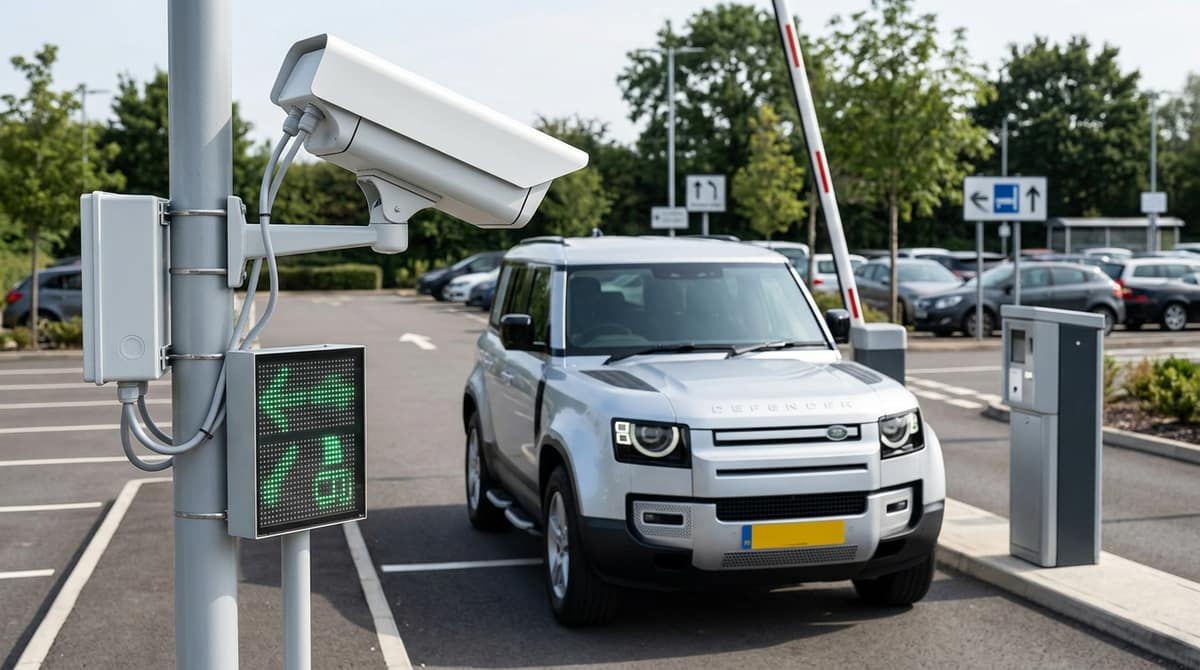
ANPR number plate recognition reads a vehicle's registration with a camera and converts it to text in under a second, so a barrier, alarm or log can respond to a known or unknown plate. It only works reliably when the camera, lens, shutter speed and infrared lighting are set up for that one job, so an ordinary IP camera with a "plate" label won't do it.
Choose the capture position first, then the camera or recorder, then check your UK GDPR and signage duties before you start logging plates.
How does ANPR number plate recognition work on a private site?
A camera captures the plate, OCR converts it to characters, and a match against a stored list triggers a barrier or alarm. Hikvision's ANPR overview describes optical character recognition working on video images, converting plates to alphanumeric characters in less than a second. The characters are then cross-referenced against a database of registered vehicles.
On a private site that database is usually your own list: staff, residents, regular contractors. A plate on the list lifts the barrier. A plate that isn't can be ignored, logged or flagged to whoever monitors the site.
Camera and lighting options
ANPR can run on existing CCTV or on cameras designed specifically for the task. Infrared lighting is commonly used so the camera can capture plates at any time of day or night. The same source notes that systems must cope with plate styles that vary from place to place, so confirm that any camera or software you buy is set up for UK plates.
The recorder matters too. The Hikvision 16-ch 1U 16 PoE 4K NVR lists ANPR among the special-function cameras it supports, and has 16 built-in PoE interfaces.
Typical private-site uses are car parks, driveways and business entrances. For the data a read produces, see our guide to what ANPR cameras check.
What lens, mounting height and angle give a readable plate?
Pick a lens that puts enough pixels across the plate at one defined capture point, with the camera set for a shallow approach angle.
Start by marking the capture point, the spot on the lane where the plate should be read. Give each lane its own camera. One camera stretched across two lanes forces a wider view, which leaves fewer pixels on each plate.
Next, work out the focal length from the distance to that point. The plate must fill enough of the frame for the recogniser to separate characters, and the camera's datasheet states what its software needs. A varifocal or motorised zoom lens lets you tune the framing on site.
A fixed wide lens suits general CCTV, where the aim is to cover a scene, but it rarely resolves a plate at a gate or barrier.
Keep the approach angle shallow, so the plate is seen close to face-on. Steep or sideways angles skew the characters. Avoid pointing the lens into oncoming headlights, and note that ANPR systems commonly use infrared lighting to read plates by day and night.
Exact mounting heights, distances and angles come from the chosen camera's datasheet or installation guide, so we don't quote figures here. CCTV Master sells the equipment only, so your own electrician or installer carries out the fitting.
How should shutter speed and night illumination be set?
Set the shortest exposure time the scene will tolerate and light the plate deliberately, because a fast-moving plate blurs long before a low-resolution image becomes the problem.
Many cameras default to auto-exposure, which lengthens the shutter at night to brighten the picture. The scene looks better, but moving plates smear into unreadable streaks. Before buying, ask the supplier whether the camera has a dedicated plate or ANPR exposure mode that holds a short shutter and lets gain and lighting do the work.
Infrared or white light
Infrared is the usual choice. Systems commonly use infrared lighting so the camera can capture plates day or night, according to Wikipedia. It is discreet and does not dazzle drivers or disturb neighbours.
White light preserves colour, which helps if you want to describe the vehicle as well as read the plate. The cost is glare for drivers and light spill onto nearby homes, which can become a complaint on a residential road.
Can ANPR read black number plates?
Sometimes, but it depends on the plate and the system. ANPR is built around compliant, road-legal plates, and the technology has to allow for plate variations from place to place. Non-standard fonts, unusual colours or low-contrast plates generally lower the read rate.
Ask your supplier for the list of plate formats the system supports, and test on site before relying on it.
Camera-only, NVR-based or a dedicated ANPR server?
For one gate, an ANPR camera on its own is usually enough. An NVR suits sites that already record centrally, and a dedicated server earns its place as lanes, lists and barriers multiply.
Camera-only (edge ANPR)
The camera reads the plate itself, so the design is one device, one cable and one allow-list. That is the simplest route for a single entrance. The catch is that the list lives on the camera, so a second lane means keeping two lists in step.
NVR-based
If your cameras already feed a recorder, adding ANPR there keeps footage and plate events in one place. The Hikvision 16-ch 1U 16 PoE 4K NVR (DS-7616NI-I2/16P) lists ANPR among its supported special-function cameras. It has 16 PoE ports and supports 2 HDDs for continuous recording, and it costs £319.70 including VAT. Availability is shown live on the product page, and the datasheet is the place to confirm which ANPR camera models it pairs with.
Dedicated server or software
Choose this for multi-lane sites, large allow-lists, or barrier and parking integration. Hikvision describes the workflow as reading the plate, checking it against a database, then raising a barrier or an alarm. Once that logic spans several lanes, a central server is easier to manage than lists scattered across cameras.
Your own electrician or installer fits the kit. You can shop at CCTV Master or ask about trade pricing if you are specifying for a client.
What read rate should you expect, and what should you ask a supplier?
No headline ANPR read rate is reliable until the supplier states the test conditions: speed, angle, lighting and plate condition all move the result. Ask how the figure was produced and whether it covers your plate formats.
ANPR technology has to take account of plate variations from place to place, so a figure measured on one plate format tells you little about another. Systems also commonly use infrared lighting so the camera can capture plates at any time of day or night, which is why it is worth asking how the quoted figure was produced after dark.
Questions to put to the supplier
- What speed, mounting angle, distance and lighting sit behind the quoted read rate?
- Which plate formats are supported, and does that include foreign plates?
- Can you see day and night sample footage from a comparable install?
- How many entries can the allow-list or block-list hold?
- What format are events exported in?
- How long will firmware updates be supported?
Pricing
We hold no ANPR camera prices in this article, so check the live product pages for current figures. On the recording side, the Hikvision DS-7616NI-I2/16P NVR lists ANPR among the special-function cameras it supports, and it offers 16 channels with 16 PoE ports. Check a specific camera's datasheet to confirm it is compatible.
This article was researched and written by CodeNest.