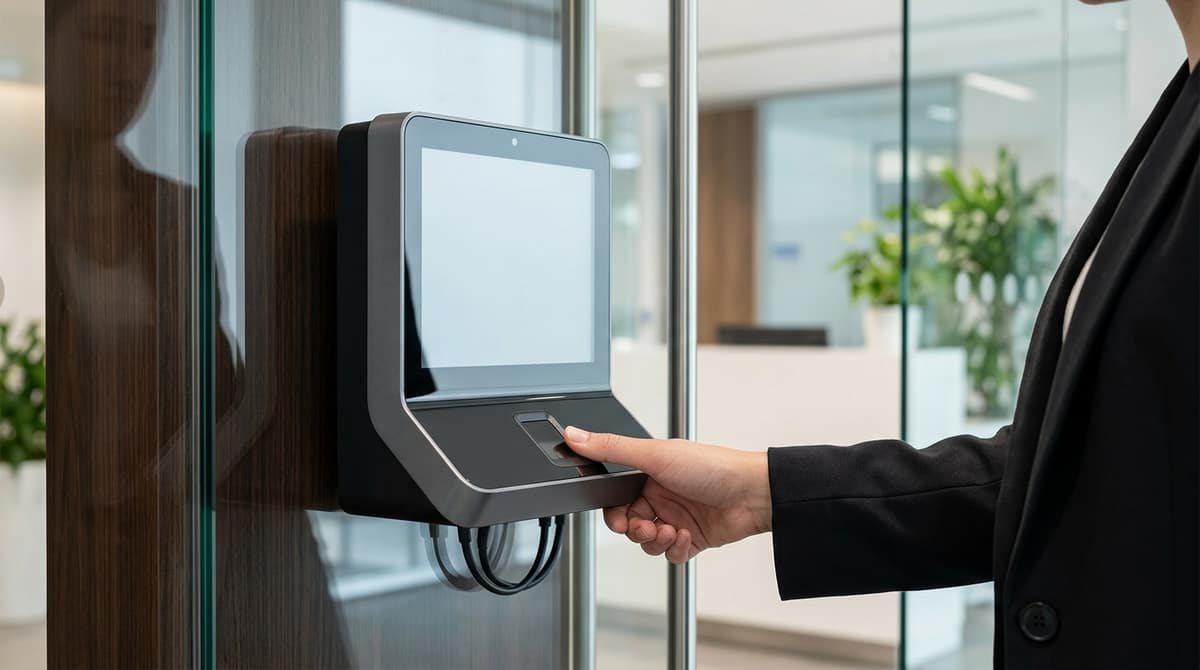
Biometric access control identifies people by a physical trait — face, fingerprint or iris — matching a live scan against a stored template to release a door, rather than trusting a card or code someone else could carry. The important qualification: on a CCTV site, that's not a standalone decision.
It sits directly beside a surveillance one, because the same terminal that decides who gets through the door is often also recording that person, which pulls GDPR and DPIA obligations into what looks like a simple hardware choice.
What is a biometric access control system?
A biometric access control system grants entry by matching a live scan of a physical characteristic — face, fingerprint or iris — against a stored digital template, rather than checking a card or a PIN.
A biometric access control system grants entry by matching a live scan of a physical characteristic — face, fingerprint or iris — against a stored digital template, rather than checking a card or a PIN. Gallagher describes the process simply: a scanner captures the credential, converts it into a template at enrolment, and every later attempt is compared against that stored record before the door releases.
Johnson Controls frames the payoff the same way — the technology is built to eliminate access cards and keypad codes altogether, since a face or fingerprint can't be handed to someone else or left at home, as Johnson Controls notes.
For a CCTV site, that's only half the picture. Biometric access control answers "who gets through this door" — but the moment they do, a separate surveillance decision kicks in: is that entry being recorded, on which camera, and for how long is the footage retained. Treating the two as one project — reader plus camera coverage of the same door — avoids the common gap where an access log exists but there's no video evidence of who actually presented the credential.
In practice, biometric access control device examples on the market include face recognition terminals and fingerprint/RFID combo readers. Stocked types include the DS-K5604-Z(H) Face Recognition Terminal with its 7-inch touchscreen and 50,000-template capacity, the compact Hikvision DS-K1T342MFWX-E1 with a 4.3-inch screen and sub-0.2-second recognition, the Dahua 2MP Face Recognition Terminal at £413.99 with 0.35-second recognition and 50,000-user support, and the Dahua ASR1102A fingerprint/RFID reader with a 3,000-template capacity over RS-485.
Face vs fingerprint vs card/PIN: which suits a UK site?
Face recognition suits high-traffic, hands-free entry points; fingerprint suits lower-traffic, cost-sensitive doors; and pairing either biometric with a card or PIN gives redundancy if the sensor is dirty, gloved, or offline.
This isn't just a preference — it's built into the hardware. Our own Smart Face Recognition Door Lock with Fingerprint combines 3D facial recognition with a fingerprint sensor on one device, plus PIN and mechanical key as further fallbacks.
The key takeaway: match the device to the door's footfall and fallback needs, not just the biometric method. A reception lobby with hundreds of daily transits wants sub-second facial matching. A plant room with a handful of authorised staff can run happily on fingerprint or card alone.
Device-level comparison
| Device |
Biometric |
Secondary credential |
Best suited to |
| Hikvision DS-K5604-Z(H) |
Face recognition, 7-inch touchscreen, 50,000 face templates |
RFID card reader |
Sites wanting a large face template capacity alongside a card option |
| Hikvision DS-K1T342MFWX-E1 |
Face recognition under 0.2s, 4.3-inch touchscreen |
— |
Standalone door needing fast facial matching |
| Dahua DHI-ASI7213YO-V3-T0 |
2MP camera, 0.35s recognition, 7" LCD, supports 50,000 users |
— |
High-traffic entrance needing fast, camera-based verification |
| Dahua ASR1102A |
Fingerprint, 3,000 template capacity |
RFID |
Lower-traffic door where card-plus-fingerprint suits a wired reader setup |
Two figures worth noting for a spec-driven decision: the DS-K1T342MFWX-E1 matches faces in under 0.2 seconds according to its own product listing. The Dahua ASI7213YO-V3-T0 is rated at 0.35s recognition speed and supports up to 50,000 users, and is priced at £413.99 per its listing.
Where card/PIN redundancy earns its keep
A biometric reader that's offline, iced over, or facing a gloved hand still needs a fallback. This is why the ASR1102A pairs fingerprint with RFID rather than relying on the fingerprint sensor alone.
The DS-K5604-Z(H) supports up to 50,000 face templates, and its RFID card reader sits alongside the face-recognition camera for the same reason, giving staff a second route in if the biometric check fails.
For a wider range of standalone and networked door access control options, browse the current stock at CCTV Master or ask about trade pricing before specifying a door.
Biometric access control at a CCTV site: what changes about the install
Adding a biometric reader means the site now produces two data streams — access logs and fingerprint or face templates on top of the camera footage — and both have to be documented and secured together.
At a monitored entrance, the reader sits alongside the NVR's video storage rather than inside it. Access logs and biometric templates become a second data set that needs its own retention and security answer. Generic "buildings" guidance from the big access-control vendors tends to be written for facilities teams rather than for the installer who's already run cabling to an NVR and now has to fit a reader alongside it, so it doesn't always join the two systems up.
The practical question is where the biometric data lives relative to the video. A terminal like the DS-K5604-Z(H) Face Recognition Terminal supports up to 50,000 face templates, separate from the NVR's video storage — use our CCTV storage calculator to work out camera retention. That means retention and deletion policy for faces has to be managed on the terminal, or its management platform, rather than folded into the camera system's existing retention settings.
Wiring in alongside the camera system
A biometric terminal is normally installed and wired as its own device rather than as an extension of the camera cabling, so adding one to a site that already has CCTV doesn't mean re-engineering the camera runs. The Hikvision DS-K1T342MFWX-E1 terminal, for example, recognises a face in under 0.2 seconds according to its product listing.
Where it gets less clear-cut is correlating events. Knowing that a reader unlocked a door at 14:32 is one thing; matching that log entry to the exact frame the camera recorded at the same moment is another. That correlation depends entirely on whichever VMS or access-management platform ties the two systems together, so don't assume out-of-the-box event linking without checking the specific platform in use.
What this means for documentation on a CCTV site
Two more things need writing down once biometrics join a camera install: a retention rule for templates, and a note in the system's data protection paperwork covering who can pull an access log versus who can pull footage. A fingerprint reader like the Dahua ASR1102A holds up to 3,000 templates on the device.
That's a second store of personal data on the same premises as the DVR/NVR. It needs the same "who can access this and why" answer that the ICO's CCTV guidance expects for camera footage, and because fingerprint and face templates count as biometric data, they raise stricter UK GDPR requirements that are worth checking with a data protection adviser before go-live.
For an installer quoting a job, the honest answer is: budget time for the extra documentation, not just the extra cable run. CCTV Master supplies the terminals and readers — shop at cctvmaster.co.uk or ask about trade pricing — but fitting the reader and setting up the access-log retention is down to the customer's own installer, following the terminal's installation guide.
Face recognition GDPR and fingerprint GDPR: what UK installers must get right
A biometric template built to identify a named individual is classed as special category data under UK GDPR, which brings stricter conditions than an ordinary CCTV image, plus a documented retention and deletion policy and visible signage before the reader goes live.
A face map or fingerprint minutiae file used to identify a named individual falls into this special category. That single fact drives everything else in this section. In the manufacturer pages surveyed for this article, that duty isn't spelled out in plain terms; Johnson Controls' own page promises to "ensure compliance with legal requirements for access control solutions" without saying what the requirement actually is.
The key point: biometric identification data carries stricter UK GDPR obligations than standard CCTV footage, and working out which condition applies is a legal judgement for the site owner, not a hardware setting.
Lawful basis is a decision, not a default
UK GDPR treats biometric data used to uniquely identify someone as special category data, which sits in a stricter tier than an ordinary CCTV image. The organisation running the door reader has to identify and record which condition it's relying on.
Explicit consent is one route, but which condition actually applies depends on the site, the workforce, and how the data is used. Getting that wrong is a legal risk a spec sheet can't fix.
What has to be documented before go-live
- Lawful basis: written down, reviewed, and available if challenged — not inferred after installation.
- Retention and deletion: a stated period after which templates are removed, tied to a named business reason (e.g. leaver processing), not left indefinite because the terminal happens to support a large number of face templates, as with the DS-K5604-Z(H) Face Recognition Terminal, which the product listing states holds up to 50,000 face templates.
- Signage: visible notice at the point of capture, consistent with the ICO's surveillance guidance on necessity and proportionality for camera-based systems.
- Access and correction: a route for an enrolled person to ask what's held and have it removed.
The takeaway: a compliant install is a paperwork exercise as much as a wiring one — the reader is the easy part.
For a residential or small office fitting a device like the Smart Face Recognition Door Lock, which supports face recognition and fingerprint unlocking, the same principle scales down but doesn't disappear. Anyone enrolling a face or fingerprint template is still processing special category data on those individuals. A short written note of why, for how long, and who can ask to be removed is worth having on file regardless of site size.
Biometric access control cost and where to buy in the UK
Biometric access control system price on this site's own catalogue ranges up to £413.99 for a commercial-grade face recognition terminal, with capacity, speed and installation type driving where a given unit sits in that range.
What drives biometric access control price
Standalone commercial terminals are priced largely on template capacity and recognition speed. The Hikvision DS-K1T342MFWX-E1 is a multi-biometric face recognition terminal with a 4.3-inch touchscreen and facial recognition claimed under 0.2 seconds. The DS-K5604-Z(H) 7-inch terminal steps up further with deep-learning accuracy, a 50,000-face-template capacity and an integrated RFID card reader for dual-credential sites.
At the top of the catalogue, the Dahua 2MP Face Recognition Access Control 7" LCD is priced at £413.99. It offers a 0.35-second recognition speed and support for 50,000 users on a 7-inch LCD display — the kind of spec a busy office lobby or multi-tenant entrance needs rather than a single front door.
Fingerprint-only hardware sits at a different price point again. The Dahua ASR1102A Fingerprint RFID Reader is a surface-mount reader with a 3,000-template capacity running on RS-485, aimed at feeding a separate access controller rather than working as a standalone lock.
Biometric access control system near me: buying vs. installing
Searching for a "biometric access control system near me" usually means looking for someone to fit it, not just supply it — and that split matters when comparing prices. CCTV Master supplies the hardware at public and trade prices; your own electrician or installer handles the fitting, so any price quoted here is for the unit itself, not labour.
Each product page carries its datasheet and installation guide so your installer has the wiring and configuration detail before quoting the job. That's the right starting point whether you're comparing a video door access control system or a pure-biometric terminal, since a face recognition unit with a camera feed — like the DS-K1T342MFWX-E1 — effectively doubles as both.
Same-day dispatch applies to orders placed before the daily cutoff shown at checkout. If a specific model shows as back order, shop at CCTV Master or ask about trade pricing to arrange a quote or delivery.
Choosing between commercial units by door count and user volume
The decision usually comes down to door count and user volume, not just budget. A shared office entrance with dozens or hundreds of staff needs the template capacity of the 50,000-user Dahua or Hikvision terminals, priced up to £413.99.
For anyone comparing options directly, CCTV Master stocks both terminals alongside standalone fingerprint readers, so the right unit can be matched to the door rather than buying on price alone. Ask about trade pricing if you're specifying more than one door.
Related products from our own range:
- DS-K5604-Z(H) Face Recognition Terminal 7-inch — Hikvision face recognition access control terminal with 7-inch touchscreen, deep learning accuracy, 50,000 face templates and RFID card reader for secure
- Hikvision DS-K1T342MFWX-E1 Face Recognition Access Control — Hikvision DS-K1T342MFWX-E1 is a multi-biometric face recognition access control terminal with 4.3-inch touchscreen, facial recognition under 0.2 seconds
- Dahua 2MP Face Recognition Access Control 7" LCD — Dahua DHI-ASI7213YO-V3-T0 2MP face recognition access control with 7" LCD display, 0.35s recognition speed, supports 50,000 users. £413.99.
- Dahua ASR1102A Fingerprint RFID Reader — Dahua ASR1102A(V2) fingerprint and RFID access control reader with 3000-template capacity, RS-485 protocol, and surface-mount installation for commercial security.