
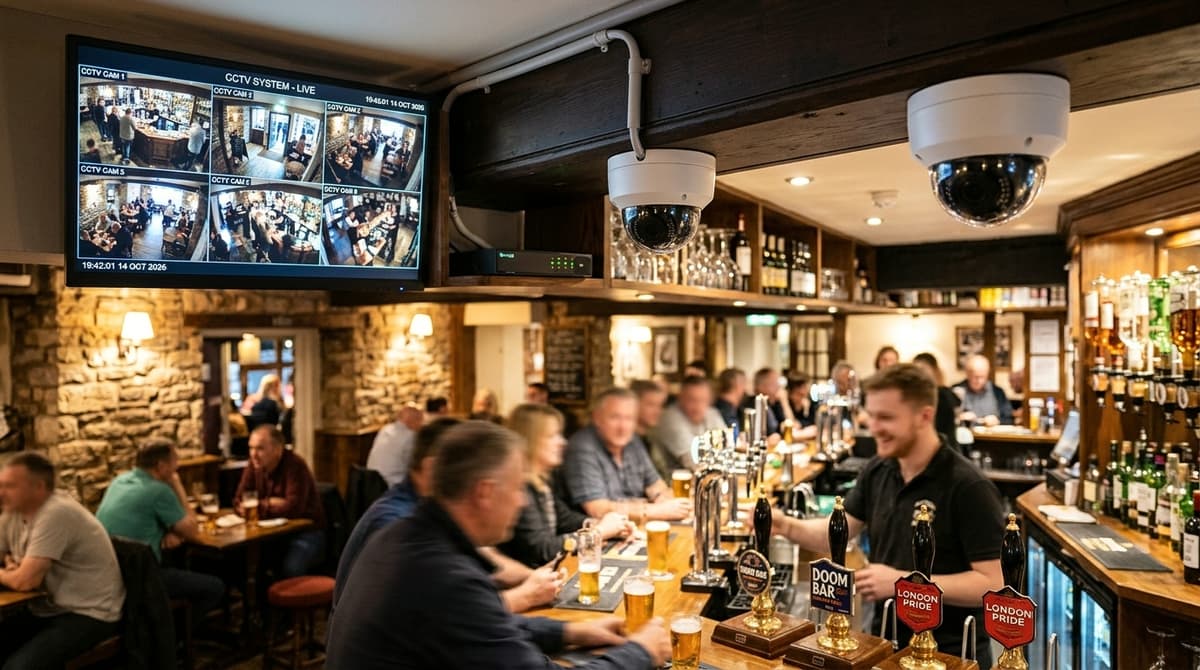
A bar or pub CCTV system should be specified around what its premises licence requires it to record, not around camera specs: clear coverage of entrances, the bar and tills, and stock areas, with footage that police can export and open. Licence conditions vary from venue to venue, so read yours before you buy anything, because retention periods, camera positions and export requirements are set there and by your licensing authority. Get those right and the choice between a basic system for a single bar and a larger setup for a late-night venue or group becomes much simpler.
What does a bar's CCTV have to prove under its premises licence?
A bar's CCTV has to show who came in, what happened at the bar and tills, and who handled stock, in footage you can hand over on request. The precise wording sits in the conditions on your premises licence, so read those before you choose cameras.
These are the areas that answer those questions:
- Entrance and door-supervisor area: a clear view of each person's face as they enter, since the door is where ID checks and refusals happen.
- Bar and tills: the serving area and cash handling, so disputes over change, refunds or an open drawer can be settled from the recording.
- Cellar and stock: the access door and the working area, which shows who handled stock and when.
- Beer garden or smoking area: enough coverage to see customers moving in and out with drinks, and any trouble that starts outside.
Retention is whatever your licence condition or licensing authority sets. Check your licence for the period rather than assuming a standard one, then size the recorder's storage to match.
Export matters as much as recording. As general guidance, make sure the system can save footage with a player or in a format the police can open, that its date and time stamps are accurate, and that a named person on the premises can export it on request.
Reolink's write-up of Met Police figures reported 9,598 call-outs to bars and pubs in 2016, including 1,706 serious woundings. Incidents at that scale are why footage needs to stand up when someone asks for it.
Which setup suits you: basic, late-night or multi-site?
Match the system to your trading hours: three core views for a daytime pub, a door-to-garden layout for late licences, and central management once you run several venues.
Tier 1: basic single site
A daytime-led pub with little late trading needs the entrance, the bar and till, and the back door or cellar. Together they show who comes and goes, what happens at the till, and the delivery route that usually goes unwatched. If you serve food, our guide to restaurant CCTV systems in the UK covers the till, kitchen and back door in more depth.
Tier 2: standard late-night
Late trading adds the door and queue line, the smoking area and beer garden, and a dedicated till-and-optics view for staff and customer disputes. The threshold camera matters most. For door supervisor incidents it needs a clear, face-level view, because a high-angle shot of a crowd rarely identifies anyone. A dim room next to a bright doorway is also hard for a basic sensor, so look for wide dynamic range on that camera.
Tier 3: multi-site or group
A group needs remote viewing from one place, the same retention period and export procedure at every venue, and user permissions. A bar manager can then see only their own site while head office sees all of them. When you mix makes of camera and recorder, check ONVIF conformance. Pelco, for example, describes its restaurant cameras as ONVIF conformant.
How do you handle low light, mirrors and glare behind the bar?
Specify wide dynamic range cameras, keep lenses off-axis from mirrors and glass, choose housings rated for the environment, and judge the picture at peak trading rather than in daylight.
Surveillant notes that a dim room lit by neon beside a bright doorway defeats a basic sensor, which is why it says wide dynamic range cameras matter more in a bar than almost anywhere else. Treat that as a line on the spec sheet, not an extra.
Mirrors and glass
Back-bar mirrors and glass-fronted fridges can bounce a camera's own infrared glow straight back into the lens. Mount cameras so they meet reflective surfaces at an angle, and frame the staff area and till instead of pointing at the mirror.
Humidity and grease
Near a kitchen pass or serving hatch, steam and airborne grease build up on domes and housings. Choose a housing rated for that environment, and read the IP rating on the product datasheet rather than assuming it from the camera's category.
Mixed lighting
Neon, LED strips and spotlights all behave differently, and the room changes as the night goes on. Check live view and recorded playback at the busiest, dimmest trading hour, not during the daylight check at handover. You are looking for readable faces at the entrance and a clear view of the till.
Can you put CCTV in pub toilets, and what about audio?
No: cameras do not belong inside pub toilets or staff changing areas, because people there have a clear expectation of privacy under UK GDPR and the ICO's video surveillance guidance.
A camera can still cover the shared corridor or lobby leading to the toilets, which is where most trouble starts anyway. Angle it so the toilet doors are not looking into view when they open, and mask any privacy-sensitive zones in the recorder settings.
Signs and a named controller
The pub operator, as data controller, needs to be identifiable on the signage, with a stated purpose for the recording and a contact point. Work through the ICO's CCTV checklist before commissioning rather than building your own list.
Audio
Sound recording is a separate decision from video. It captures conversations, which is more intrusive, so it needs its own lawful basis and justification. For most bars, the safest default is to disable the microphone on every camera and the recorder, and only revisit that with a documented reason.
Staff
Tell staff in writing where cameras cover the till and bar, and why. Covert monitoring of employees is a different matter, and generally something to avoid.
Are wireless CCTV systems any good in a pub?
Wireless cameras suit a low-risk extra view such as a beer garden or an outbuilding, but they are a poor foundation for any camera your licence depends on.
The building works against them. Thick walls and cellars weaken the radio signal, and a crowded bar puts a lot of phones on the same Wi-Fi bands. A camera that streams cleanly at 10am can stutter on a Saturday night, which is when you most need the footage.
"Wireless" also describes only the video link. Every camera still needs power, from a mains adapter or a battery, so you either run a cable anyway or depend on someone remembering to recharge. Once a power run is unavoidable, a single PoE cable carrying power and data is the simpler and steadier option.
For the entrance and the bar, use wired PoE. Where your premises licence carries a CCTV condition, those are the views that have to record reliably. Keep wireless for the beer garden edge or a storeroom, where a dropped frame costs you little.
Our wired, wireless and hybrid CCTV comparison sets out the architecture trade-offs. Once the core views are wired, our guide to how many cameras a small business needs helps you count what remains.