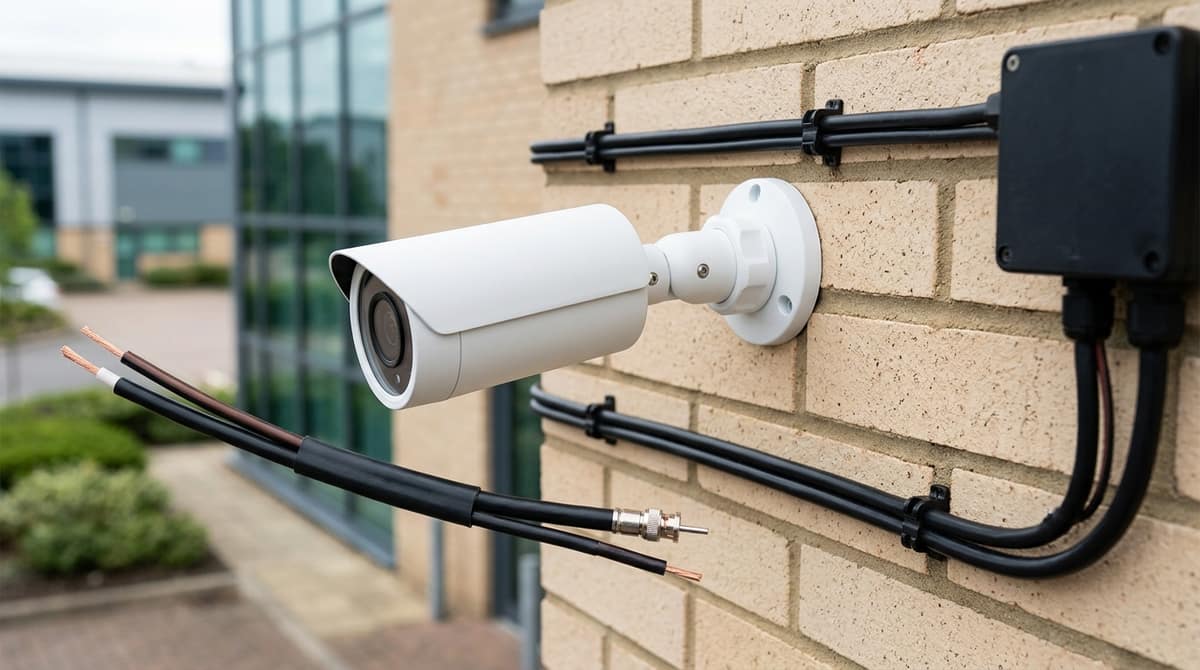
Shotgun cable is RG59 coax with a twin power pair attached, so one pull carries video and 12V power to an analogue HD camera (TVI, CVI, AHD or CVBS). The usable run length isn't set by the "RG59" label. It's set by voltage drop along the thin power pair and by the camera's own specification. Before you trust a long run, check the datasheet to see whether the conductors are copper or copper-clad, because that changes the resistance and the voltage that reaches the camera. For a broader look at what pan and tilt cameras do, see our PTZ explainer.
What is RG59 shotgun cable, and what cable does CCTV use?
Analogue HD cameras use coax or RG59 shotgun cable, while IP cameras use Cat5e or Cat6 network cable carrying power over PoE. Which one you need depends on the camera type, so match the cable to the recorder and cameras before buying a drum.
Shotgun cable (also sold as shotgun camera cable) is a 75-ohm RG59 coax core with a twin power pair attached alongside it. One pull therefore carries both video and power. Our RG59 Shotgun Cable 100m Reel – Coax + Power Black has 2 x 0.5mm power conductors and a 6.15mm outer diameter. It has a PVC jacket, is rated for indoor and outdoor use, and suits TVI, CVI, AHD and CVBS systems. For IP cameras, see our Cat6 and PoE guides instead.
Does the coax type matter?
Yes. Two listings that both say "RG59" can be built differently. A BED Electrical trade listing describes a budget copper-clad build with a copper-clad aluminium screen, 0.75mm² power cores and a 6.10mm diameter. The Kenable SFX listing instead highlights a braided screen for extra shielding and 0.75mm² power cores.
Check the datasheet for conductor material, screen and power-core size, not just the "RG59" label.
Typical sizes
For shotgun cable, the sizes in the evidence are close together: roughly 6.1mm overall diameter on both the 6.15mm and 6.10mm listings, with power cores quoted at 0.5mm or 0.75mm². If routing through walls or conduit matters, our thinner Siamese RG59 reel is described as flexible for conduit and wall runs.
How far can an RG59 shotgun run go?
There is no single safe distance: video reach depends on the camera and recorder format, and power reach depends on voltage drop. So take the maximum coax distance from your camera or DVR datasheet.
The 100m reel is the length our shotgun cable is sold in, so each camera drop is cut from it. The practical question is how much of the reel one drop uses up, and whether the camera at the far end still gets a usable supply.
What limits each half of the cable
- Coax (the picture): impedance, shielding and braid. The RG59 Shotgun Cable 100m Reel – Coax + Power Black is a 75 ohm cable with a 6.15mm diameter, and the Kenable SFX listing points to braided coax for extra shielding.
- Twin pair (the DC power): voltage is lost along both cores, out and back. Camera voltage = supply voltage − (camera current × resistance of the pair). The cores on our reel are 2×0.5mm, while the Kenable listing gives 2 x 0.75mm².
Check before you cut
- Voltage window: the lowest and highest voltage the camera's datasheet says it will accept.
- Supply output: its voltage and current rating, set against what the camera draws.
- Conductor material: the BED Electrical listing for a 0.75mm² budget shotgun cable specifies a copper-clad-steel conductor but does not identify the power-core material. Don't use it to pick a resistance figure for the power pair; take that from the datasheet of the cable you buy.
How do you calculate voltage drop on a shotgun cable run?
Work out loop resistance as 2 × length × resistivity ÷ conductor area, then multiply by camera current to get the volts lost. Confirm the final figure against your camera's datasheet.
loop resistance (Ω) = 2 × L × ρ ÷ A
voltage drop (V)    = I × loop resistance

L = one-way cable length (m)
ρ = conductor resistivity (Ω·mm²/m)
A = conductor area (mm²)
I = camera current (A), taken from its datasheet
The 2 is there because current travels out on one power core and returns on the other, so the electrical path is double the cable length. Pure copper is around 0.0172 Ω·mm²/m at 20°C. Copper-clad steel or aluminium has a higher resistivity, so the same area loses more volts.
Reading the conductor spec
Area and material both matter. A 0.75mm² core has about a third less resistance than a 0.5mm² core of the same material. Material is the bigger unknown. One 100m trade listing for a 0.75mm² shotgun reel specifies a copper-clad-steel conductor but does not say which material the power cores use. It therefore cannot tell you which resistivity to use for the power pair.
Our RG59 Shotgun Cable 100m Reel lists 2×0.5mm power conductors. The product specification does not state the conductor material, so check the datasheet before choosing ρ.
When the calculation fails
If the drop leaves less voltage than the camera's minimum input, change the setup:
- Shorten the run, or move the power supply closer to the camera.
- Power the camera locally and use the shotgun reel for video only.
- Run a larger power cable alongside a separate coax.
- Move to a network camera on PoE over data cable.
Bulk reel or pre-made leads: which is better for installers?
Choose pre-made leads for short, repeatable, fixed-length drops. Choose a 100m reel when runs vary, run long, or must pass through trunking or a wall.
Pre-made leads
- BNC and DC ends are factory-fitted, so there is no on-site crimping.
- Lengths are fixed, so any excess has to be coiled up behind the camera or recorder.
- The moulded connectors are bulkier, so a lead may not pull through a tight drilled wall.
Bulk reel
- You cut to length, so you leave less excess cable than with a fixed-length lead, allowing for offcuts and installation slack.
- Crimp quality is down to the installer. Allow time for the compression tool and for testing each end before the camera is fixed.
With either, the weak points are the BNC crimps at both ends, the DC connector, and any joint outdoors. Joints that sit outside need weatherproofing.
For a reel, the RG59 Shotgun Cable 100m Reel – Coax + Power Black is 75 ohm RG59 with 2×0.5mm power conductors and a 6.15mm diameter. The RG59 Shotgun Cable 100m Reel – Video & Power is a thinner, more flexible Siamese build for conduits and walls.
Power conductor size varies between reels. The Kenable SFX listing, for example, quotes 2×0.75mm². Check the datasheet against your camera's current draw on long runs.
How do you run shotgun cable through walls and trunking, and which reel should you buy?
Drill just wider than the 6.15mm cable, protect the run in sleeving or trunking, and choose the reel by how tight your route is. Your own installer or electrician should do the fitting. CCTV Master sells the equipment but does not fit it, so work from the product datasheet or installation guide.
Running the cable
- Drill size: Size the hole for the bulkiest thing that must pass through it. Bare cable fits a small hole, but a fitted BNC or DC plug does not, so pull the cable before terminating or drill larger.
- Entry point: Outdoors, let the cable drop below the hole and rise into it. That drip loop makes water run off the low point instead of tracking along the cable into the wall. Seal the gap around the cable.
- Sleeving or trunking: Sleeve the cable where it passes through masonry or cavities. Use trunking on exposed surface runs; our CCTV cable trunking guide covers sizing and fixing. Your electrician can advise on keeping this low-voltage cable apart from mains cabling.
Where the pair splits
A shotgun cable is a coax and a power pair joined side by side, and they separate at each end. The RG59 coax carries video to the DVR, while the two power cores go to the DC supply rather than the recorder. At the camera, the coax meets the BNC input and the cores meet the power lead.
Which reel
Choose the Coax + Power Black reel when any of the run is outdoors; choose the thinner Video & Power reel for crowded conduit or wall routes. Both are 100m reels of RG59 shotgun cable for TVI, CVI, AHD and CVBS systems.
Related products from our own range:
This article was researched and written by CodeNest.