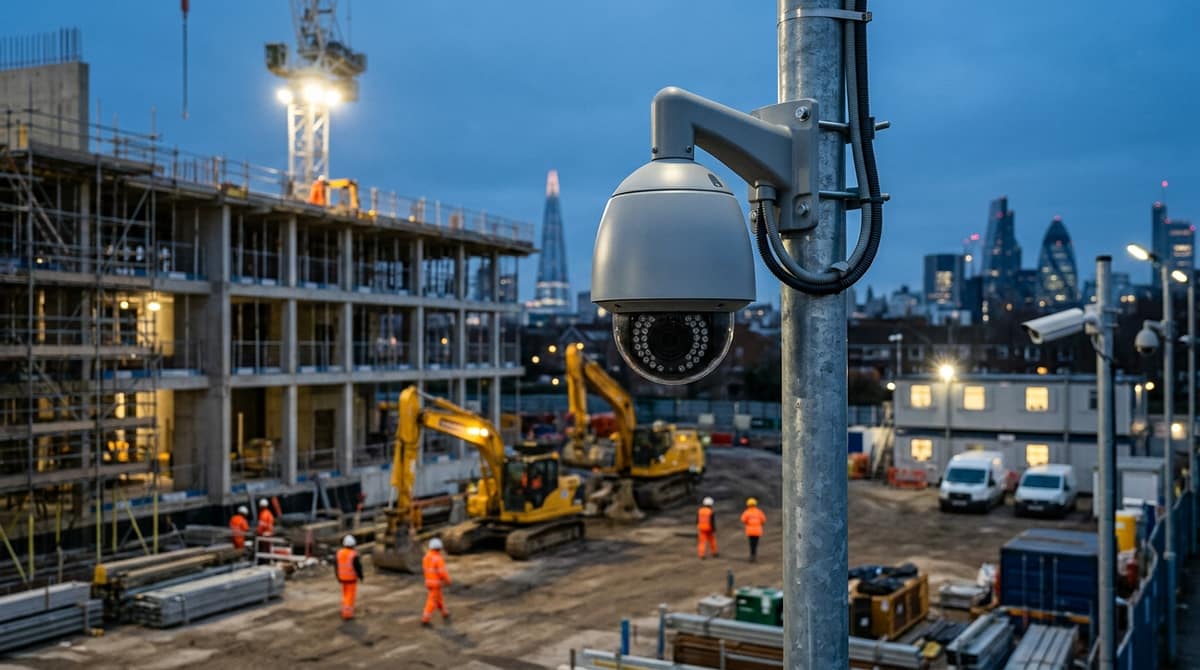
Round-the-clock CCTV for a construction site means more than recording: a camera or sensor detects an intruder, an operator verifies it on live video, and the alarm is escalated to a keyholder or the police. On a site with no mains supply or fixed broadband, that chain only holds if the power survives weekends, the 4G connection can carry video when an alarm fires, and the monitoring contract says who gets the call. Cameras are the cheap part of the job. Power, data and escalation are where site systems most often fail, so settle those before you compare lenses or resolution.
What does 24/7 CCTV for construction sites actually involve?
24/7 CCTV for construction sites means detect, verify, escalate: a trigger raises an alarm, an operator checks live video, then someone is called. Recording alone is not a 24/7 watch.
A camera or sensor picks up a person or vehicle and sends an alarm. An operator at a monitoring centre looks at the live feed to confirm a real intruder, then contacts the site manager or the police. Providers such as OxBlue list motion detection, real-time alerts and live-agent alert verification as separate service layers.
Home and shop systems assume mains power, a fixed network and a recorder someone reviews after the event. A building site may have neither, so power and connectivity come before camera choice. Our Business CCTV Systems and Best CCTV System guides cover the fixed-premises basics.
The HSE question
CDM 2015 places duties on the principal contractor to take reasonable steps to prevent unauthorised access to the site. CCTV is not mandated by that wording; it is one measure among several. Check the HSE's own CDM guidance for what applies to your project.
Who does what
CCTV Master supplies the equipment: cameras, recorders, PoE switches and cabling. Your electrician or installer fits it following each product's datasheet or installation guide. Monitoring is a separate contract with a monitoring company. Shop at CCTV Master or ask about trade pricing.
How do you power cameras on a site with no mains?
Match the power source to how many hours the cameras must run unattended: battery for a night, generator plus battery for evenings and weekends, solar or fuel cell where no supply exists at all.
| Source |
Suits |
Trade-off |
| Battery only |
Short gaps, or a backup layer |
Fixed runtime, then it goes dark |
| Generator plus battery |
Sites that run a generator in working hours |
Needs refuelling, and the battery must cover every hour the generator is off |
| Solar |
Long, fully off-grid periods |
Winter UK daylight can leave a deficit, so size the array and battery for the worst month |
| Fuel cell |
Off-grid sites with no usable sun |
Fuel cartridges must be swapped on a schedule |
Managed-tower providers pair a generator with enough battery to cover evenings and weekends when it is off. For sites with no supply, they offer solar plus fuel-cell units.
Work out your runtime
Battery Wh ÷ total load W = hours.
- Battery Wh: ____ (usable capacity, not the label figure)
- Total load W: ____ (camera + router + lights + heater)
Lights and heaters dominate the load, so check whether they run continuously or only on a trigger.
What happens when the generator stops
A well-built unit switches to battery without rebooting, keeps recording, and sheds the heaviest loads first. Put the router on its own battery. Then it stays online after the camera supply fails or is reset, so you still receive the "running on battery" alert and can see the fault remotely.
For the 12V supply and PoE budget behind these loads, see our 12V CCTV Power Supply and PoE Switch for CCTV guides.
How much 4G data does continuous video use, and what happens when the link drops?
Continuous streaming over 4G is the expensive option; trigger-based clip upload with local recording is the practical one.
Working out the data
The sum is: MB = bitrate (Mbps) × 3,600 × 24 × days ÷ 8. Take the bitrate from your own camera's stream settings and run the sum for each stream you might send.
- Continuous main stream: the highest bitrate, running every second of the day.
- Sub-stream: the same formula with the camera's lower-bitrate stream, which suits live checking rather than evidence.
- Event-only clips: replace the 3,600 × 24 with clip length in seconds multiplied by expected events per day. A site that triggers on people and vehicles only, rather than every moving shadow, uploads far less. Some platforms filter alerts this way, as OxBlue describes for its own service.
Keeping the link alive
A single SIM is one point of failure. A dual-SIM or bonded router can fail over between carriers, and 5G or fixed wireless is worth adding as a fallback where coverage allows. Check the data plan against the carrier's live terms, because fair-use limits and video restrictions vary.
Record locally first
When the link drops, the recorder keeps recording. Our 500GB storage category lists the entry-capacity drives for recorders. To size retention, run the same bitrate sum for each camera, add the results, and divide the drive's usable capacity by the daily total. Confirm that your recorder or camera backfills missed events once the link returns, as not all do.
Know when it has gone down
Set up offline, disk-fault and power-loss alerts rather than finding a gap after a theft. Managed monitoring services often build this in. On a self-managed system, check how often your own devices report in.
Which cameras work best for night-time and theft-prone perimeters?
Detect first, verify second: cover the perimeter with PIR or radar triggers, then add cameras that let you confirm what set them off.
A camera on its own is a weak night-time detector. On building site CCTV systems, a PIR or radar trigger picks up a person or vehicle at the fence, and the camera supplies the evidence. For long, dark boundaries, thermal cameras are the usual step up because they work from heat rather than visible light. Detection distances vary by model, so rely on the datasheet figures, not a brochure line.
Bullet or dome?
- Domes suit gates and entrances, where you want a close, tidy image of faces and plates and a housing that is harder to knock out of alignment. Check the datasheet for an IK vandal rating.
- Bullets suit long fences and hoarding lines, because they are simple to aim straight down a run.
For vehicle checks at the gate, our guides to outdoor cameras, PTZ and ANPR go further.
Lights, speakers and the legal side
Managed-service providers such as Eyrus describe perimeter cameras fitted with flood lights and speakers, which the monitoring operator can use to challenge a detected intruder. Talk-down is a deterrent, but recording sound is a separate matter from playing it out. Under UK GDPR, the ICO's CCTV guidance treats audio recording as more intrusive than video, so avoid it unless you can justify it.
Any camera that overlooks a pavement or road will generally need clear signage and a documented purpose. This is general guidance, so read the ICO guidance for your own site.
Non-Chinese brands
Hikvision, Dahua, Annke, Tiandy and TP-Link VIGI, the brands we sell, have Chinese origins, but a brand's origin is not the same as where a particular product is made. If a client or contract bars Chinese-manufactured equipment, check the manufacturing origin of each specific product against the contract wording before ordering. Your electrician or installer fits the kit, and each product's datasheet covers mounting and power.
Shop at CCTV Master or ask about trade pricing.
How do monitoring centres escalate alarms, and which contract terms matter?
A verified alarm typically goes to the site contact or keyholder first, and police are usually called only once a crime is confirmed in progress, though the exact procedure depends on your contract.
The usual sequence
The sequence below comes from the managed-monitoring pages in our research. Eyrus, a US provider, describes the first three steps and then a customisable procedure for contacting the site and/or police. OxBlue lists live-agent alert verification and custom monitoring hours.
- A detector or motion analytic raises an alert.
- The operator views the live feed to verify it.
- The operator speaks over the camera speaker, or triggers a siren or light.
- If the intruder stays, the centre follows the agreed call list, which may include a keyholder, site manager, patrol and emergency services.
Those extracts only name the site contact and police explicitly. Keyholder and patrol call-outs are common in UK monitoring, but confirm them with the provider. UK police response policy also varies, so ask how your provider handles it rather than assuming an automatic dispatch.
Contract checklist
This is general guidance rather than a legal requirement. Ask for each item in writing:
- Alarm handling time: is there an SLA, and from which point does it start?
- Escalation order: who owns and updates the call list when site staff change?
- Hours covered: are they continuous, or only out of hours? Who pays for false alarms and call-outs?
- Video retention: how long is footage kept? Who is the data controller under UK GDPR, you or the provider? Often the site operator is the controller and the centre a processor, but the contract should say so.
- Standards: does the centre hold NSI or SSAIB-style certification, and does it work to BS 8418 for detector-activated remote monitoring?
Get the escalation order and call-list ownership agreed before the cameras go live. We sell the cameras and recorders at cctvmaster.co.uk, but the monitoring contract is a separate agreement with your chosen provider.