
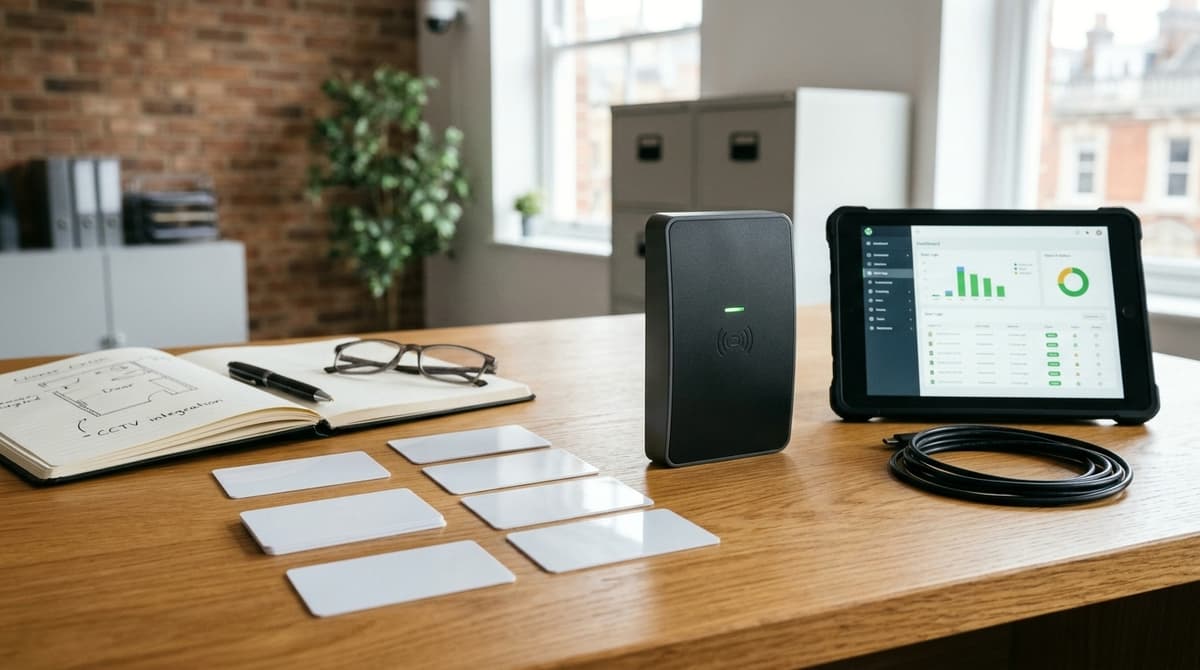
An RFID access control card is a passive chip and antenna that the reader powers by radio field. The controller then checks the card's ID against its permissions and either releases the lock or refuses. For most new installations, a 13.56MHz card with a modern encrypted chip (such as MIFARE DESFire) is the safer specification, because a 125kHz proximity card sends a fixed ID that can be copied. Those cards can still suit low-risk doors where that trade-off is acceptable. The reader decides what a card can do, so choose the reader and card together rather than buying either on its own.
What is an RFID access control card and how does it work?
An RFID access control card holds a passive chip and antenna that a reader powers by radio field, then reads when the card is presented.
The card has no battery. Within range, the reader's field energises the chip, which returns its ID number. The reader passes that to a controller, which checks it against stored permissions and either releases the lock or refuses. AlphaCard describes proximity cards and fobs the same way: they open doors wirelessly once within range of a reader. The practical gain is that nobody needs a metal key or a PIN, and a lost credential can be removed at the controller.
Two frequencies dominate. IP Security Depot lists common 125 kHz prox cards and fobs, while 13.56 MHz cards use ISO 14443 or ISO 15693 chips, according to RFID Inc. The card must match the reader's frequency, but that alone is not enough: the reader and controller must also support the card's chip type and data format.
Can you use one on a phone?
As general guidance, a phone can emulate some 13.56 MHz credentials through NFC, but a 125 kHz system generally cannot be used this way. Confirm phone credentials against the reader's datasheet before relying on them.
A 13.56 MHz example
Our 13.56MHz RFID NFC key fob (ACM-KEYFOB-13.56MHZ) costs £1.37. It sends its identification data to a compatible reader, and the system then grants or denies access based on programmed permissions.
125kHz or 13.56MHz: which card should you specify?
Specify 13.56MHz smart cards for new installs and higher-risk doors, and keep 125kHz proximity cards for low-risk internal doors and legacy systems. The table below is general guidance, not a rule for every chip or reader.
| 125kHz proximity | 13.56MHz smart card (chip varies: MIFARE Classic, DESFire and others) | |
|---|---|---|
| Data model | Fixed ID number | Chip with memory; authentication on better chips |
| Cloning and encryption | Fixed ID, no encryption | Varies by chip; older MIFARE Classic has known weaknesses, DESFire is the stronger option |
| Typical fit | Low-risk internal doors, legacy systems | New installs, higher-risk doors |
| Cost | The cheapest cards | A modest premium |
| Reader compatibility | Card must match the reader's frequency; many readers read only one family | Same |
On cost, the 13.56MHz NFC key fob is listed at £1.37 including VAT. Check its product page for the live price, and price your own quantities from the pages rather than from a rule of thumb.
Read range
Frequency alone is a poor guide to range, so don't pick a card on that basis. Range depends on the reader's antenna, the card or fob form factor and where the reader is mounted. Take measured range figures from the reader's datasheet.
Matching card to reader
Buy the reader and credentials as a pair. A 125kHz unit such as our RFID access control keypad will not read a 13.56MHz fob. Matching frequency is necessary but not sufficient: the reader and credential must also support the same chip type and system format, which is why card makers such as JNRFID match the card and chip to the access system protocol and reader model. For a wider look at options, see our CCTV buyers guide.
Even within 125kHz, the card format (commonly 26, 35 or 37 bit) and the facility code must suit your reader and system. Confirm both before ordering a batch of cards for existing rfid access control readers.
Can an RFID access card be copied?
Yes: a basic 125kHz proximity card can usually be cloned in moments with inexpensive hardware, so treat it as a convenience credential rather than strong security. That is general guidance, and it holds whatever the card looks like.
Mitigations, in order of value:
- Choose an encrypted 13.56MHz chip. Specify DESFire and avoid legacy Classic, which is the older format and is not worth building a new system around.
- Add a second factor. Where the reader supports PIN plus card, a cloned card alone no longer opens the door. The WiFi 125KHz keypad controller is a standalone unit at £16.55 (VAT included), with a WG26 reader output and smart app control. Confirm the exact PIN and card modes on its product page first, and remember it reads 125kHz cards, so the PIN is doing the protective work.
- Delete lost credentials straight away. A card that is still enrolled on the controller works for whoever finds it.
Pair it with a camera
A camera covering the reader and the door will not stop a clone, but it shows who used it. Frame the shot so a face and the reader are both visible. Because it records people, UK GDPR applies, so display signage and follow the ICO's CCTV guidance.
Cards, PINs or biometrics: what changes under UK GDPR?
Card IDs tied to named people are personal data; biometrics used to identify someone are special category data and need stronger justification. The exact position depends on the controller's purpose, so treat this as a guide, not legal advice.
A card number held against a name in an access log is ordinary personal data, so you need a lawful basis, a stated purpose and a sensible retention period. A fingerprint or face template used to pick out one individual adds a separate Article 9 condition on top of that basis, and a DPIA is often expected. The ICO publishes guidance on both biometric data and special category processing; check it for your own use case.
The practical difference is reversibility. A lost card is deleted from the controller and replaced, and a spare credential such as the 13.56MHz RFID NFC key fob costs £1.37. Nobody can reissue a fingerprint or a face. For the face-matching route, see our facial recognition access control article.
A camera on the door is a separate question
If a camera covers the entrance, its footage falls under the ICO's CCTV guidance and signage expectations, regardless of how the door unlocks. The card log and the video are two datasets, so each needs its own purpose and retention decision from the site owner.
What should you tell your supplier before ordering?
Give your supplier the card frequency, the reader's output format and the system it must work with, because a card that misses any of these simply won't read.
- Frequency and chip family: 125 kHz proximity or 13.56 MHz smart, per JNRFID, and whether the credential must be encrypted.
- Reader output format: common formats are 26, 35 and 37 bit, each tied to a facility or site code, according to IDShop. Our 125 kHz RFID keypad lists WG26.
- Form factor and quantity: card, fob or clamshell, and how many. Our 13.56 MHz key fob is listed at £1.37.
- Pre-programmed or blank: and whether the existing system needs matching card numbers.
- System type: a standalone controller or a networked system, and whether it must sit alongside your CCTV recorder or door entry.
- Mounting surface and rating: metal or outdoor, plus the reader's IP rating, taken from its datasheet.
- Spares and revocation: how many spare cards you need, and how a lost credential will be barred.
Have your own electrician or an independent accredited installer check the reader's datasheet and wiring before you commit to a quantity.