
nvr meaning
NVR Meaning in CCTV: NVR vs DVR Explained (2026)
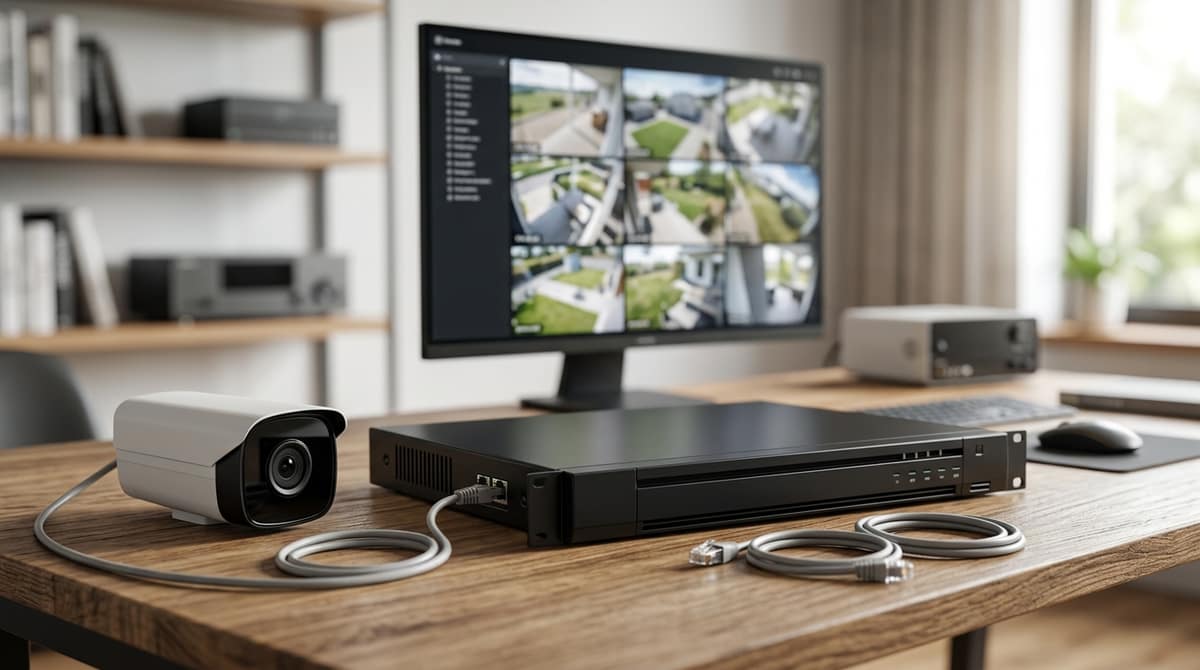
An NVR (network video recorder) records footage from IP cameras over your network, and the cameras do the video encoding themselves.
On this page
- NVR meaning in CCTV: what it stands for and how it differs from a DVR
- How do NVRs and DVRs handle IP and analogue cameras?
- What should you do with your existing cameras? (decision tree)
- Check before you decide
- Where does a hybrid XVR fit in a mixed estate?
- Which NVR should you choose when you go IP?
- Spec checklist
- Where the range fits
- Related products
An NVR (network video recorder) records footage from IP cameras over your network, and the cameras do the video encoding themselves. A DVR (digital video recorder) does that job for analogue cameras (HD-TVI, AHD, CVI) connected by coax, so the recorder you need follows from the cameras and cabling you already have. If you have a mix of both, a hybrid recorder can cover it.
Outside CCTV, "NVR" can also mean non-violent resistance, a parenting approach, which is a different subject from the security recorder covered here.
NVR meaning in CCTV: what it stands for and how it differs from a DVR
NVR stands for network video recorder: a recorder that stores digital video from IP cameras, which do the video encoding themselves. That covers the "nvr meaning in cctv" and "nvr meaning camera" searches, since an "NVR camera" is simply an IP camera that streams to one. Per OmniNVR, an NVR can be a dedicated appliance or software running on a supported computer or device.
Dedicated units record to their own drives, and many include built-in PoE ports. The Hikvision 8-ch 4K PoE NVR is one example, with 8 PoE ports so each camera runs on a single cable.
A DVR works the other way round: it digitises analogue camera signals itself, so the recorder does the encoding. The practical difference is where the encoding happens: in the camera for an NVR, in the recorder for a DVR.
Other meanings turn up in the same searches. Wiktionary lists lowercase "nvr" as an adverb in text messaging and internet slang, which is the "nvr meaning text" query and a separate usage from the recorder. Capitalised, Merriam-Webster gives "no voltage release". Wikipedia also lists Non Violent Resistance, a psychological intervention for problematic behaviour, which is the sense behind the autism, parenting and education searches. None of these relate to CCTV.
How do NVRs and DVRs handle IP and analogue cameras?
An NVR takes IP cameras over Ethernet, a DVR takes analogue over coax, and neither accepts the other's cameras unless it's a hybrid. The split exists because an IP camera encodes its own video and sends it as digital data. An analogue camera sends a raw signal, and the DVR does the encoding.
General guidance:
- Cable: an NVR system runs on Cat5e or Cat6 Ethernet cable. A DVR system runs on coax.
- Power: IP cameras can take power over the same Ethernet cable (PoE). Analogue cameras normally need a separate supply at the camera or a spur from a central power unit.
- Feeding the recorder: with an NVR, each camera connects either to a PoE port on the recorder or to a PoE switch on the network. With a DVR, each camera's coax goes straight to a numbered input on the back.
Many NVRs have built-in PoE ports, which removes the separate switch. Our range includes 8-, 16- and 32-channel PoE models, such as the Hikvision 8-ch 4K PoE NVR, the Hikvision 16-ch PoE NVR and the 32-channel 24-PoE Hikvision unit.
Mixing brands is workable but not guaranteed. Compatibility varies, and it commonly runs through ONVIF or vendor integrations, so check the recorder's supported camera list first.
The trade-off: IP gives you resolution headroom, with our NVRs reaching 4K and 8K-class output. But if the existing coax can't be reused, you're paying for new cable runs, which for many retrofits is the bigger cost than the recorder.
What should you do with your existing cameras? (decision tree)
Working cameras that are correctly positioned decide the recorder, so replace only what is failing or inadequate.
General installer guidance, in order:
- All analogue, still giving usable images: keep the cameras and fit a DVR or XVR to renew the recorder.
- Analogue estate needing a few extra cameras: use a hybrid XVR and add IP channels where it supports them. Check the datasheet for how many IP channels it accepts and at what resolution.
- All IP already: an NVR only. A PoE model such as the Hikvision 8-ch PoE NVR with AcuSense AI powers and records each camera over a single cable.
- Planning a full move to IP with no usable cabling: an NVR plus new Cat6 runs.
Check before you decide
- Camera condition and field of view: does each one still cover the area it was installed for?
- Whether the coax is sound and reusable, or corroded and damaged.
- Whether anyone has recorded complaints about evidence quality, such as unreadable faces or plates.
- Who will fit it. We sell equipment and do not install, so the customer's own electrician or installer should work from the product's datasheet or installation guide.
Where does a hybrid XVR fit in a mixed estate?
A hybrid XVR suits a phased upgrade because one box accepts analogue formats and some IP cameras, but it is a stepping stone, not a destination. You keep the existing coax working while IP cameras are added site by site.
Three trade-offs to weigh:
- Format and channel limits vary by model. Which analogue standards and how many IP channels a unit accepts is a datasheet question, so check before ordering.
- IP channel counts are often lower than on a dedicated NVR. Treat that as general guidance and confirm against the specification.
- Analogue-style inputs carry no PoE. IP cameras on a hybrid will typically need a PoE switch or injectors, which adds cost and a power point.
This guide doesn't quote hybrid or DVR models. Check the live category pages at cctvmaster.co.uk for current options, or send a trade pricing enquiry.
When to skip hybrid: if you already plan to move most of the estate to IP, compare the hybrid's documented IP channel limit with your planned camera count; if it falls short, start with a dedicated NVR. A unit such as the Hikvision 16-ch PoE NVR has integrated PoE ports, so no separate switch is needed for the cameras it powers.
Which NVR should you choose when you go IP?
Match the NVR's PoE ports to your camera count first, then check drive bays and the recording resolution each channel supports. Everything else is secondary.
Spec checklist
- PoE ports vs cameras: One cable then carries power and data to each camera. Channels without a PoE port need another way to be powered and connected, such as a PoE switch.
- Drive bays: Retention depends on disk capacity and your recording settings, so more bays give you more room to extend it.
- Maximum recording resolution: Check that it covers your highest-resolution camera.
- Bandwidth: Total camera bitrate must stay within the recorder's input limit.
- AI features: Only worth paying for if you want smarter motion detection.
Where the range fits
- The Hikvision 8-ch PoE NVR with AcuSense AI has built-in power and records up to 12 MP, so it suits a small system with AI detection.
- The Hikvision 8-ch 4K PoE NVR gives you 8 PoE ports for eight cameras.
- The Hikvision 16-ch PoE NVR with 8K decoding adds H.265+ compression and 256 Mbps of bandwidth.
- The Hikvision 32-ch 24 PoE 8K NVR has four drive bays. It has 24 PoE ports against 32 channels, so eight cameras would need another suitable network connection and power arrangement.
Check each product page's datasheet for the full specification before ordering.
Related products
Related products from our own range:
- Hikvision 1.5U 24 PoE 8K NVR – 32-ch DS-7732NI-M4/24P — Hikvision 32-channel recorder with 24 PoE ports (one cable powers and connects each camera), 4 drive bays and 8K HDMI. Built for large IP camera systems.
- Hikvision 8-ch PoE NVR with AcuSense AI — 8-channel PoE NVR with built-in power, AcuSense AI detection and up to 12 MP recording. Plug-and-play installation for residential and commercial surveillance.
- Hikvision 8-ch 4K PoE NVR: AcuSense Recorder, 8 Cameras — The Hikvision DS-7608NXI-I2/8P/S is an 8-channel 4K NVR with 8 PoE ports, so cameras run on one cable.
- Hikvision 16-ch PoE NVR with 8K decoding — 16-channel Hikvision PoE NVR with integrated power over Ethernet ports, H.265+ compression and 256 Mbps bandwidth for professional CCTV surveillance systems.
This article was researched and written by code-nest.dev.
