
nvr vs dvr
NVR vs DVR: Which Recorder Matches Your Cabling
If you've already got coax run through the walls, a DVR — or better, a Penta-brid model like the XVR-3108HS-5MP-LITE, which accepts HDCVI, AHD, TVI, CVBS and…
On this page
- What actually matters when choosing nvr vs dvr
- 9CH 4K PoE NVR Recorder with 8 Port PoE, H.265+ — best for a clean, plug-and-play IP camera upgrade
- 8 Channel 4MP Hybrid DVR for CCTV Systems — best for upgrading an existing analogue-cable install without a rewire
- Dahua XVR5104HS-I3 4-Channel DVR + 1TB Recording — best for a straightforward DVR upgrade with storage sorted
- 4-ch Hikvision AcuSense Turbo HD DVR with facial recognition — best for upgrading an existing coaxial run without rewiring
- Which one should you buy?
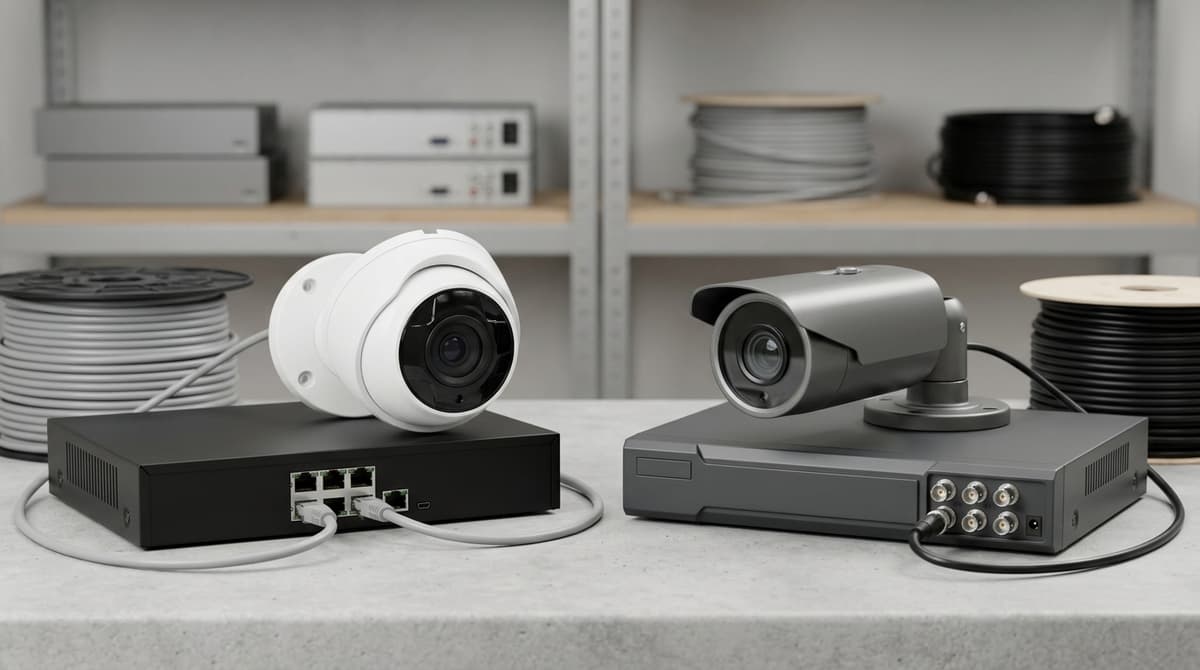
If you've already got coax run through the walls, a DVR — or better, a Penta-brid model like the XVR-3108HS-5MP-LITE, which accepts HDCVI, AHD, TVI, CVBS and IP on the same box — keeps that cabling earning its keep. If you're pulling fresh Ethernet, an NVR with PoE cameras is the far simpler build: one cable per camera, no separate power run. Get this wrong and you're either re-wiring a house for no reason or paying for IP capability you can't use over coax.
What actually matters when choosing nvr vs dvr
Four things decide nvr vs dvr for most UK buyers: existing cabling, camera resolution needs, channel count, and cable-run distance. Get these right and the rest of the spec sheet is detail.
Existing cabling is the first filter. If a property already has coax runs, a DVR such as the Dahua XVR5104HS-I3 4-Channel DVR reuses that infrastructure, since most DVRs are Penta-brid units accepting HDCVI, AHD, TVI, CVBS and IP signals on the same box. A new build with no cabling favours NVR plus PoE cameras, because one Cat5e/Cat6 run carries both power and data.
Resolution and detection features are the second. DVR channels on hybrid units like the 8 Channel 4MP Hybrid DVR top out around 4MP with H.264/H.265 compression, while NVR-based IP systems scale further — the catalogue includes 8K NVRs such as Hikvision range's 16-ch and 32-ch 1U/1.5U models, and AcuSense-enabled DVRs (Hikvision iDS-7208HUHI-M1/S at 8MP) add human/vehicle detection to cut false alarms on analogue channels too.
Channel count and PoE budget are the third. A 9CH 4K PoE NVR gives 8 independent 100Mbps PoE ports and up to 8TB storage — match camera count and expected retention to the ports and drive bays before ordering, not after.
Cable-run distance is the fourth. PoE over Cat6 typically works well within standard Ethernet distance limits per run before needing a switch or repeater; coax-based DVR runs can go further on a single cable but carry power separately. For a straight retrofit onto existing coax, an entry unit like the 8-Channel 5MP Lite DVR range keeps cost down; for a fresh install, NVR plus PoE is usually the simpler cable plan. Browse the full range at cctvmaster.co.uk or ask about trade pricing for multi-site jobs.
9CH 4K PoE NVR Recorder with 8 Port PoE, H.265+ — best for a clean, plug-and-play IP camera upgrade
Verdict: this is a 9-channel 4K PoE NVR built for buyers moving from a DVR/analogue setup to full IP, thanks to 8 independent PoE ports that let you skip a separate PoE switch entirely — best for anyone comparing nvr vs dvr and wanting a straightforward, one-box IP install.
- 8 independent 100Mbps PoE ports: cameras plug straight into the NVR and get power over the same cable, which is the practical difference that shows up in every nvr vs dvr comparison — no separate injector or switch to buy or configure.
- 9 channels total, so you get one spare channel beyond the 8 PoE ports for a further networked camera on the existing LAN.
- H.265+ compression keeps file sizes down versus older H.264 DVR footage, stretching retention on the same drive.
- Up to 8TB storage support, giving reasonable runway for continuous recording across 8 cameras before you need to think about overwrite cycles.
- Plug & play IP camera detection simplifies setup considerably compared with the manual channel configuration typical of hybrid DVRs.
The trade-off: this only works with IP (network) cameras, so it's not a fit if you've already got analogue HDCVI/AHD/TVI cameras installed — for that, a hybrid DVR such as the 8 Channel 4MP Hybrid DVR keeps your existing cabling working.
Shop the 9CH 4K PoE NVR Recorder with 8 Port PoE, H.265+ or ask CCTV Master about trade pricing.
8 Channel 4MP Hybrid DVR for CCTV Systems — best for upgrading an existing analogue-cable install without a rewire
A hybrid DVR built for sites that already have coax runs in the walls: this 8-channel unit records at 4MP over TVI, AHD, CVI or CVBS and can also take IP camera inputs, so you're not locked into one camera type when you extend the system later.
- 8 analogue-type channels at up to 4MP, with H.264/H.265 compression to keep storage demands manageable.
- Genuinely hybrid inputs — TVI, AHD, CVI, CVBS and IP on the same recorder, useful where cameras were bought over several years from different ranges.
- HDMI and VGA outputs cover both a modern monitor and older on-site displays, with remote mobile access for off-site viewing.
- In stock for same-day dispatch from CCTV Master.
The trade-off in the nvr vs dvr debate: a DVR like this depends on coax cabling per camera, so it doesn't get you PoE and voltage drop calculator's single-cable power-and-data convenience — if you're wiring a new site from scratch, an NVR such as the 9CH 4K PoE NVR Recorder is usually the simpler build. For retrofitting existing coax runs, this DVR is the pragmatic, lower-disruption choice.
Shop the 8 Channel 4MP Hybrid DVR at CCTV Master, or ask about trade pricing.
Dahua XVR5104HS-I3 4-Channel DVR + 1TB Recording — best for a straightforward DVR upgrade with storage sorted
A 4-channel Dahua WizSense DVR with the 1TB hard drive already fitted, this is the pick if you want to stop juggling separate drive purchases and just wire up cameras the same afternoon.
- Penta-brid inputs: takes HDCVI, AHD, TVI and CVBS analogue cameras alongside IP cameras up to 4K, so it suits sites with a mix of existing coax runs and newer network cameras.
- 1TB pre-installed: no separate hard drive purchase or fitting — useful if you'd rather not calculate retention maths from scratch before ordering.
- 4 channels: right-sized for a small shop front, flat entrance or single-property setup rather than a multi-camera commercial site.
- WizSense analytics: Dahua's onboard AI features aim to cut false alarms compared with basic motion detection on older DVRs.
Where it falls short: four channels won't stretch to a larger site, and because it's a DVR rather than an NVR it's built primarily around coax-fed analogue cameras rather than a PoE IP camera system — if you're starting fresh with IP cameras and want simpler single-cable runs, an NVR is generally the better route. For a small analogue-based upgrade with the storage question already solved, buy the Dahua XVR5104HS-I3 4-Channel DVR + 1TB Recording.
4-ch Hikvision AcuSense Turbo HD DVR with facial recognition — best for upgrading an existing coaxial run without rewiring
A 4-channel Turbo HD DVR built for sites that already have coax in the walls: it keeps your existing cabling and camera positions while adding Hikvision's AcuSense deep-learning analytics on top, which is the practical case for DVR over NVR when a rewire isn't on the table.
- AcuSense filtering distinguishes people and vehicles from irrelevant motion (leaves, headlights, animals), cutting the false-alert volume that plagues basic DVR setups.
- Facial recognition and perimeter protection (line-crossing, intrusion) are built in — analytics normally reserved for pricier NVR/IP combinations.
- Up to 8MP support per channel, well ahead of the older analogue-era 1080p ceiling most legacy DVRs are stuck with.
- 4-channel, 1U form factor — right-sized for a small shop, flat or single-storey home rather than a multi-entrance site.
The trade-off is real: coax still can't match a PoE IP camera for detail at distance or for easy repositioning, and you're capped at 4 channels here. If you're wiring from scratch, an NVR-based camera system usually makes more sense; if you're keeping existing cable runs, this is a sound, tidy upgrade path. Buy the 4-ch Hikvision AcuSense Turbo HD DVR with facial recognition.
Which one should you buy?
For most upgrades in 2026, choose NVR: it handles better low-light detail via digital camera processing, scales cleanly with PoE, and matches what most current IP camera ranges are built around. A straightforward starting point is the 9CH 4K PoE NVR Recorder with 8 Port PoE, H.265+, which powers up to eight cameras from its own 100Mbps PoE ports and takes an 8TB drive without needing a separate injector or switch.
Budget or replacing an existing analogue system: DVR still wins on cost and compatibility with coax cabling already run through a property. If you've got RG59 or similar already in the walls, a 4-ch Hikvision AcuSense Turbo HD DVR reuses that wiring, records at up to 8MP and adds facial recognition and perimeter protection without a rewire.
Small home setup, four cameras, no PoE budget maths to work through: a compact DVR is the pragmatic choice. The Dahua XVR5104HS-I3 4-Channel DVR arrives with a 1TB drive already fitted, supports HDCVI, AHD, TVI, CVBS and IP inputs, and is ready to record as soon as it's plugged in — useful where the cameras are a mix of old and new.
Mixed-brand or gradually-upgraded estate: a hybrid DVR bridges the gap. The 8 Channel 4MP Hybrid DVR takes TVI, AHD, CVI, CVBS and IP cameras on the same recorder, so an ageing analogue install and a couple of newer IP cameras can share one box while the rest gets replaced over time.
There's no universal answer to nvr vs dvr which is better — the right pick depends on existing cabling, camera count and budget, not brand preference. Both categories are stocked in depth: 20 NVR models and 33 DVR models are listed at CCTV Master, with trade pricing available on request for installers speccing multiple sites.
This article was researched and written by itmaster.uk.
