
cctv for farms
Farm CCTV: 4G, Solar & Long-Range 2026
Farm CCTV differs from a standard outdoor system in three ways: it needs to work where there's no fixed broadband (4G/cellular backup), often no mains power at…
On this page
- Why standard outdoor CCTV falls short on a farm
- Does CCTV need Wi-Fi, or will 4G do the job on a farm?
- Is solar CCTV actually viable for farm buildings and gateways?
- What actually needs covering: gates, yards, livestock buildings and boundaries
- Gateways and entrances
- Machinery yards and fuel stores
- Isolated buildings and livestock sheds
- What "long-range" actually means for a farm camera
- Related products
Farm CCTV differs from a standard outdoor system in three ways: it needs to work where there's no fixed broadband (4G/cellular backup), often no mains power at the camera point (solar viability, honestly assessed), and it needs to cover distances a domestic dome or bullet camera was never built for (long-range lenses, not wide-angle). Get those three constraints right and the camera choice follows; get them wrong and the system fails the first time a battery drains in December or a beam won't reach the second gate.
Why standard outdoor CCTV falls short on a farm
Generic outdoor cameras are built assuming mains power and an Ethernet or Wi-Fi signal reach the camera position — on most farms, neither does. A yard camera near the house works fine; the same camera at a field gate, a remote gateway or a machinery store 400 metres from the nearest socket usually doesn't.
Hikvision range's own farm guidance names this directly: farm sites commonly face a lack of stable power supply, no internet access at outdoor monitoring points, and a high cost of running mains power out to remote devices (Hikvision SMB Solutions for Farms). Uniview's farm solution page raises the matching problem from the installation side: complex terrain makes cable runs difficult, and the sheer size of a typical holding pushes deployment costs up fast (Uniview SMB Farms Solution).
Both vendors are describing the same gap from opposite ends — one lists what's missing at the camera, the other what it costs to fix by wiring. A domestic-spec PoE camera with a 4K sensor and colour night vision still needs a cable or a reliable radio link back to a recorder; drop it in a field with no trunking route and none of that spec matters.
The constraint isn't camera quality — it's power and connectivity reaching the camera at all, which is why farm CCTV planning has to start with the site's power and network map, not the camera spec sheet. Once mains power and a cable run to a central point are confirmed, a DVR such as the Dahua WizSense 4-Channel AI DVR can record from the cameras it's wired to, with face recognition and SMD Plus detection built in per the Dahua WizSense product listing — but that spec doesn't by itself solve the off-grid, no-cable-route locations Hikvision and Uniview describe above; for those, check your chosen camera and recorder are confirmed compatible before you buy. Ask CCTV Master about trade pricing on multi-camera farm setups — we stock installer-grade kit and can talk through power routing and cable costs for your site.
Does CCTV need Wi-Fi, or will 4G do the job on a farm?
Neither is mandatory everywhere: use Wi-Fi or wired PoE where broadband already reaches, and fall back to 4G/cellular only where it doesn't. Hikvision names "outdoor areas lacking electricity and internet" as a specific farm deployment challenge, distinct from the connectivity most urban or retail sites take for granted, per the Hikvision farms solution page.
The practical rule is simple: pick the connection based on distance from the router, not personal preference. A calving shed 200 metres from the farmhouse router is a poor Wi-Fi candidate; a machinery store three fields away with no cabling route is exactly where a 4G camera earns its keep.
The trade-off is worth stating plainly. A 4G camera's performance depends on signal strength at that exact spot — one corner of a field can differ from another — and it needs an ongoing SIM or data plan, which is a running cost, not a one-off purchase.
For buildings near the farmhouse or yard where broadband already exists, wired PoE remains the more reliable option and carries no recurring data charge once installed — the camera draws power and sends footage down one cable, with no dependence on mobile signal at all. Reserve 4G specifically for the outlying gateway or isolated barn where cabling isn't realistic.
Bold takeaway: choose wired PoE wherever cabling is feasible, and treat 4G as the fallback for genuinely remote structures, not a default. Anyone speccing a mixed farmyard system should check a recorder's channel count and storage budget against what they actually plan to wire in; the Dahua WizSense 4-Channel AI DVR is a 4-channel penta-brid recorder supporting up to 10TB CCTV storage calculator, suited to a handful of wired cameras around the yard — check its datasheet and your chosen cameras' specifications before assuming any 4G or cellular unit can feed into it, since compatibility isn't a given across camera types. For help matching a recorder to your farm's mix of wired and remote cameras, ask about trade pricing at CCTV Master.
Is solar CCTV actually viable for farm buildings and gateways?
Solar CCTV works for remote gateways without mains power, but only when power and 4G connectivity are both solved together. A fully-charged camera with no signal is as useless as one with a dead battery.
Yes — solar-powered CCTV is a genuine option for a remote gateway, gate or field entrance with no mains supply nearby, but it solves one specific problem rather than replacing wired systems generally. Hikvision points to the "high costs to provide stable power supply for monitoring devices" as the actual driver behind off-grid farm designs, per the Hikvision farms solutions page — this is a cost-of-cabling problem, not a lifestyle upgrade.
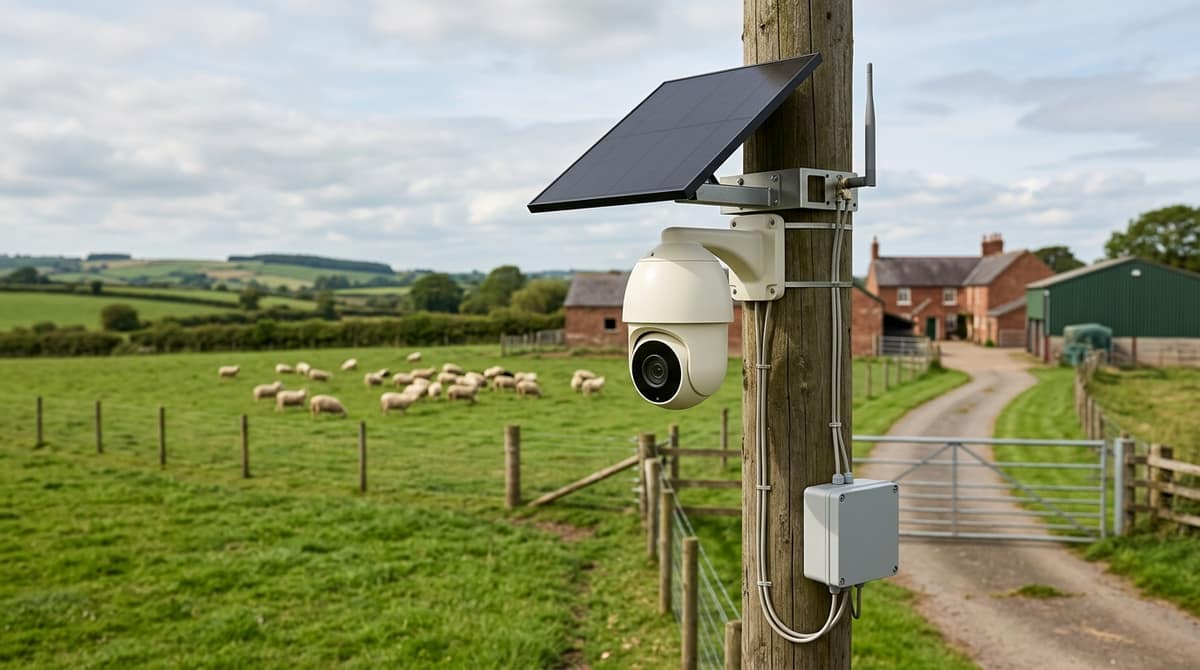
A solar camera only works if power and connectivity are solved together. Uniview's own farmland configuration pairs a solar panel directly with a 4G IP camera as the standard off-grid unit, per the Uniview SMB Farms solution — because a fully-charged solar camera with no signal at a remote pasture is exactly as blind as one with a dead battery. Uniview also lists a second tier for tougher sites: solar panel, smart management box, wireless bridge and a PTZ camera with Wise-ISP tech, aimed at spans where 4G alone doesn't reach.
Before ordering solar for a farm building or entrance, run through the honest checklist:
- Is this genuinely off-grid, or just an awkward cable run? If mains power is 30 metres away, a PoE run and a switch will often outperform solar on reliability and cost per year, though the right choice still depends on terrain and existing ducting.
- Is there a usable 4G signal at that gateway? Uniview's farmland unit assumes 4G connectivity exists — without it, the camera has nowhere to send footage.
- Does the site have consistent daylight, or is the camera under tree cover or a barn overhang? Solar output depends on sun exposure, and Uniview separately flags "lack of stable power supply and network connectivity" and "complex terrain" as deployment challenges specific to farms, per Uniview.
- Do you need recorded footage on an NVR, or just alerts? Off-grid solar units are typically standalone; if you also want centralised storage from mains-fed buildings, that's usually a separate wired system rather than an extension of the solar one.
- Does the footage need to identify a face or numberplate, or just confirm movement? Identifiable evidence at a gateway depends on the camera's positioning, lens choice and lighting conditions at the time, not the power source — solar and mains cameras are equally capable or limited here.
For farm buildings that do have power — the milking parlour, workshop, main yard — a wired IP camera on PoE into an NVR remains a straightforward and often cheaper-to-run choice; solar earns its keep specifically at the gate three fields away. For help specifying either approach for your own layout, shop at https://cctvmaster.co.uk or ask about trade pricing.
What actually needs covering: gates, yards, livestock buildings and boundaries
A farm perimeter isn't one continuous line worth blanket coverage — it's a handful of specific risk points that each need targeted detection: vehicle entrances, machinery yards, fuel stores and isolated livestock buildings. Spreading cameras thinly along a field boundary wastes budget on ground that offers little actionable warning.
Gateways and entrances
The main gate or track entrance is a natural control point, because almost anyone with harmful intent has to pass through it. Detection of a vehicle or person approaching from an unexpected direction, or entry outside the hours the farm normally operates, is more useful than a general view of open fields, per Secure Your Farm.
A camera covering the gate can capture number plates and faces at the one pinch point everyone must use, though this depends on the camera's position, lens choice and the light conditions on the approach — a fixed wide-angle unit sited too far back won't resolve a plate the way a correctly focused lens at the right distance will. For the footage quality that makes identification possible, shop at https://cctvmaster.co.uk or ask about trade pricing on a system specified to your farm's gateway layout.
Machinery yards and fuel stores
Machinery yards and fuel compounds follow predictable routines — deliveries, staff movements, contractor visits — which makes anomalies easier to flag. The same source notes that an alert triggered before someone reaches a roller shutter or fuel tank matters more than blanket sensing spread across the whole boundary.
A fixed camera on the yard entrance, recorded on a DVR with face recognition such as the Dahua WizSense 4-Channel AI DVR, gives that earlier warning without needing sensors on every fence panel. This is a 4-channel penta-brid DVR with a 20,000-face database and SMD Plus detection for filtering out irrelevant motion — check the datasheet or installation guide before pairing it with any specific camera, particularly for off-grid or cellular units, since compatibility isn't something to assume. Ask our team about trade pricing on multi-camera yard installations — we hold installer-grade kit in stock and can talk through power routing for your site.
Isolated buildings and livestock sheds
Livestock buildings and remote sheds are often the hardest points to reach with mains power or fixed broadband, which is exactly why they're overlooked and exactly where a gap in coverage tends to persist longest. This is where solar CCTV cameras for farms and 4G-connected units earn their keep, avoiding cable runs to a shed that may sit several fields from the nearest supply — a difficulty Uniview lists among the general deployment challenges facing rural sites.
Any camera destined for this kind of exposed, unheated location should carry an IP66 or higher ingress rating so wind-driven rain and dust don't compromise it over a full winter.
What "long-range" actually means for a farm camera
On a farm, long-range means clearly identifying a vehicle or person 30–50 metres away at a gate or drive. A camera needs a lens matched to the actual distance, not just higher megapixel count.
On a farm, "long-range" usually means clearly identifying a vehicle or person at a field gate, along a drive, or across the gap between a barn and a workshop — often 30-50 metres away, not the 5-10 metre porch-to-path distance most domestic cameras are designed for. That gap catches out a lot of buyers who assume any outdoor camera will do.
Getting usable detail at that distance is a lens and sensor problem before it's a marketing one. A fixed camera with a small lens might give a wide, welcoming view of a yard but reduce a person at the gate to a handful of blurred pixels — enough to see something moved, not enough to identify who.
A camera rated for long-range work needs a lens matched to the actual distance you're covering, not just a bigger box or a higher megapixel count on the spec sheet. Varifocal lenses, which let you adjust the zoom and angle of view on site, are generally more useful here than fixed lenses because a field entrance and a gap between buildings rarely sit at the same distance from the mounting point.
It's also worth separating detection from identification. A camera can pick up motion across a large field at long range, but recognising a numberplate or a face at the same distance usually needs a tighter, longer lens — so the "range" your installer quotes should specify which task it applies to.
Related products
Related products from our own range:
- Dahua WizSense 4-Channel AI DVR with Face Recognition — 4-channel Dahua WizSense AI DVR with face recognition (20,000 database), SMD Plus detection, penta-brid support, up to 10TB storage and 4K output.
This article was researched and written by the CodeNest content engine.
