
commercial cctv camera
Commercial CCTV Camera Guide for UK Sites (2026)
For commercial work, choose a CCTV camera by what the site demands of it (water, impact, temperature range, light contrast and mounting height), not by the…
On this page
- Why does a consumer spec sheet mislead on a commercial job?
- What do IP66, IP67, IK08–IK10, WDR and IR range actually tell you?
- IP66 and IP67 (IEC 60529)
- IK08 to IK10 (IEC 62262 / BS EN 62262)
- Temperature, WDR and IR range
- Which specs suit a loading bay, shopfront, car park, lobby or farm outbuilding?
- Warehouse loading bay
- Retail shopfront
- Car park
- Office lobby
- Farm or outbuilding
- What cable, brackets and accessories does a commercial camera need?
- Analogue sites
- IP sites
- Termination and protection
- Brackets and fitting
- How do you quote multi-site commercial CCTV, and what does it cost?
- Storage formula
- Installer checklist
- Related products
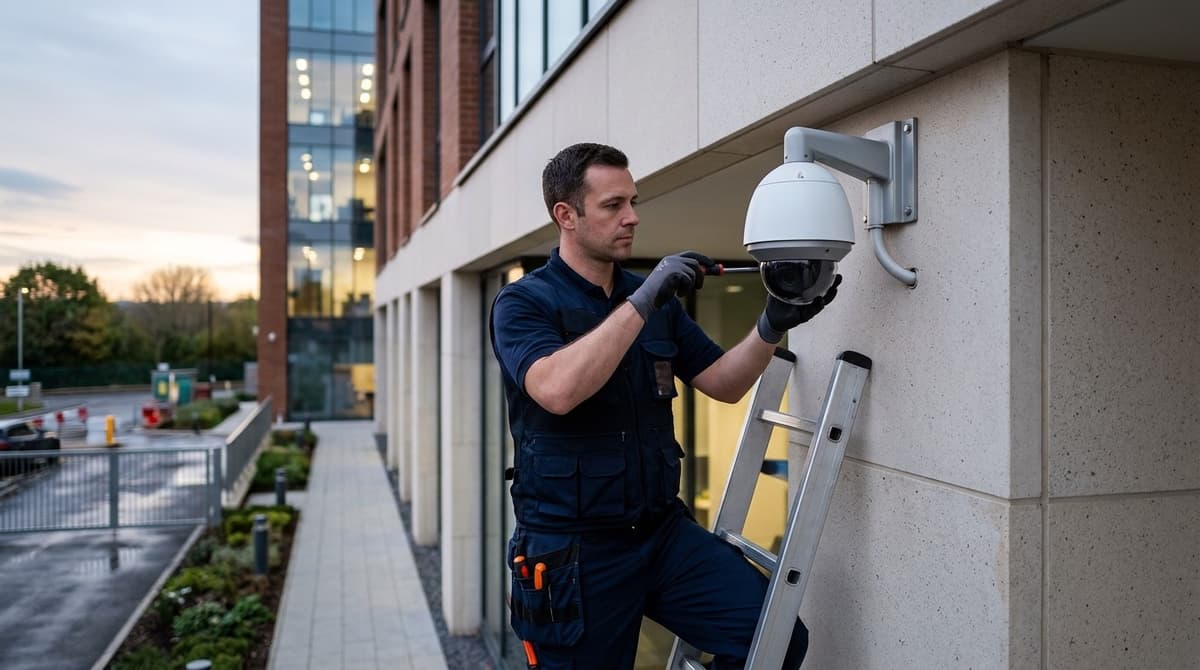
For commercial work, choose a CCTV camera by what the site demands of it (water, impact, temperature range, light contrast and mounting height), not by the headline megapixel figure. No single camera is best for every site, and a rating only counts if the housing, cable entry and bracket meet it too: an IP66 or IK10 body fitted with a poorly sealed cable entry or a weak bracket will not deliver that protection. The sections below match IP66/IP67, IK08–IK10, operating temperature, WDR and IR range to common UK site types, so you can specify and quote with confidence.
Why does a consumer spec sheet mislead on a commercial job?
A consumer spec sheet describes a camera's best case, not how it copes with a commercial site, so a headline figure is a poor guide when choosing a commercial CCTV camera. As general installer guidance, the gaps matter more than the numbers printed.
Consumer sheets lead with resolution and "up to" night-vision distances. They are often silent on impact rating (the separate IK code, not the IP code), operating temperature range, and what the IP rating actually covers, which is dust and water ingress only. Before buying, check each of those against the mounting height, exposure and climate of the site.
Ratings also describe the camera body, not the installation. A shield or enclosure does not upgrade an IP rating; it only reduces how much rain and direct sun the camera takes. A rain and sun shield suits that job, but shield fit varies between turret and dome models, so check it against your camera's dimensions first.
Commercial work also adds liability, which makes evidence quality matter more than headline pixels. Our UK business CCTV laws article covers the legal side.
What do IP66, IP67, IK08–IK10, WDR and IR range actually tell you?
Each code is a narrow, tested claim: water and dust (IP), impact (IK), and the light and temperature limits the camera was specified for. None of them says the camera suits your site.
IP66 and IP67 (IEC 60529)
These are the standard definitions. The first digit, 6, means dust-tight. The second digit separates the two ratings: 6 is protection against powerful water jets, and 7 is protection against temporary immersion (the standard test is up to 1 m for 30 minutes).
- Pressure-washed bays: IP66 is the right match, because jets are what it is tested against. Close-range, hot, high-pressure washing is harsher, so look for IP69 or keep the nozzle away from the camera.
- Flooded or ground-level mounts: IP67, because it covers brief immersion. It does not mean the camera can sit underwater permanently.
- Dual ratings: an IP67-only camera is not automatically proven against jets. Look for "IP66/IP67" if you need both.
IK08 to IK10 (IEC 62262 / BS EN 62262)
IK08 is a 5 J impact and IK10 is 20 J, the top of the scale. Within arm's reach, such as shopfront soffits, yard gates and low car-park walls, IK10 is the sensible target.
"Vandal-resistant" is a marketing phrase, not a rating. Ask for the IK number, and check that it covers the whole camera, dome included, rather than just the housing.
Temperature, WDR and IR range
- Operating temperature: read the datasheet's stated range against the coldest and hottest your site gets. Unheated outbuildings and open loading bays can differ widely from a heated office.
- WDR: it matters where bright and dark areas share one frame, such as glazed lobbies and shopfronts with backlight. Look for a stated figure in dB and for whether it is true multi-exposure WDR or digital processing.
- IR range: this is a manufacturer's maximum under test conditions, not a distance at which you can identify someone. Fog, nearby walls and glass reduce what you actually get, and IR reflecting off a window will wash out the image.
Which specs suit a loading bay, shopfront, car park, lobby or farm outbuilding?
Each site has one dominant problem: impact and washdown at the bay, glare at the shopfront, weather and distance in the car park.
Warehouse loading bay
Choose for knocks and water first. A camera near a dock door faces forklift and lorry strikes and possibly pressure washing, so look for a high IK impact rating and a sealed IP rating, then mount it clear of the vehicle swing path. Doorways flip between bright daylight and a dark interior, so wide dynamic range (WDR) matters. Keep the mount high enough to be out of reach but still accessible for lens cleaning and servicing.
Retail shopfront
Glass is the difficulty. WDR copes with backlit entrances, and a camera inside a window can reflect its own infrared (IR) off the glazing and wash out the picture, so test or angle it away from the glass. Anything within arm's reach needs a vandal-resistant IK rating. If cameras capture people, UK GDPR and the ICO's CCTV guidance expect clear signage, and cameras facing public pavement need extra thought.
Car park
Weather and area drive the choice here. IP66 or IP67 housings suit exposed poles and walls, while a varifocal lens or several cameras handle the width. Lighting varies from sodium lamps to darkness, so low-light performance matters. Mounting higher widens coverage but reduces identification detail at the same distance, so decide whether you need overview or recognition. For a kit-level view of how far these cameras actually reach, see our 4-camera CCTV kit coverage limits. Plate capture is a separate job, covered in our ANPR guides. Once the camera is up, mounting hardware that is fitted correctly keeps the aim and seal you specified.
Office lobby
Indoors, IP rating matters little. Prioritise WDR, because glass entrance doors put bright daylight behind every visitor, and mount at a height that captures faces rather than the tops of heads. Where reception staff or the public can reach a camera, add IK protection. Signage still applies.
Farm or outbuilding
Temperature swings, condensation, dust and rodents are the threats, so check the operating temperature range on the datasheet and choose a sealed housing. Outbuildings are often far from the house, which makes cable run length and power supply the real constraints. For an analogue camera, our 40m BNC CCTV cable with power is £13.79 and carries BNC video and integrated DC power in a single lead, though this particular lead is 40 m long, so measure the actual route first. Mains work in the outbuilding should go to a qualified electrician.
What cable, brackets and accessories does a commercial camera need?
Analogue cameras need a BNC video-and-power lead, IP cameras need either PoE network cable or a WiFi connection, and either type needs its connection points protected in a way that suits the position.
Analogue sites
The 40m BNC CCTV video and power lead costs £13.79. It carries video through BNC connectors and power through an integrated power cable in a single lead, and it is designed for connecting analogue cameras to a DVR.
This particular lead is 40 m long. That suits runs where the DVR sits within reach of the camera, but it is not a long-run solution. Measure the cable route, not the straight-line distance, before ordering.
IP sites
For PoE cameras, the choice between Cat6 and Cat5e is covered in our Cat6 and Cat5e articles. Outdoor runs have their own considerations, which the external Cat5e article sets out.
Termination and protection
Protect every connection point appropriately for the installation. A joint or connector left exposed outdoors is a common point of failure, so check the IP rating on the datasheet of whatever enclosure or junction box you choose. Don't specify one for an exposed position unless a rating is stated. The junction box guide covers sizing and IP detail.
Brackets and fitting
Mounting brackets vary by camera model, so check the datasheet for the mount your camera takes. Fitting is done by your own electrician or installer, using the product datasheet or installation guide.
How do you quote multi-site commercial CCTV, and what does it cost?
There is no honest single price for a UK warehouse system. Camera count, recorder capacity, cable runs and retention all change the total, and none of them can be pinned down without a site survey.
Quote each site on its own, then add the shared items such as central viewing. The drivers behind any commercial CCTV system cost are:
- Camera count and NVR channels, with spare channels for growth
- PoE switch capacity
- Cable length and route
- Access equipment for high bays and external elevations
- Retention period
We sell the equipment and do not fit it. Your own electrician or an independent NSI or SSAIB-accredited installer does the commercial CCTV camera installation, so ask them to itemise labour separately from kit.
Storage formula
Storage = bitrate × recording seconds × number of cameras, reduced if you record on motion only. Take the bitrate from each camera's datasheet or the NVR maker's calculator, at the stream settings you will actually run. Recording seconds is retention days × 86,400. Divide by 8 to turn bits into bytes.
Installer checklist
- Per camera: IP rating, IK rating, operating temperature, WDR need, mount height
- PoE budget per switch: total camera draw against the switch's stated budget, with headroom
- Cable: type, route and run length against the manufacturer's limit
- Retention and storage: days required, motion or continuous recording, drive capacity per NVR
Related products
Related products from our own range:
- Hikvision 5MP AcuSense Turret Camera with IR Night Vision — Hikvision DS-2CD3356G2-ISU 5MP turret camera with AcuSense detection, 40m IR night vision, and PoE power. IP67 weatherproof for outdoor security.
- Hikvision 8MP 4K Turret Camera DS-2CE78U1T-IT3F — 8MP 4K HD-TVI turret camera with EXIR 2.0 night vision to 60m, IP67 weatherproof, switchable analogue formats for coaxial CCTV systems.
- Hikvision 4K Two-Way Audio Turret Camera — 8MP 4K turret camera with built-in two-way audio over coax, 30m IR night vision, and IP67 weatherproofing for CCTV systems.
- 8MP Hikvision Motorized Varifocal Turret Camera IP66 — 8MP motorized varifocal PoE turret camera with 2.8–12mm lens, 30m IR night vision, IP66 weatherproof housing and H.265+ compression for professional surveillance.
Recommended products
From our own range — picked for what this guide covers.
- Hikvision 5MP AcuSense Turret Camera with IR Night VisionHikvision DS-2CD3356G2-ISU 5MP turret camera with AcuSense detection, 40m IR night vision, and PoE power. IP67 weatherproof for outdoor security.View product →
- Hikvision 8MP 4K Turret Camera DS-2CE78U1T-IT3F8MP 4K HD-TVI turret camera with EXIR 2.0 night vision to 60m, IP67 weatherproof, switchable analogue formats for coaxial CCTV systems.View product →
- Hikvision 4K Two-Way Audio Turret Camera8MP 4K turret camera with built-in two-way audio over coax, 30m IR night vision, and IP67 weatherproofing for CCTV systems.View product →
- 8MP Hikvision Motorized Varifocal Turret Camera IP668MP motorized varifocal PoE turret camera with 2.8–12mm lens, 30m IR night vision, IP66 weatherproof housing and H.265+ compression for professional surveillance.View product →
Frequently asked questions
What is the best commercial security camera?
No single camera is best; choose by what the site demands. Match IP66/IP67 for water, IK08-IK10 for impact, operating temperature, WDR for high-contrast light and IR range for darkness. These ratings only count if the housing, cable entry and bracket also meet them.
What does a commercial CCTV installation cost for a UK warehouse?
We can't give a reliable figure without a site survey. Cost depends on camera count, cable run lengths, mounting heights and recording. Ask each installer to quote the same specification, including ratings and cabling, so the quotes compare like for like.
How to install commercial security cameras?
Survey the site, choose cameras by environment, plan cable routes, mount them, then connect to the recorder. For analogue systems, our 40m BNC CCTV video and power lead carries both signals in one cable to a DVR. Before ordering, check that the camera, DVR and cable are compatible with each other, and check the run length against your site.
How to select CCTV camera for home?
Start with where the camera will sit, not the megapixel figure: weather exposure, light contrast and mounting height. Home sites are usually less demanding than commercial ones, but the same checks apply to ratings, bracket and cable entry.
Does a rain and sun shield improve a camera's IP rating?
No. A shield only reduces exposure to rain and sun; the rating still describes the camera body. If you add a shield, check it fits your camera's size and shape before buying.
- commercial
- cctv
- camera
Written by
CCTV Master Editorial Team
CCTV Master's guides compare the cameras and recorders we stock on the specifications that matter, with every figure checked against the manufacturer's datasheet before publication.
Related reading
- 4-Camera CCTV Kit: Real Coverage Limits4 camera cctv kit
- Best CCTV Outdoor Security Cameras 2026cctv outdoor security camera
- What ANPR Cameras Actually Check: MOT, Tax & Insuranceanpr camera what do they check
- PoE Cameras Explained: UK Buyer's Guide 2026poe camera
- CCTV Camera Offline: Fix No Videocctv camera offline no video
- CCTV Camera Bracket Fitting Guide 2026cctv camera bracket