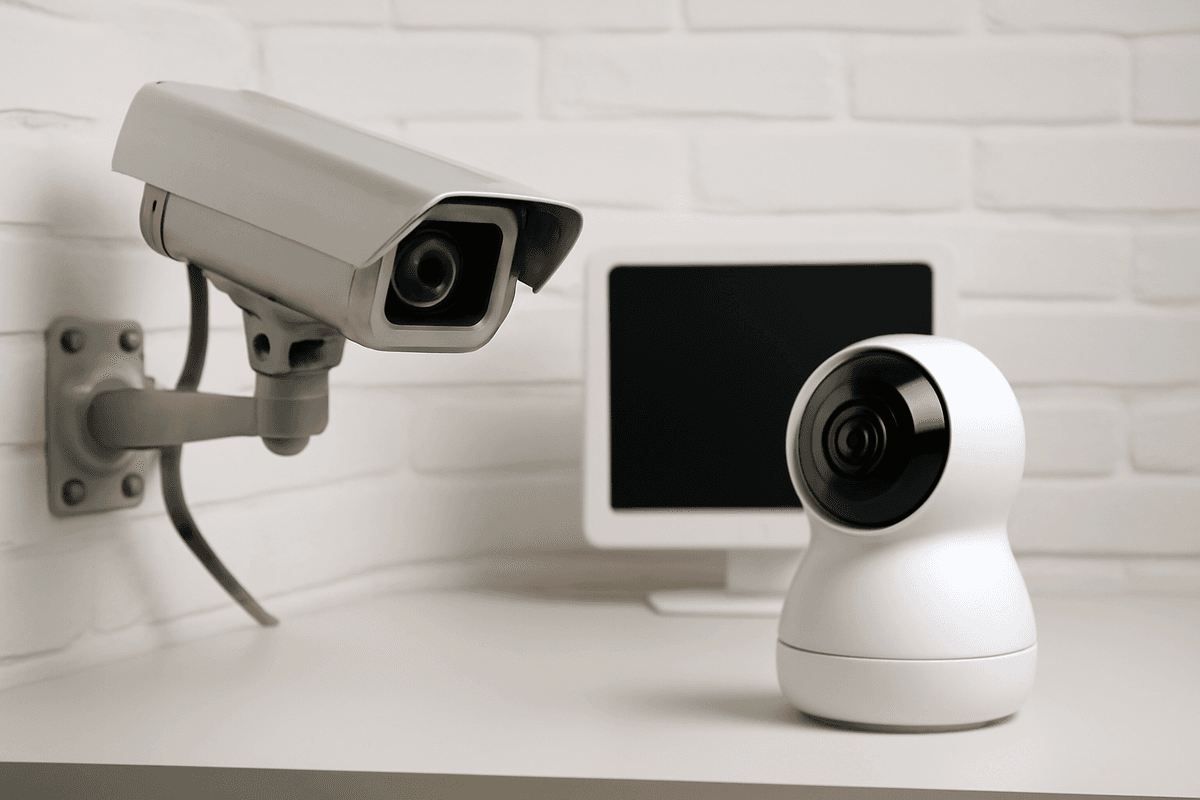
Most people shopping for "CCTV and camera" systems are searching for the same thing — the terms are interchangeable in the UK market, but the distinction bites you the moment you're specifying cable runs, recorders, or resolution. CCTV means closed-circuit television: video transmitted to a defined, private set of recording or monitoring devices. Every system you'll encounter — analogue coax to a DVR, IP cameras over Cat5e to an NVR, or a hybrid of both — fits that definition.
What's worth knowing is that "analogue" no longer means low resolution. The UK-CA-3K-G2 is a TVI analogue camera running a 3K CMOS sensor at 2960×1665 with a minimum illumination of 0.001 lux (F1.0, AGC on) — sharper and more light-sensitive than plenty of IP cameras at the same price point. The real decision isn't CCTV versus security camera; it's which architecture suits your site, your existing cable infrastructure, and your recorder budget.
What Is the Actual Difference Between CCTV and a Security Camera?
"CCTV" and "security camera" are not the same thing — CCTV is a transmission architecture, not a product category. Every CCTV system uses security cameras, but not every security camera is part of a CCTV system.
CCTV: What the Term Actually Means
CCTV stands for closed-circuit television. Video is transmitted to a defined, private set of recording or monitoring devices — a DVR, NVR, or dedicated monitor — and never broadcast publicly. That's what separates it from broadcast television, and it's what gives operators legal control over footage under UK GDPR and the ICO's surveillance camera code of practice.
"Security camera," by contrast, has no technical definition. Retailers use it as a catch-all for anything from a £30 Wi-Fi doorbell to a professional 4K turret on a Cat6 network. When a buyer asks what the difference is between a CCTV camera and a security camera, the answer in professional usage is: there isn't one — a CCTV camera is a security camera, operating within a closed circuit.
The Three System Architectures UK Buyers Actually Encounter
All three architectures below are technically CCTV. The meaningful differences are resolution ceiling, cabling type, and how power is delivered.
1. Analogue CCTV over coaxial cable to a DVR
Cameras transmit a composite or HD analogue signal (TVI, AHD, CVI, or legacy CVBS) over RG59 or RG6 coax to a Digital Video Recorder. Modern analogue is far from obsolete — current-generation 3K CMOS sensors such as those in the UK-CA-3K-G2 and DS-2CE12KF0T-LFS deliver 2960 × 1665 at 20 fps in TVI mode, with minimum illumination of 0.001 lux at F1.0 with AGC on (0 lux with white light active). Power is supplied separately via 12 V DC, which means running two cables to each camera unless you use a siamese coax-and-power cable, a local PSU at the camera end, or Power over Coax (PoC) where both the camera and DVR support it. For a plain-English explanation of how these recorders fit in, see our NVR meaning guide.
2. IP cameras over Cat5e/Cat6 to an NVR
IP cameras encode video on-board and transmit compressed streams — typically H.265+ — over a standard network to a Network Video Recorder. A single Cat5e/6 cable carries both data and power via PoE (IEEE 802.3af at 15.4 W, or 802.3at at 30 W per port). Resolution is uncapped by the transmission medium, 4K and beyond is straightforward, and cameras can be accessed remotely over IP without additional hardware.
3. Hybrid DVR/NVR accepting both signal types
Hybrid recorders accept analogue HD inputs on coax and IP camera streams simultaneously. This is the most common upgrade path in the UK: existing coax infrastructure is retained for cost reasons while new IP cameras are added where higher resolution or PoE convenience is needed. The analogue channels remain capped by whichever analogue standard is in use.
| Architecture |
Cable |
Power delivery |
Resolution ceiling |
Recorder type |
| Analogue HD (TVI/AHD/CVI) |
RG59/RG6 coax |
Separate 12 V DC (or PoC where supported) |
3K–5 MP typical |
DVR |
| IP / networked |
Cat5e/Cat6 |
PoE (802.3af/at) |
4K+ |
NVR |
| Hybrid |
Coax + Cat5e/Cat6 |
Both |
Depends on channel type |
Hybrid DVR/NVR |
Which System Type Suits Which UK Use Case?
Your building type, cabling reality, and legal obligations should drive the system choice — not budget alone. Get the architecture right first; then spec the hardware.
Domestic Terraced Home or HMO
For a standard terraced house, a 4–8 channel PoE NVR kit with wired PoE IP cameras is the most practical choice. Running a single Cat5e or Cat6 per camera is straightforward in most UK terraces, and PoE eliminates separate power supplies at each head-end.
Understand your PoE budget before you buy. IEEE 802.3af delivers 15.4 W per port; IEEE 802.3at (PoE+) delivers 30 W per port. A typical 8-port NVR with a built-in switch budgets around 120 W total — enough for eight 802.3af cameras at modest draw, but not eight PTZ or heated cameras pulling close to their rated maximum simultaneously. Check the NVR's total PoE budget in the datasheet, not just the per-port figure.
Wi-Fi cameras suit retrofits where running cable is genuinely impractical — through solid Victorian brick walls, for instance — but 2.4 GHz congestion in dense terraced streets is a real problem. Dual-band 5 GHz cameras reduce interference, though range through masonry drops sharply. Where you go wireless, power each camera from a local mains spur rather than relying on a PoE NVR port.
HMOs carry stronger legal obligations. Tenants are data subjects under UK GDPR, and the ICO's CCTV code of practice applies in full. You must display clear signage at every entrance and in any communal area under surveillance, state who operates the system, and document your lawful basis under Article 6. Cameras must never cover private living spaces — bedrooms, bathrooms, or individual letting rooms. Failure to comply can result in ICO enforcement action regardless of system size.
Retail Unit
A hybrid DVR/NVR is the sensible starting point for most UK retail premises that already have coaxial cabling from an older analogue system. Ripping out working coax to go full-IP adds cost without proportionate benefit; a hybrid recorder accepts both analogue and IP channels, letting you upgrade cameras incrementally. Size your system based on your premises layout and coverage requirements before committing to hardware — use a CCTV storage calculator to estimate recording capacity once you've settled on resolution and bitrate. The same principles apply to CCTV for schools and other institutional settings, where existing infrastructure and incremental upgrades often make hybrid systems the most cost-effective choice. For detailed guidance on choosing a CCTV system, consult our comprehensive buyer's guide.
For the shop floor itself, analogue 3K cameras — such as those using a 3K CMOS sensor at 2960 × 1665 and a minimum illumination of 0.001 lux at F1.0 with AGC on — perform well under typical retail fluorescent or LED lighting. Note that these are HD-TVI analogue cameras: the compression codec and bitrate are determined by the DVR, not the camera itself. When the DVR records using H.265 or H.265+, storage consumption depends on the bitrate the DVR is configured to use — at 4 Mbps per channel, for example, continuous 24-hour recording runs to roughly 43 GB/day; at 2 Mbps it halves to around 22 GB. Variable bitrate and motion-triggered recording reduce those figures further in quiet periods. White-light models rated at 0 lux with the illuminator active provide full-colour night images, useful for after-hours footage where monochrome IR makes it harder to identify clothing colour or product packaging.
Audio recording in retail requires explicit justification. Under UK GDPR Article 6, you need a documented lawful basis — typically legitimate interests — and the ICO's position is that audio capture is significantly more intrusive than video alone. If you deploy cameras with audio, signage must specifically state that audio is being recorded; a generic "CCTV in use" notice does not cover it. Many retailers disable microphones entirely to sidestep this compliance burden. If you keep them active, retain a written legitimate interests assessment.
Point-of-sale cameras benefit from a varifocal lens — a 2.8–12 mm motorised zoom lets you tighten the field of view onto the till area without repositioning the mount. Fixed 2.8 mm lenses give wide aisle coverage but may not resolve facial detail at the distances typical in larger retail units.
Construction Site
Temporary PoE or 4G/LTE IP cameras are the standard solution for UK construction sites, where mains power and network infrastructure are either unavailable or constantly changing. These systems offer flexibility and rapid deployment without requiring permanent installation, making them ideal for monitoring active work areas, equipment, and materials throughout the project lifecycle. Battery-backed or solar-powered options further reduce dependency on site infrastructure, whilst 4G connectivity ensures footage is transmitted securely even in remote locations. Construction managers benefit from real-time alerts and cloud storage, allowing them to monitor multiple sites simultaneously and maintain compliance with health and safety regulations.
Storage, Retention, and UK Legal Compliance: What Installers Get Wrong
Two mistakes tend to arrive together on the same job: undersized storage and missed ICO registration. One runs out on day 16; the other lands the client a fine they didn't see coming.
Storage Maths: How Much HDD Do You Actually Need?
Start with bitrate, not resolution. The daily storage a camera consumes depends almost entirely on the recorded bitrate — resolution and frame rate determine the ceiling, but encoder settings, scene complexity, and VBR behaviour determine where you actually land.
A rough working guide for continuous recording:
| Recorded bitrate (H.265) |
Approx. GB/day per camera |
| 1 Mbps |
~11 GB |
| 2 Mbps |
~22 GB |
| 4 Mbps |
~44 GB |
| 6 Mbps |
~65 GB |
| 8 Mbps |
~86 GB |
These figures assume constant bitrate. VBR — which most modern DVRs default to — will reduce average consumption on quiet scenes and spike it on movement. Treat the table as a planning ceiling, not a guarantee.
The UK-CA-3K-G2 and DS-2CE12KF0T-LFS are both analogue TVI cameras outputting a 3K signal at 2960 × 1665 and 20 fps. They don't encode H.265 themselves — that compression happens in the DVR. When a compatible DVR records these cameras using H.265 or H.265+, the effective bitrate typically falls in the 4–8 Mbps range depending on DVR settings and scene activity, putting you at roughly 44–86 GB per camera per day under continuous recording.
Worked example: 8 × 3K cameras, motion-triggered, 31-day retention
- Cameras: UK-CA-3K-G2 or DS-2CE12KF0T-LFS, 2960 × 1665 @ 20 fps TVI
- DVR codec: H.265, assumed average 5 Mbps per channel under motion
- Duty cycle: 30% (motion-triggered — reasonable for retail or a car park, but a busy entrance during trading hours can run 60–70%, so verify on site)
- Daily storage per camera: ~54 GB × 30% = ~16 GB/camera/day
- 8 cameras: ~128 GB/day
- 31-day retention: ~3.97 TB raw footage
Add 20% headroom for filesystem overhead, index files, and event snapshots: minimum 4.8 TB — so specify a 6 TB HDD. A single 4 TB drive, the default in many budget DVRs, runs out around day 25 at this duty cycle — and earlier if the site is busier than assumed.
Size the drive to the retention period before the client signs off. Discovering the gap after commissioning is an avoidable conversation.
ICO Registration: Who Must Register and What It Costs
Operating CCTV in a business context almost always means processing personal data, which means registering with the ICO as a data controller under the Data Protection Act 2018 and UK GDPR. It's one of the most consistently missed steps during installation. Failure to pay the required data protection fee when due can lead to ICO enforcement action and financial penalties.
ICO data protection fee tiers — check current figures at ico.org.uk before quoting, as fees are subject to change:
| Tier |
Organisation type |
Annual fee (indicative) |
| Tier 1 |
Micro-organisations (turnover ≤ £632,000 or ≤ 10 staff) |
~£40 (or less by direct debit) |
| Tier 2 |
Small and medium organisations |
~£60 |
| Tier 3 |
Large organisations (turnover > £36m or > 250 staff) |
~£2,900 |
The domestic exemption is narrow and frequently misunderstood. A homeowner's cameras covering only their own property and garden are exempt. The moment a camera captures a neighbour's driveway, a shared access road, or a public pavement, the exemption falls away. Beyond that, there are other limited exemptions — for example, certain not-for-profit bodies — but most commercial operators won't qualify. If in doubt, register.
HMO landlords are a particularly common blind spot. Fit cameras in the communal areas of a house in multiple occupation and you're processing tenants' personal data — registration is required. The same applies to any retailer regardless of size: a single-camera corner shop is not exempt. Installers who don't raise this at the survey stage are leaving clients exposed to regulatory risk. Registration takes minutes online and costs far less than the potential fines, making it a non-negotiable part of any professional installation. The ICO's guidance on CCTV and monitoring is detailed and regularly updated, so it's worth reviewing before any system goes live.
Which System Do You Actually Need? A Practical Decision Guide
Your recorder choice locks in more cost than any camera decision — buy the wrong type and you're replacing infrastructure, not just hardware. The four scenarios below map common client situations to the right technology; find the one that fits and skip the rest.
Under £300 total budget → Analogue 4-channel DVR kit with 3K CMOS cameras
A sub-£300 budget rules out most IP NVR kits once you price in PoE switching and Cat5e runs. A 4-channel HD-TVI or AHD DVR paired with cameras such as the UK-CA-3K-G1 gives you genuine 2960 × 1665 resolution, ICR day/night switching, and 0.01 lux minimum illumination at F2.0 with IR — more than adequate for domestic driveways, small retail counters, or single-storey commercial premises.
These analogue kits use standard coax and BNC connectors, which most DIY installers can terminate without specialist tools. At 3K (2960 × 1665) with a 2.8 mm fixed lens, you have enough pixel density to read number plates at up to roughly 8–10 metres — which covers the majority of residential use cases.
Need remote viewing or cloud-based motion alerts → IP NVR or hybrid DVR with onboard P2P/cloud relay
Remote streaming is where analogue systems hit a hard ceiling. For 1080p remote viewing, your router needs sufficient upstream bandwidth — the actual figure varies by codec, frame rate, and whether sub-streams are used, but as a working rule, budget at least 1–2 Mbps upstream per camera and check your ISP's upload speed before specifying more than two or three simultaneous remote streams on a standard FTTC connection.
An IP NVR handles this natively; a hybrid DVR can encode analogue channels and push them remotely but adds latency. If you already have some IP cameras and some analogue, a hybrid recorder lets you consolidate both on one platform without replacing working hardware.
Cloud alert features — motion push notifications, clip upload — also demand stable upstream bandwidth and, in a business context, a reviewed privacy notice under UK GDPR. Cloud-stored footage is processed data, and the storage provider's data processing agreement must be in place before go-live.
Existing coax cable already installed → Hybrid DVR; reuse the cable and upgrade cameras to HD-TVI or AHD 3K
Ripping out RG59 or RG6 coax to replace it with Cat5e is rarely justified on cost. HD-TVI and AHD both carry HD video over existing coax runs — the UK-CA-3K-G1 and UK-CA-3K-G1-B support TVI at 3K/20 fps and AHD at 5 MP/20 fps over the same cable that previously carried SD analogue.
The practical limit is run length: HD-TVI maintains signal quality up to approximately 500 m on RG59, though 3K mode performs best under 300 m. Check your existing cable gauge and condition before assuming it will support the higher data rate. Power the cameras via siamese coax+power cable, a local PSU, or Power over Coax (PoC) where your camera and DVR both support it.
Outdoor, exposed, or harsh environment → Specify by IEC 60529 IP rating, not marketing language
"Weatherproof" and "outdoor-ready" are meaningless without a certified IP rating on the datasheet. For standard UK outdoor locations — eaves, car parks, building corners — IP66 is the minimum acceptable rating (dust-tight, protected against powerful water jets). For construction sites, coastal installations, or anywhere subject to sustained water ingress or pressure washing, specify IP67 (immersion to 1 m for 30 minutes).
Always pull the manufacturer's datasheet and confirm the IEC 60529 rating before specifying.
Related products from our own range:
- 5MP PIR Fixed Turret CCTV Camera TVI/AHD/CVI — • Supports 5MP (Lite) and 2MP Full HD video output over coaxial cable • Integrated PIR sensor for accurate heat-based motion detection • 1/3" CMOS image sensor with selectable resolution output
- 2MP PIR Fixed Turret CCTV Camera AHD/TVI/CVI/CVBS FHD — • 2MP Full HD resolution (1920 × 1080) video output over coaxial cable • Integrated PIR sensor for accurate motion detection • 1/3" CMOS image sensor for stable and clear video capture • Fixed lens
- 8 MP 4K ColorVu Audio Fixed Turret Camera (Black) — 4K ColorVu Audio Fixed Turret Camera High quality imaging with 8 MP, 3840 × 2160 resolution 24/7 color imaging Audio , built-in mic 3D DNR technology delivers clean and sharp images 2.8 mm fixed
- 8MP 4K ColorVu Turret Camera with Audio & Night Vision — 8MP 4K ColorVu turret camera with built-in audio, 25m white light night vision, and IP67 weatherproofing. Analogue CCTV for home and business security.