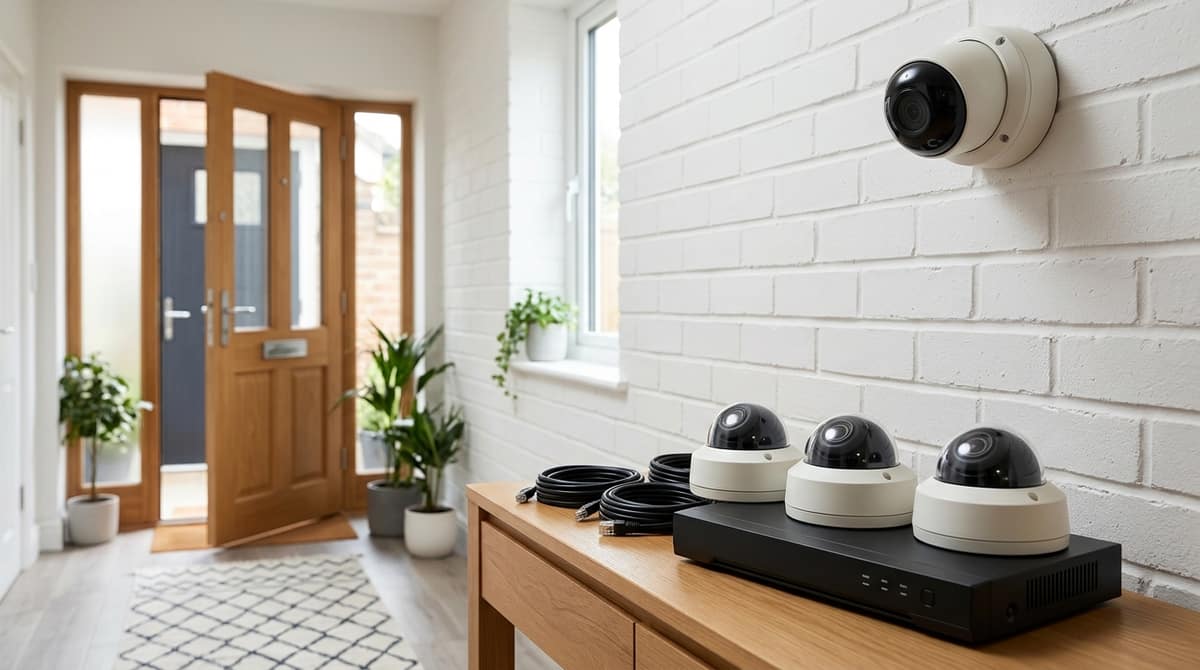
A four-camera kit is, as a rule of thumb, enough to cover the front door, back door, driveway and one side return of a typical UK semi — on a detached house or a shop with a yard, it's worth mapping the boundary first, since an extra angle or two is often needed. Before you commit to a box that says "4 camera," it's worth checking exactly what's inside: some hybrid DVRs give you four BNC inputs plus a fifth IP channel for an extra camera later, which is the difference between a kit you can extend and one that means buying a second recorder outright. That spare IP channel is a spec worth asking about on any recorder before you buy, rather than assuming it's there — it doesn't add a fifth analogue input, so don't count on running five BNC cameras off a "4-channel" DVR. Browse our full range of 2 camera kits if you're starting smaller, or compare the 4MP kits if you want more detail per camera. For a wider choice of resolutions, see our 2MP kits range, or browse our 4 camera kits range, or see the full selection of 10 camera kits for larger properties.
What area does a 4-camera CCTV kit realistically cover?
A 4-camera kit can be enough to cover the main approach points of an average UK semi or small shop — front door, back door, driveway and one side return or garden — but as a rule of thumb it won't wrap all four elevations of a larger detached property. If you're weighing up a 4 camera kit against a bigger build, that's the trade-off to plan around.
Each camera has a fixed lens with a set focal length, such as the 8MP 4K ColorVu Turret Camera, which covers a defined zone rather than a continuous ring around the building. Four cameras therefore give you four defined zones, not a seamless perimeter, so there will always be gaps between them; the job is choosing the four zones where an intruder is most likely to appear.
Where the four cameras earn their keep
- Front elevation — door and driveway together, generally the highest-value position since it captures visitors, deliveries and vehicle activity in one frame.
- Rear elevation — back door and garden or patio, another common entry point worth covering on most semis.
- Side return or gate — often the first blind spot a property has, and worth a camera if it's the only route to the rear.
- Fourth camera — a second angle on the driveway, a garage, or a wider shot of the garden, depending on which elevation carries the most risk.
On a typical three-bed semi, that combination can cover the obvious entry points well without leaving an approach unwatched. A detached house with a long side passage, a driveway plus a separate rear garden, or a commercial unit with a yard will often need a fifth or sixth camera to close the gap — a limitation worth planning for before buying rather than discovering after installation.
The realistic takeaway: four cameras suit four distinct risk points, not four walls of a larger building. This is easy to miss — a 4-channel DVR is normally sold populated with four cameras already accounted for, so if a survey later shows a gap, check the specific product's channel count and expansion options on its product page rather than assuming spare capacity is included as standard.
Why does "4 camera" not always mean 4 recording channels?
Channel count on the recorder and camera count in the box are separate specifications. A kit marketed as '4 camera' describes only how many cameras are included, not how many the recorder can support, which may be higher and allow for later expansion.
Channel count on the recorder and the number of cameras in the box are two separate specifications, and buyers who assume they match can end up with a system that has no room to grow. A kit marketed as a "4 camera cctv CCTV kits" tells you how many cameras are in the box; it says nothing about how many the recorder can actually take. If you're looking for a Turbo HD kit specifically, check the recorder's channel spec before you buy.
Some 4-camera kits on the market are built around a recorder with more channels than cameras supplied, leaving the spare channels free for later — a genuinely different purchase to a 4-channel recorder sold with 4 cameras already using every input.
One has headroom; the other is at capacity from day one, and adding a fifth camera later to a fully populated recorder means replacing the whole unit, not just buying another camera.
Channel count vs camera count, side by side
| Configuration |
Cameras included |
Channels free after setup |
| 4-channel DVR + 4 cameras |
4 |
0 — fully populated |
| 8-channel DVR + 4 cameras |
4 |
4 — room to expand |
Our own Hikvision 4K CCTV Kit — 8-Channel DVR, 1 Camera illustrates the same principle from the opposite direction — an 8-channel DVR supplied with just one camera, leaving channels open for a phased build-out. On the hybrid side, a recorder such as the Annke DW41JD (SKU AN-DV4-5MP-DW41JD, shown here for illustration rather than a product we stock) supports up to 4 BNC cameras plus one IP camera on a single hybrid 5-in-1 DVR — a genuine 4-channel-plus-one ceiling, not an 8-channel box in disguise.
Before buying, check the recorder's maximum channel count on its own datasheet, separately from the number of cameras pictured in the bundle photo — the two numbers are only guaranteed to match on kits explicitly sold as fully populated. For anyone planning to add cameras within the next year or two, paying slightly more for spare channels now is often cheaper than replacing a maxed-out recorder later — ask CCTV Master about trade pricing on 8-channel kits sold with fewer cameras.
What's the difference between a wired, wireless and IP 4-camera kit?
Wired analogue and PoE IP kits send video down a physical cable, while wireless kits send it over Wi-Fi and are usually powered by battery or solar rather than mains. Knowing which architecture applies to a given kit changes both the install day and the ongoing running cost.
Battery/wireless kits
Battery and solar-powered kits avoid running mains or data cable to each camera, which suits a rented property or a fence line with no existing conduit. The trade-off is that batteries need periodic charging or a solar panel top-up, and picture reliability at the camera position depends on Wi-Fi signal strength rather than a fixed cable run.
This is generally the fastest kit to fit but the one with the most ongoing maintenance.
Wired analogue (BNC/coax + separate power)
Coax carries the video signal, a separate cable carries 12V power, and the camera runs continuously with no battery cycle to manage. A 4-channel hybrid DVR of this type — a 5MP-Lite H.265+ recorder taking up to 4 BNC cameras plus one IP camera — is a typical hub for this style of kit, and CCTV Master's own Prolux 4CH Hybrid DVR 4MP H.265 Recorder is built on the same hybrid principle.
Cable cost is modest and the technology is well understood, but two runs per camera means more first-fix work.
PoE IP kits
A 4-camera IP kit over PoE runs a single cable per camera carrying both power and data back to an NVR, so there's only one cable to first-fix and no local power supply needed at the camera. This generally makes for a cleaner install on a fresh cable run, and image quality can scale higher too.
The Hikvision 4K PoE Camera System | AcuSense NVR Kit shows the resolution PoE IP kits can reach, with an AcuSense NVR for human/vehicle detection built in.
Whichever architecture suits the building, CCTV Master stocks wired analogue, PoE IP and DVR/NVR components for same-day dispatch — ask about trade pricing if you're speccing more than one job.
What resolution and lens angle should a 4-camera kit have?
Resolution and lens angle trade off against each other; wider lenses cover more ground but reduce pixel density. Match specifications to each camera's job: tight lenses for identification at distance, wider lenses for coverage across larger areas.
Resolution and lens angle trade off against each other: a wider lens covers more ground but shrinks the useful pixel density on any one person or number plate, so match the spec to the job each camera is doing. There's no single correct answer across a 4-camera cctv kit — the right approach is usually to mix specs by position, not fit all four the same.
A driveway or gate camera needs enough resolution and a tight enough field of view to resolve a face or plate at 10–15 metres; a wide garden, yard or rear-elevation camera is better served by a lens that trades detail for coverage across the whole space. Getting this the wrong way round is a common design mistake — a wide lens on the gate camera often leaves plates as an unreadable smear even in decent light.
Resolution tiers in practice
- 1080p (2MP) — the base spec on budget 4-camera kits, including many analogue DVR bundles built around a hybrid 5-in-1 recorder. Fine for general activity detection at shorter range, weaker for identification at distance.
- 4K (8MP) — meaningfully more detail for faces or plates further out. Our 8MP 4K ColorVu Turret Camera, £34.48, is a single-camera example of this tier, with colour night vision instead of the usual monochrome infrared image.
Between these two sits 5MP/"3K", a reasonable middle ground where budget stretches to it — 3MP kits like the Hikvision 3K CCTV Kit are offered as a bundled option, and 5MP kits sit at the higher end of that same range. For 2MP options at a lower price point, see our 2MP kits range.
Matching lens angle to the job
Fixed-lens turrets and domes on entry-level kits commonly carry a short focal length lens for a wide view — as a rough rule, the shorter the focal length, the wider the coverage and the less detail at distance. That's typically fine for general driveway coverage but too wide for reading a plate at the far end of a long drive.
Budget kits marketed as a general-purpose "4 camera HD CCTV kit" generally standardise on one lens across all four cameras for cost reasons, which is exactly the compromise a mixed-position install avoids. If identification at range genuinely matters on one camera, that's the one to spec at 4K with a narrower lens; the rest of the kit can stay at 1080p or 5MP covering wider ground.
How much does a 4-camera CCTV kit cost in the UK, and what should be included?
A complete kit should include a recorder, all four cameras, cabling, power supply, and storage at a single fixed price, but costs vary widely by resolution and brand. Ensure the listing explicitly includes a hard drive and all components needed to record on day one.
A complete 4-camera kit should cost you a single fixed price that includes the recorder, all four cameras, cabling, a power supply and normally storage — but boxed kits vary so widely by resolution and brand that we won't quote a market-wide average here, because it moves too much between retailers and specs to state reliably. What matters more than any single price point is checking the listing actually bundles everything needed to plug in and record on day one.
What a complete kit needs to include
- A recorder rated for 4+ channels. For analogue/BNC cameras that's a DVR; for PoE IP cameras it's an NVR. A hybrid 5-in-1 DVR supporting up to 4 BNC cameras plus one additional IP camera is worth knowing about if you might want to add an IP camera later — though that spare IP channel is only free if you haven't already filled all four BNC channels with cameras.
- All four cameras, matched in resolution to the recorder — pairing a high-resolution recorder with lower-resolution cameras wastes the recorder's channel capacity.
- Camera cabling or PoE leads. Pre-terminated camera cables are common on boxed kits; if a camera needs to sit further from the recorder than the supplied lead allows, budget for extra cable separately.
- A power supply sized for the number of cameras — analogue kits typically need a multi-way PSU distributing power to each camera, PoE kits draw power over the network cable from the NVR or a PoE switch instead.
- A hard drive, or at least the mounting for one. Some boxed kits ship with a drive pre-installed and ready to record; others expect you to fit your own SATA drive into an empty bay. This is easy to miss — check the listing states "HDD included" explicitly, not just "HDD compatible."
Why we won't quote one number
Retail prices for 4-camera kits shift with camera resolution, recorder channel count, and whether audio or colour night vision is included — a genuinely single figure would mislead more than it helps.
Our own range gives a sense of the spread: a single-camera Hikvision bundle, the Hikvision 3K CCTV Kit — 4-Ch DVR + 1 Camera, sits at one end, and pricing climbs from there with camera count and resolution — so a genuine 4-camera bundle will naturally land higher than any single-camera starting price. Rather than anchoring to a market average, check what's actually itemised in each listing — recorder, cameras, cables, PSU, storage — and compare on that basis.
For a fixed, itemised 4-camera bundle at a stated price, Shop at CCTV Master or ask about trade pricing if you're speccing multiple sites.
Related products from our own range:
- Hikvision 3K Camera Kit — 4-Channel DVR & 1TB Recording — Complete Hikvision 3K (5MP) CCTV kit: 4-channel H.265 DVR, 1 turret camera and 1TB hard drive pre-installed, ready to record straight out of the box.
- Hikvision 4K PoE Camera System | AcuSense NVR Kit — Get crystal-clear 4K surveillance with a Hikvision PoE camera system. Includes AcuSense NVR for smart human/vehicle detection & easy setup.
- Prolux 4CH Hybrid DVR 4MP H.265 Recorder — 4-channel hybrid DVR supporting HD-TVI, AHD, CVI and CVBS cameras with 4MP Lite recording, H.265 compression and dual-stream viewing for home and small