
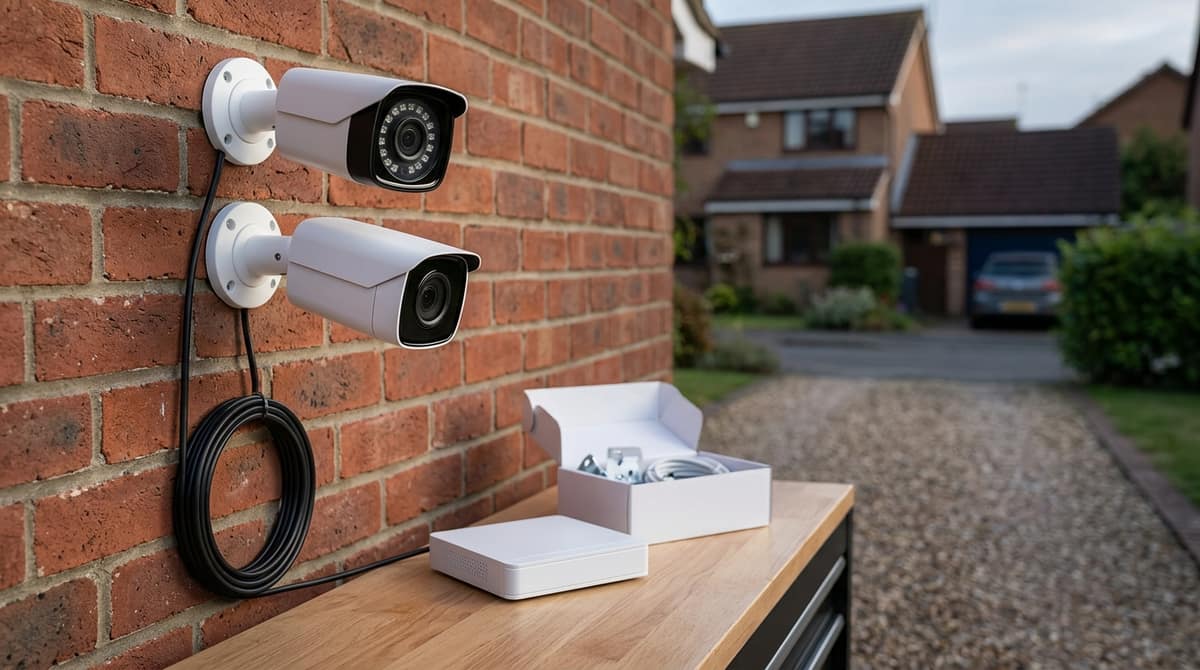
No single camera is best for night vision, because the right choice depends on whether your site has ambient light after dark. Where street or building lighting exists, a colour low-light camera such as ColorVu can capture usable colour detail. In a genuinely unlit yard or field boundary, infrared is the dependable baseline because it needs no outside light. Thermal is a different tool: it detects people and vehicles in total darkness but does not identify them, so it suits perimeter detection rather than reading number plates or recognising faces.
What is the best CCTV camera for night vision at your site?
The best night vision camera is the one matched to your site's light: colour (ColorVu or low-light) where there is ambient light, infrared where there is none. A headline spec tells you far less than the scene does.
Suburban driveway with street lighting
Colour night vision suits this scene, because street lamps give the sensor light to build a colour image from. The Hikvision 3K ColorVu Bullet Camera records at 2960 × 1665, reaches 40m with white light and IR, and is rated IP67. It works with HD analogue DVRs, so check your recorder first. The VIPER PRO 5MP 3K ColorVu also uses a built-in smart light to give colour footage in place of black-and-white infrared. Either is a sound pick if you are weighing the best night vision CCTV camera for a home.
Unlit commercial yard
Infrared is the dependable baseline here because it needs no ambient light at all. The Hikvision 5MP Bullet Camera with EXIR 2.0 gives 30m of IR range, is IP67 weatherproof and uses H.265+ compression. Expect monochrome footage after dark.
Large site needing wide coverage
One camera can sweep a big area if it can pan and tilt. The 4MP Hikvision PTZ Camera with ColorVu pans 350°, tilts 0–90° and gives colour night vision up to 30m. It is PoE powered, IP66 rated and takes a microSD card up to 512GB. A PTZ only views one direction at a time, so it complements fixed cameras on entrances rather than replacing them.
Choose by the light you have, then by the range you need.
IR vs ColorVu: what does each show after dark?
Infrared cameras show a black-and-white image in total darkness, while ColorVu-style cameras show full colour but need some ambient or supplemental light. Both count as night vision. The question is which kind suits the scene you're watching.
| Method | Image | Light needed | Example |
|---|---|---|---|
| IR LEDs | Black-and-white | None (0 lux) | Hikvision 5MP EXIR 2.0 bullet, 30m IR |
| Large-aperture lens, f/1.0 | Colour | Moonlight or streetlight; rated around 0.001 lux | Starlight-class sensors |
| Large-aperture lens, f/1.6 | Colour | Streetlight; rated around 0.01 lux | Most outdoor installs |
| Built-in white light | Colour | None from the scene | VIPER PRO 3K ColorVu |
The lux figures come from a 2026 colour night vision guide's comparison table. Treat them as typical ratings, since real results depend on the sensor and the scene.
Colour helps with identification. Clothing and vehicle colour are often the first things a witness or the police ask about, and a monochrome frame can't give you that. The Hikvision 3K ColorVu bullet records 2960 × 1665 and pairs 40m of white light with IR, so it can fall back to infrared. The VIPER PRO uses its smart light in place of black-and-white IR.
Pick IR where the area is genuinely dark and you need coverage that doesn't depend on any light source; pick ColorVu where there's streetlight or the camera can supply its own white light. Check the datasheet for the lux rating and light range before you buy.
Where does thermal fit, and why can't it be your evidence camera?
Thermal suits large perimeters as a detection and alert layer. It can't be your evidence camera because it records heat, not faces or number plates.
General guidance only: range, resolution and price vary by model, so take figures from the datasheet.
Thermal picks up heat signatures, so a person standing in the dark at a distance shows up against cooler ground. In principle it can also keep working where infrared washes out, such as in fog, glare or foliage. How well it does so varies by model, so confirm against the manufacturer's datasheet before relying on it.
The limit is that thermal detects rather than identifies. A warm human-shaped outline tells you someone is there, but it won't show a face or let you read a plate.
Let thermal raise the alarm, and put an identification-grade camera on the choke point. A gate, door or vehicle entrance covered by a camera such as the Hikvision 3K ColorVu Bullet Camera (40m white light and IR, IP67) gives you the footage that matters afterwards.
Thermal costs more than a standard camera and only pays off on large, high-risk sites. Most homes don't need it. If you're choosing for a house, our 4K and outdoor camera roundups are the better next click.
What UK-specific night-time issues change the choice?
Street lighting, neighbours and privacy rules decide which night mode suits a UK site: colour in lit towns, IR or a built-in light in dark rural plots, and an ICO check for anything covering beyond your boundary.
Sky glow and street lighting
As general installer guidance, urban ambient light helps colour cameras, which need some light to work with. Rural sites often have too little, so infrared or a camera with its own light does the work. Lamps in or near the field of view can also cause glare and false motion triggers, so check the scene after dark before fixing anything.
White-light cameras
Visible light from a camera such as the Hikvision 3K ColorVu Bullet Camera, which pairs 40m white light with IR, can be a nuisance issue if it floods a neighbour's windows. Aim it down onto your own ground, set a schedule, or use IR-only mode where needed.
Privacy and signage
A camera that covers a pavement, road or neighbouring property may bring UK GDPR and the ICO's CCTV guidance into play. That is not universally the case for every domestic setup, and signage duties depend on circumstances. Read the ICO's guidance on domestic CCTV before you fix cameras, and take advice if your coverage extends beyond your boundary.
Which night-vision camera should I choose? A selection flowchart
Pick ColorVu where there is ambient light or you accept a white light, IR where you don't, and add thermal only for long boundaries. Work through these in order and stop at the first step that settles it.
-
Is there usable ambient light in the camera's field of view, such as street lighting or security lights?
- Yes: use ColorVu or another low-light colour camera, for example the VIPER PRO 5MP 3K ColorVu.
- No: go to step 2.
-
Are you happy to use a visible white light there, given the neighbours and the site?
- Yes: choose ColorVu with its smart light. The Hikvision 3K ColorVu Bullet pairs 40m of white light and IR with IP67 weatherproofing.
- No: choose IR, such as the Hikvision 5MP Bullet with EXIR 2.0, which has 30m IR range.
-
Is this a long boundary where you need to detect people at distance rather than identify them?
- Yes: consider thermal for detection, plus an IR or ColorVu camera at the key point for identification.
- No: stay with IR or ColorVu.
-
Do you need to follow activity?
- Use the 4MP Hikvision PTZ with ColorVu. It pans 350°, tilts 0–90° and gives colour night vision up to 30m.
-
Does your recorder support the camera?
- The ColorVu bullet works with HD analogue DVRs, so check yours before ordering.
- The PTZ and EXIR models are network cameras, so they need an IP-capable recorder and a PoE supply.
Browse the full range at CCTV Master, or ask about trade pricing if you're buying for several sites.
Related products
Related products from our own range:
- Hikvision 5MP Bullet Camera with EXIR 2.0 Night Vision — 5MP fixed bullet network camera with 30m IR night vision, IP67 weatherproof, H.265+ compression and built-in mic.