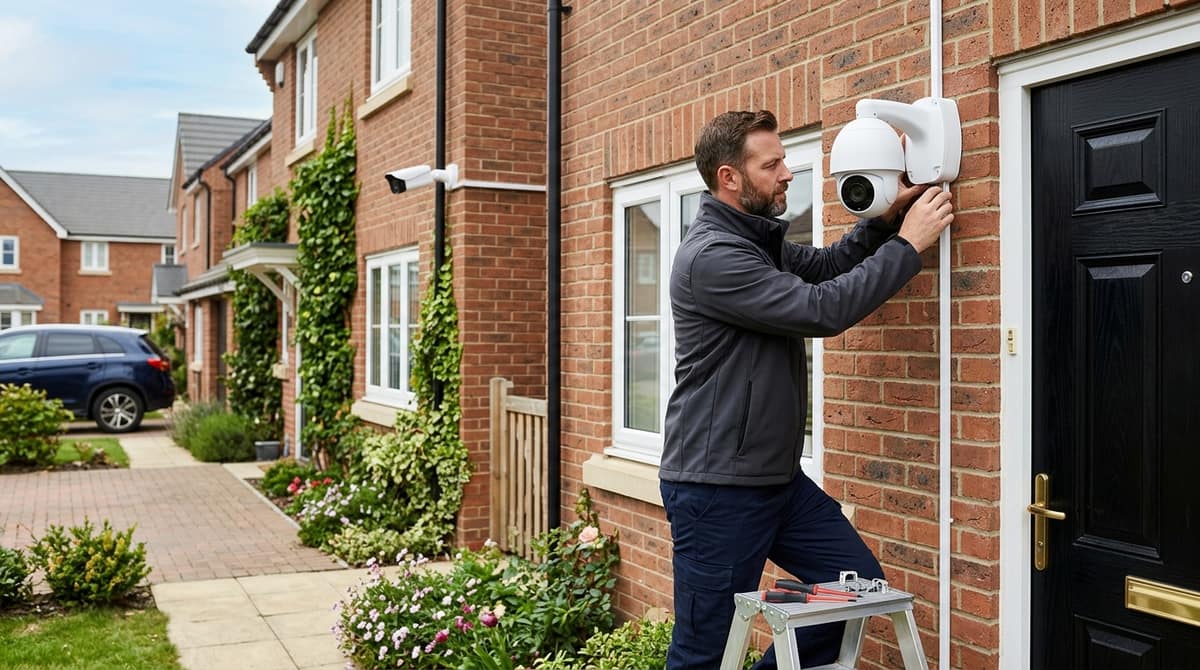
Home CCTV is legal in the UK and you don't need a licence for it, but once your cameras capture people beyond your property boundary, such as a neighbour's garden, a shared space or a public road or pavement, UK GDPR and the Data Protection Act 2018 apply to you. Video doorbells count too.
Most disputes start not with owning a camera but with where it points, so the practical rule is to aim cameras at your own property and treat anything wider as a legal responsibility you have to manage.
What is the law on CCTV at home in the UK?
You don't need a licence to run CCTV at home in the UK, but data protection law applies once a camera records beyond your own property.
That covers neighbours' homes or gardens, shared spaces and public areas such as a pavement or street, according to the GOV.UK domestic CCTV guidance (updated 21 May 2026). Video doorbells are covered as well as fixed cameras. The practical test is what the lens can see: if it takes in anyone else's space, you have legal obligations as well as a security system.
Audio adds to the risk. The ICO's home CCTV page says that the images and voices of other people count as their personal information, so a camera or doorbell with a microphone can capture more than you intended. Its advice is to aim cameras at your own property wherever possible.
Who regulates what
- Information Commissioner's Office (ICO): enforces GDPR and the Data Protection Act 2018, and is the body that handles complaints about home cameras.
- Biometrics and Surveillance Camera Commissioner: does not regulate domestic systems and has no powers to inspect, audit or sanction them, as Northamptonshire Police's guidance notes.
- Surveillance Camera Code: binds "relevant authorities" such as police and councils under the Protection of Freedoms Act 2012. Householders are only encouraged to follow it voluntarily.
Can my CCTV cover my neighbour's garden, and can theirs point at mine?
Your camera should capture only your own property where possible. If it records a neighbour's garden, data protection law applies equally to them if their camera looks at yours.
Your camera should capture only your own property where possible, and if it can't avoid a neighbour's garden, data protection law applies. The ICO says that once a camera records someone else's property, a public area or a communal space, the images and voices of those people count as their personal information. That brings duties to minimise what you record, warn people and delete footage.
A neighbour's garden is the classic grey zone, and the same rules bind them if their camera looks at yours.
Before you aim the camera
Work down this ladder, as Northamptonshire Police's domestic CCTV guidance suggests:
- Ask whether CCTV is needed at all. The force asks whether it is the best answer, what alternatives exist and whether it will affect people's privacy. Lighting, fencing or a gate may solve the problem.
- Reposition the camera so its view stays on your own land.
- Use privacy filters or blockers to blur neighbouring areas when the angle can't change.
If a neighbour's camera bothers you
Start with a conversation, not a complaint. The ICO's order is:
- Talk to them and ask why they installed it.
- Ask what the camera records and whether any filters are in use.
- Send the ICO's template letter. It reminds the owner that a request for personal information usually needs a response within one calendar month.
- Complain to the ICO on 0303 123 1113.
- If the behaviour amounts to harassment, treat it as a police matter.
What do UK GDPR duties mean in practice for a home system?
You need a clear recording purpose, signage, secure storage, regular deletion, and must respond to footage requests within one calendar month. Stop recording if someone objects and you lack legitimate reason to continue.
Once a camera films beyond your boundary, UK GDPR applies, and you need a clear purpose, signage, secure storage and a deletion routine. The ICO says this applies to fixed cameras and smart doorbells alike, because images and voices of other people count as their personal information. In practice, that means:
- A clear reason for recording, such as deterring burglary, written down before you rely on it.
- Capturing no more than you need, so angle or mask cameras that cover pavements or neighbouring gardens.
- Signage where people may be filmed.
- Secure storage with limited access, so the recorder is not on an open network or shared with the whole household.
- Regular or automatic deletion, which most recorders can be set to do.
- Responding to requests for footage.
- Stopping if someone objects and you have no legitimate reason to continue, per the Commons Library summary of the ICO page.
The ICO's template letter says data protection law usually requires a response within one calendar month. A workable process:
- Receive: log the date the request arrives, as that starts the month.
- Locate: find the relevant clip before your automatic deletion removes it.
- Check others' images: see whether neighbours or passers-by appear, and whether sharing the clip would expose them.
- Reply: send the footage or an explanation. If you cannot meet the deadline, the template asks you to say when you can.
Do I have to tell my neighbours?
Signage is required, but the ICO guidance cited here does not make a personal heads-up to neighbours a legal step. Still, the ICO suggests complainants start by talking or writing to the owner, so a short conversation up front can head off a formal complaint.
Planning permission, court evidence and other edge cases
Check local planning authority requirements if listed or in a conservation area, and read lease terms before installation. Keep original footage unedited and note your recorder's time source for potential court use.
Check before you drill: listed status, a conservation area, or a lease or tenancy clause can restrict where you fix a camera.
Planning permission
I'm not giving height or size limits here, because the rules depend on the property and the local authority. If your home is listed or in a conservation area, ask your local planning authority first. If you rent, or own a leasehold flat, read the lease or tenancy terms and ask your landlord or freeholder before fixing anything to the building.
Are cameras allowed in court?
Footage can be offered to the police as evidence, and the court decides what it admits. You can't guarantee that any clip will be used, but you can avoid damaging it:
- Keep the original files unedited, and export copies rather than trimming the originals.
- Note where the recorder's time and date come from, and whether the clock was correct.
- Stop the recorder overwriting relevant clips. Export them promptly rather than leaving them to loop.
Is it illegal for my boss to watch me on CCTV from home?
That is an employment and monitoring question, not a domestic CCTV one, and the guidance this article draws on doesn't cover it. Contact the Information Commissioner's Office about how personal data is handled, and ACAS for workplace rights.
What should I check before buying and setting up home CCTV?
Settle the field of view, audio, storage and signage before you buy, because those four choices create or avoid most of your legal exposure.
- Write down why you need CCTV. Northamptonshire Police asks whether CCTV is the best answer, what alternatives exist, and whether it will affect people's privacy.
- Map each camera's view against your boundary. The ICO says that if a camera captures a neighbour's property, a public area or a communal space, data protection law applies.
- Check datasheets for privacy masking or zone settings if a shared area or neighbouring window sits in frame.
- Disable audio unless you can justify it. The ICO counts recorded voices as personal information.
- Put signs where people enter the field of view.
- Secure the recorder and limit who can view footage.
- Set a deletion period and make sure the recorder enforces it.
- Keep a note of your reasoning and a contact point for requests. The ICO says a CCTV owner usually has to answer a request for personal information within one calendar month.
Do the boundary mapping on paper before ordering, because a wrong lens or mounting position is costly to correct afterwards.
CCTV Master sells equipment but does not carry out installations. Your own electrician or installer fits the kit, so give them the datasheet or installation guide for each product. Our home CCTV systems guide compares wired, wireless and hybrid architectures. You can also shop at https://cctvmaster.co.uk or ask about trade pricing.
Related products from our own range:
- 24-hour CCTV warning sticker — 24-hour CCTV warning sticker to alert visitors and comply with UK privacy law. Deter intruders and inform people they're on camera.