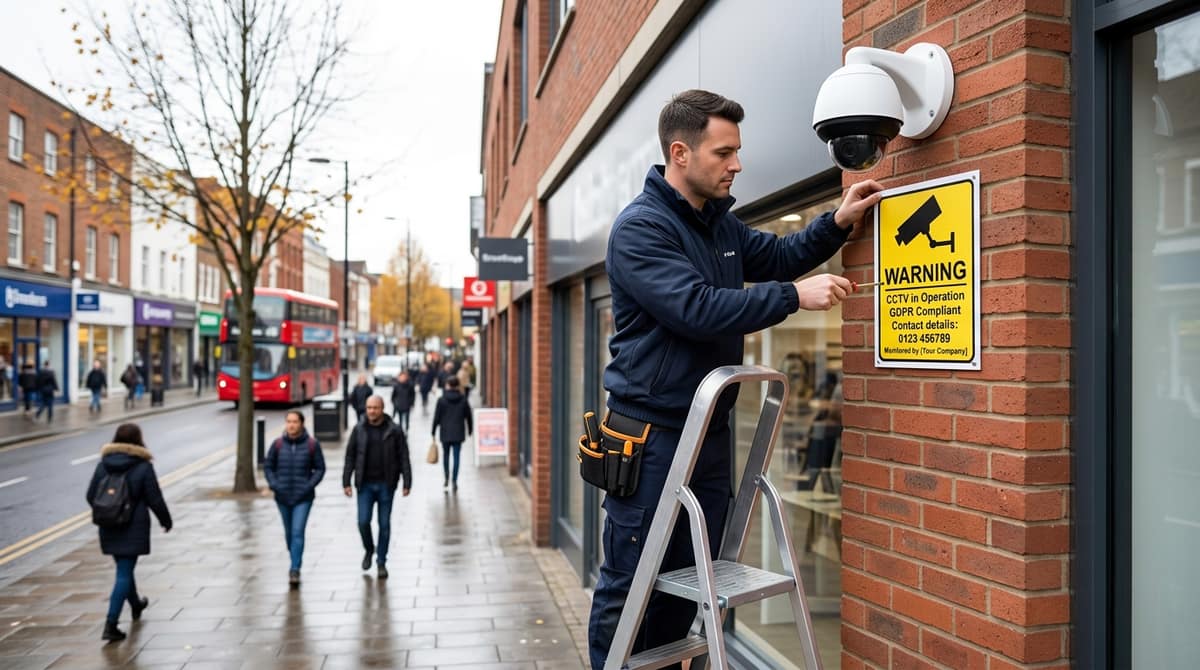
There is no single legally mandated CCTV sticker in the UK, but if your cameras capture identifiable people beyond purely household use, UK GDPR and the Data Protection Act 2018 require you to tell them, and clearly visible signs are the normal way to do it. GOV.UK says businesses must let people know they may be recorded, "usually by displaying signs", so a camera without one is hard to defend.
The ICO says its CCTV guidance is under review following the Data (Use and Access) Act, so check its current page before you finalise your signage.
What are the CCTV signage requirements in the UK?
UK data protection law requires you to tell people they may be recorded, and clearly visible, readable signs are the route GOV.UK points to.
Under UK GDPR and the Data Protection Act 2018, the underlying duty is transparency. GOV.UK says businesses must tell people they may be recorded, "usually by displaying signs", and that those signs must be clearly visible and readable.
Are CCTV signs compulsory?
The legal duty is to inform people, and no named statutory sticker exists. A sign is simply the practical way to meet that duty, so a business should treat one as essential. A cheap CCTV sign is fine if it carries the right content, and what it says matters more than what it cost.
A good sign tells people:
- that recording is taking place
- who is responsible for the system
- why the cameras are there
- who to contact with questions
Domestic setups are different. GOV.UK says data protection rules do not apply to a camera on your own home used for household purposes, such as protecting it from burglary. The ICO's home CCTV guidance covers fixed cameras and smart doorbells, and it is currently under review following the Data (Use and Access) Act.
Audio changes the wording
If your cameras record sound, the ICO says you must make that clear to people. It also stresses that a camera being able to record audio does not mean you should use it, and audio is hard to justify.
This is a UK guide. Ireland and NZ have their own regulators and rules, so anyone searching for CCTV signage requirements in Ireland should check their national regulator's guidance.
Do you need a CCTV sign at home?
No, not if your cameras only cover your own property; once they capture neighbours, the street or shared areas, data protection law applies and signs follow. GOV.UK says data protection rules do not apply to a camera on your own home for household purposes, such as protecting it from burglary. The ICO's home CCTV guidance says the law does apply once footage takes in someone else's property or a public or communal space. That covers fixed cameras and smart doorbells alike. The ICO page also notes the guidance is under review after the Data (Use and Access) Act, so check it again before you rely on it.
A simple decision rule
- View stays inside your boundary: a sign is optional, though it still works as a visible deterrent. Cheap CCTV signs are fine here.
- View reaches the pavement, a neighbour's garden or a shared drive: treat yourself like a small organisation and put up clear signs at the points where people enter the covered area.
Before you buy
Sketch your plot and draw each camera's field of view on it. If a cone spills past the boundary, re-aim the camera or use privacy masking on that zone, if the model supports it.
I can't point to a fixed sign wording or a set penalty for a purely domestic setup in the ICO or GOV.UK pages, so be wary of anyone quoting one.
Where should CCTV signs go?
Put signs at each monitored zone's entry point, where people will see them before entering a camera's field of view. A camera schedule listing each zone and its entry point helps ensure no gaps are missed.
Put a sign where people will see it before they enter a camera's field of view, and give each camera zone its own sign. That is best-practice guidance, not a fixed rule. GOV.UK and the ICO set the principle (signs must be clearly visible and readable) but don't dictate exact positions.
Build a camera schedule
Before ordering signs, list every camera on one row. Each row gets a zone, the entry point where someone first becomes visible, and the sign needed there. The example below is illustrative:
| Camera |
Zone covered |
Entry point |
Sign needed |
| 1 |
Car park |
Vehicle entrance |
Large, readable from a car |
| 2 |
Main door |
Front approach |
At the door, eye level |
| 3 |
Reception |
Inside the door |
Indoor sign |
| 4 |
Rear yard |
Side gate |
Gate or wall sign |
Cover the usual points: car park entrances, the main door, reception, internal areas with cameras, and side or rear access. A camera at a rear gate with no sign is the gap that schedules catch.
Check legibility after dark
Visit at night with the lighting as it will be. If you can't read the sign from where a person first enters the camera's view, move it or light it. Check viewing distance too, as a sign that reads fine at a door may be unreadable from a car.
Size
Suppliers commonly recommend A4 indoors and A3 outdoors. That is trade convention, not law. Go larger where drivers need to read the sign at a vehicle entrance. Your own electrician or installer can fix the signs and any lighting; check the sign's own instructions for mounting.
What should a CCTV sign say, and what must sit behind it?
A CCTV sign should name who operates the system, say why it records (crime prevention, for example) and give a contact point, backed by written justification.
A sign cannot make an unjustified system lawful. It tells people what is happening, while your records show you were entitled to do it.
The ICO's "things you need to do" steps set out what should sit behind the sign:
- Consider the privacy impact. Keep cameras out of toilets and changing rooms, where the ICO says filming would not usually be fair or proportionate. Exceptional cases, such as repeated serious antisocial behaviour, need strong justification and clear notice that people are being filmed there.
- Consider audio carefully. A camera being able to record sound is not a reason to use it. If you do record audio, people must be told, and the ICO suggests switching it on only in specific circumstances, for instance when staff press a button.
- Document your decision. Record the purpose, the areas covered and the retention period.
- Carry out a DPIA if the use is likely to be high risk.
- Be able to retrieve footage and redact third parties. Anyone can ask to see images of themselves, and GOV.UK says you must usually provide them free of charge within 1 calendar month.
A cheap sign with the right wording and a one-page decision record beats an expensive sign with nothing behind it.
What happens if CCTV signs are missing or wrong, and how do you check before handover?
Missing or wrong signs can lead to an ICO complaint and investigation. Before handover, verify signage matches each camera zone, test the access-request process, photograph signs at night, and keep documentation of purpose, retention, and any audio recording.
Missing or wrong signs can lead to a complaint to the ICO, which can investigate and take enforcement action, and staff can complain if CCTV is used unfairly. I won't quote a fine figure because none is sourced here. The practical risk is an investigation where nothing was written down.
Pre-handover checklist
Work through these in order and keep the evidence with the handover pack:
- Purpose written down. The ICO's guidance asks for a document covering why you need CCTV, which areas it covers and how long footage is kept.
- Camera schedule matched to signs. Each camera's field of view should have a sign a person meets before entering it.
- Audio decision recorded. If microphones are live, the signs must say so. If they are disabled, record that.
- Retention set. Check the recorder's overwrite period matches the written document.
- DPIA screened. The ICO says a Data Protection Impact Assessment is needed where use is likely to be high risk.
- ICO fee checked. GOV.UK says you can register and pay online.
- Access-request process tested. Per GOV.UK, you usually must provide footage free within 1 calendar month, so run a dummy request through.
- Signage photographed at night. Check the wording and contact details are readable by torchlight or street light.
Cheap signs
Searching for cheap CCTV signs is fine, but specify content and durability rather than chasing the lowest price. That means outdoor-rated material, legible text and a working contact. A cheap sign that fades or omits the contact fails the same check as no sign.
Installer and buyer note
Itemise signs and compliance work as separate lines in any quote, so nothing gets quietly dropped to hit a price. CCTV Master sells the equipment but does not fit it, so your own installer should sign off this checklist. You can shop at cctvmaster.co.uk or ask about trade pricing.
Related products from our own range: