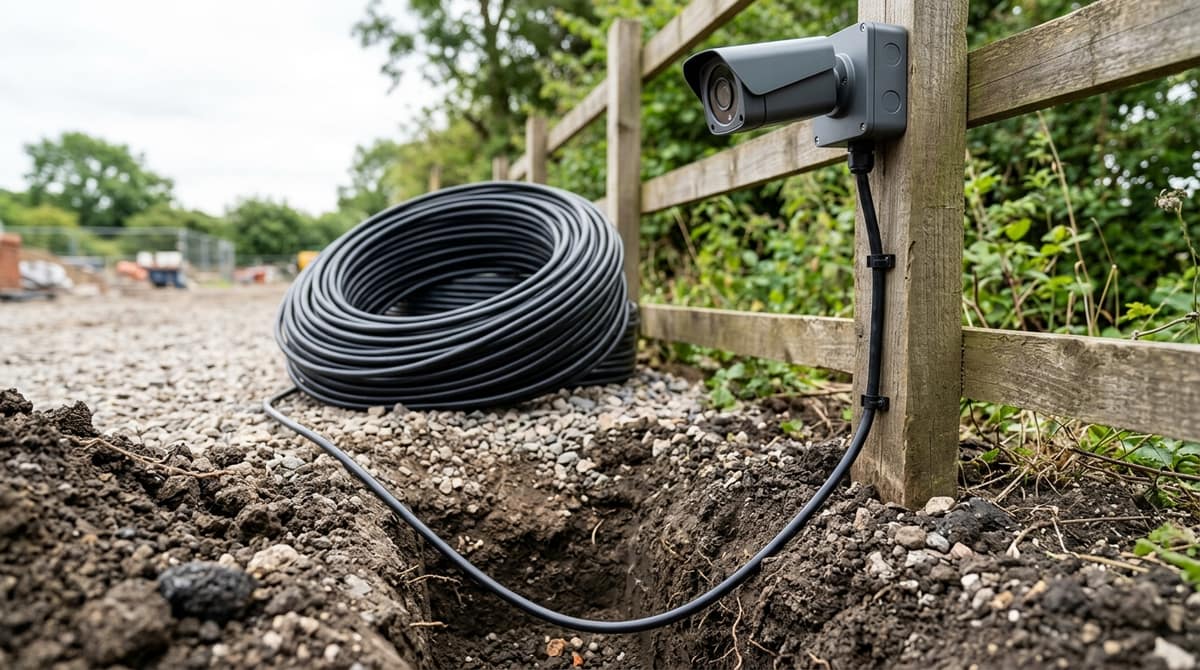
Yes, Cat6 can go outside, but only if it is an external-grade cable made for the job. Many are PE (polyethylene) jacketed, like the solid copper PE reels in our range. An ordinary indoor LSZH or PVC patch cable is not automatically suitable outdoors, and the jacket material alone does not settle whether a particular cable is outdoor-rated.
Burial is a separate question from outdoor use, and an "outdoor" listing may not cover it. Check the datasheet for direct-burial wording before the cable goes in the ground.
Once you've confirmed the cable is rated for outdoor use, the remaining choice is between Cat6 and Cat6a. That depends on run length, interference and how much headroom your CCTV system needs.
Can Cat6 cable go outside, and what does "outdoor rated" actually mean?
Standard indoor LSZH or PVC patch cable is not built to take sunlight and moisture, so outdoor runs need external-grade Cat6, which usually has a polyethylene (PE) sheath. Our Cat6 Outdoor Network Cable 305m is a Connectix U/UTP cable with solid copper conductors and a PE sheath, listed for Gigabit CCTV, PoE and structured cabling.
"External grade", "outdoor ethernet cable" and "UV rated network cable" are the phrases people search and sellers use. A PE sheath does not by itself mean the cable is UV-stabilised or fit for burial. Only some datasheets say so, and the wording differs between products. Our RJ45 CAT6 Outdoor Cable 1m listing, for example, states a UV-stabilised PE/LDPE jacket outright.
Burial claims need the same scrutiny. The trueCABLE unshielded outdoor Cat6 page describes a UV-resistant OSP jacket for above-ground use and states it is "not rated for direct burial". By contrast, one retail listing describes its PE-jacketed reel as "suitable for burying underground" without naming any burial standard, so treat that kind of wording as a prompt to check the manufacturer's datasheet, not as a rating.
Check the datasheet for:
- a stated UV-resistance claim, not just "PE"
- an explicit burial or above-ground statement
- solid copper conductors, if the cable will carry PoE and voltage drop calculator
As for how long Cat6 lasts outside, none of the datasheets we hold gives a lifespan figure, so we won't offer one. It depends on the sheath's UV stability and on whether the run is exposed or protected in conduit.
Which outdoor Cat6 is right for your route: wall, conduit, duct or buried?
A UV-resistant outdoor Cat6 suits wall, conduit and duct routes. Only a cable whose datasheet states a burial rating belongs directly in soil, and duct is the safer default for CCTV.
Choosing by route
- Clipped to an external wall: choose a cable sold as UV-resistant outdoor Cat6 with a PE jacket, since sunlight is a key exposure.
- In conduit: the same PE outdoor cable works, and the conduit adds mechanical protection on top of the jacket.
- In underground duct: use outdoor cable again, with the duct doing the protecting. A duct also lets you pull a replacement through later without digging.
- Direct in the ground: the jacket must be explicitly burial-rated. That is a manufacturer-specific spec, so check the datasheet for the exact cable you buy.
Why the datasheet decides burial
Jacket material alone does not tell you a cable can go directly in soil. Burial ratings vary from one cable to the next, so look for an explicit direct-burial statement from the manufacturer. If the datasheet does not give one, treat the cable as suitable for wall, conduit or duct only.
The practical default
As general installer guidance, even where a jacket permits burial, put it in duct or conduit for a camera run. A cable in duct can be pulled out and replaced without re-digging the trench.
For long or multi-camera runs, the Cat6 Outdoor Network Cable 305m is a solid copper, PE-sheathed reel rated for Gigabit and PoE CCTV use. If you want a cable sold specifically as duct grade, the Cat6A F/FTD Duct Grade Outdoor Cable – 10Gbps is a shielded Cat6A option for underground and external installations, rated for 10Gbps up to 100m and PoE compatible. We sell the cable but do not fit it, so your own electrician or installer terminates it. Check the product's datasheet or installation guide before choosing burial.
For many IP camera runs, solid-copper Cat6 is enough. It covers Gigabit and PoE, and Cat6a earns its extra cost mainly where you want shielded cable or 10Gbps backbone links.
|
Connectix Cat6 outdoor |
Cat6A F/FTD duct grade |
| Construction |
U/UTP, unshielded, solid copper, PE sheath |
F/FTD, shielded, duct-grade sheath |
| Speed listed |
Gigabit-rated |
10Gbps up to 100m |
| PoE |
Suits PoE and CCTV |
PoE compatible |
The Cat6 line is the Connectix Cat6 outdoor 305m reel, a reel for longer camera runs. The Cat6A comparison is the Cat6A F/FTD Duct Grade Outdoor Cable – 10Gbps. We also list the Connectix TruLAN Cat6A F/FTP outdoor cable, which has foil-shielded twisted pairs and a heavy-duty PE sheath. The table comes from the product listings, so check each datasheet for the jacket rating before burying or exposing the cable.
Trade-offs (general guidance)
- Shielding adds work. Shielded cable can need shielded connectors and correct earthing, and it may be slower to terminate than unshielded. Check the datasheet for the earthing method.
- Cameras rarely need more than Gigabit. IP cameras connect at 100Mbps or 1Gbps, so 10Gbps only helps on switch-to-switch or NVR uplinks. Cat6a makes more sense where a switch-to-switch or NVR uplink could use the headroom.
- Read datasheets like-for-like. Compare shielding, conductor material (solid copper or not), jacket material and outer diameter. Our Cat6 listings state solid copper conductors and a PE sheath.
For the category ladder, AWG and solid versus stranded conductors in more depth, see our Cat6 Ethernet cable spec guide for CCTV.
Working out cost per metre
Compare the live prices on each product page. Work out cost per metre as reel price divided by reel length, so reels of different sizes are judged on the same basis.
For reference, the Excel Cat6 Cable 305m Outdoor, Solid Copper PE Sheath is £106.26 inc. VAT.
Solid copper vs CCA, and how to buy by length: 100 ft, 100m or 305m
Buy solid copper for anything carrying PoE; copper-clad aluminium (CCA) is a budget compromise, not an equal swap. This is installer guidance rather than a test result, as we hold no measured data comparing the two conductor types. CCA has higher DC resistance than solid copper of the same gauge, which matters most on long PoE runs.
Whichever reel you choose, check that the product page states solid copper conductors before buying it for PoE cameras. Our Connectix 305m reel is solid copper with a PE sheath and is listed as gigabit-rated for CCTV, PoE and structured cabling. Check its product page for the current price.
The Excel Cat6 305m outdoor cable box is also solid copper with a PE sheath and suits CCTV cameras and PoE. It is listed at £106.26 inc. VAT.
Converting lengths
- 100 ft is about 30.5m, so a single short camera run often needs no more than that.
- 100m is roughly 328 ft.
- 305m is 1000 ft, the length behind most "1000 ft" listings.
Choosing a length
A full 305m reel covers several camera runs from one purchase, and you cut each run to fit. A shorter reel is easier to justify for one or two cameras.
For a very short hop, such as a camera near the switch, a pre-made lead saves you crimping. Confirm the lead is rated for outdoor use on its datasheet before you rely on it outside.
How do I terminate and protect outdoor Cat6 so it actually lasts?
Keep every termination inside a weatherproof enclosure or junction, because the connection is the part of an outdoor run least able to cope with the weather. The jacket is built to face UV and rain. A bare RJ45 plug or a badly sealed joint is not.
Crimping outdoor Cat6
Many outdoor Cat6 cables use solid copper conductors, and that changes which plug you buy. Solid cable needs an RJ45 plug rated for solid conductors of the right gauge (often 23AWG on outdoor Cat6), because plugs made for stranded patch cable can seat poorly on it.
- Check the jacket diameter against the connector spec. Outdoor jackets are thicker than indoor ones. trueCABLE's connector-compatibility notes give an overall jacket diameter of 6.30mm for its unshielded outdoor cable and 7.10mm for its unshielded direct burial cable, while our RJ45 CAT6 outdoor reel lists 6.0-6.5mm. Diameter varies between makes, so measure your own reel.
- Keep untwisting to a minimum. Strip only as much jacket as the plug needs and leave the pairs twisted right up to the point where they enter the contacts.
- Protect the finished plug. Mount the connection in an enclosure or junction, and check that enclosure's IP rating on its datasheet.
A cable to terminate
Our RJ45 CAT6 U/UTP outdoor cable is sold by the metre from a reel rather than as a finished lead, so the ends are terminated on site. Its listing gives 23AWG solid copper conductors, a UV-stabilised PE/LDPE jacket and suitability for PoE to IEEE 802.3bt (the standard often called PoE++). It suits an IP camera run, and your own electrician or installer can crimp it following the datasheet.
UV resistance is not crush resistance. If the cable is buried or exposed to knocks, run it in conduit.