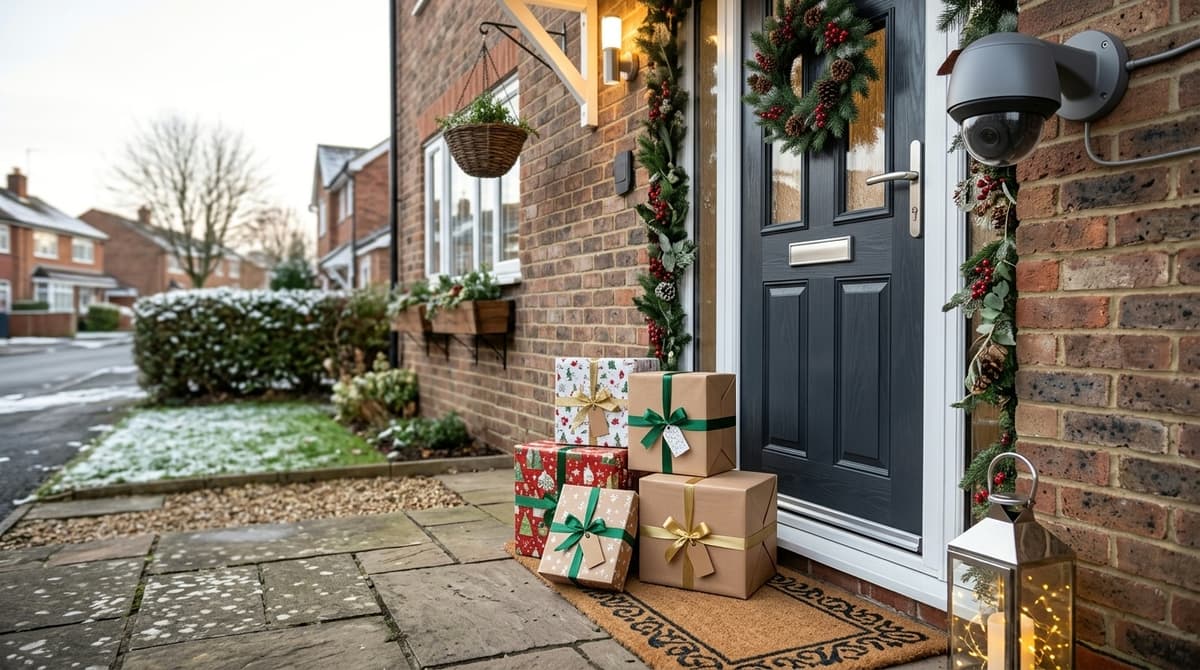
CCTV helps with Christmas parcel theft only when the footage shows who took the parcel, which way they came and left, and exactly when. A clip of a hooded figure at the door proves it happened, but it rarely identifies anyone. With BBC News reporting more than £660m of parcels stolen in the past year, citing FOI data, it's worth getting this right before the peak delivery weeks. The difference usually comes down to camera angle, porch glare, an accurate clock and keeping recordings long enough to hand over, and this guide covers each of them.
Usable footage shows who took the parcel, which direction they came from and when; a hooded figure at the door only proves a theft happened. To identify a person, the camera needs a clear view of the face and approach route, a correct clock and a recording that survives the incident.
BBC News reports an expected £34bn of online Christmas spending and more than £660m of parcels stolen in the past year, citing FOI data. The Guardian puts the figure at £666.5m, so the two differ slightly.
- A neighbour's doorbell clip helped a customer secure a full refund after a parcel went missing, according to BBC News.
- In Cardiff, BBC News covered parcel thieves with a trolley caught on camera. That is evidence of a failed delivery, not just a theft.
Where evidence usually fails
Footage fails when the camera is mounted too high or too far back to catch faces, or when the clock is wrong, which makes the "when" unprovable. It also fails when the recorder sits where a thief can reach it. A locked steel enclosure such as the 180×180mm DVR lock box, priced at £65.89 including VAT, keeps the recording device out of casual reach.
Check the clock after any power cut, and export the clip promptly so the original recording is kept intact.
Most failures come from placement and settings, not the camera itself: a dim porch, glare, the wrong aim, an untested night mode, or an exposed recorder. The points below are installer guidance, and your own electrician or accredited installer should apply them on site.
Dark porch
A dim porch gives you a silhouette rather than a face. Add a steady light source that stays on through the evening, and don't rely on the camera's night mode alone to make up the difference.
Glare from porch lights
A bright lamp inside the frame can wash out the person standing under it. Move the camera or the light so the lamp isn't pointing at the lens, and switch on the camera's backlight compensation or WDR setting if it has one. Check the datasheet for that feature rather than assuming it's there.
Camera aimed at the door, not the approach path
A thief's face is visible on the way in, not at the letterbox, where they are usually looking down at the parcel. Angle the view so it covers the path or gate as well as the doorstep. Our night vision post covers IR versus ColorVu, so that comparison isn't repeated here.
Night mode never tested
Check that the night mode actually switches on, and that it produces a usable image at the distance where someone stands. Walk the approach after dark, then play back the recording rather than the live view. Recorded footage is what you will hand to the police.
Recorder left in reach
Good footage is worthless if the recorder walks out with the thief. Keep it out of sight, and consider a steel enclosure such as the 15×15 DVR lock box.
Where should the three cameras go: drop point, approach path and collection counter?
Give each camera one job: a tight view of the drop point, a wide view of the approach path, and a view of the shop's collection counter. A home may need only the first two.
- Drop point: Frame the step, porch or locker tightly enough to show the parcel, the person and the moment of pickup. Include the courier as well as the thief. That is the record a "delivered" dispute needs.
- Approach path: Aim a wider angle toward the gate or pavement so faces arrive head-on rather than from above or behind. Covering a public area also captures passers-by, which can bring UK GDPR and the ICO's CCTV guidance into play, so keep the field of view no wider than needed and put up signage.
- Shop collection counter: Cover the handover point so the customer's face and the parcel are both in frame. Add the shelving or back-room door where uncollected parcels sit. Keep the recorder out of reach too; a steel enclosure such as the CCTV DVR Lock Box 15×15 Steel Security Enclosure is £53.47.
A doorbell camera is a useful extra. A customer secured a refund after parcel theft was caught on camera, per BBC News. But it sits at the door and sees only a short distance, so it can't replace the approach-path view.
Cameras are evidence tools. They may deter an opportunist, but they won't stop a parcel being lifted or guarantee its recovery.
Keep footage for at least as long as the gap between a delivery and the moment you notice the parcel is missing, plus a margin for holidays. In the Cardiff case, BBC News reported that a resident checked her own security camera and saw a thief take her parcel and put it in a trolley already filled with others, so the evidence only mattered once the loss was reported.
Storage needed = bitrate × recording seconds × number of cameras (convert bits to bytes by dividing by 8). Compare that with the retention your NVR's storage menu reports for your actual disk and settings. Recording on motion or events, rather than continuously, can stretch capacity. This is general guidance, as real bitrates vary with resolution, codec and scene.
Keep the clocks honest
- Enable NTP, or set the time manually, on the NVR and on every camera.
- Before December, compare the recorder's clock with a phone clock and record the difference.
- Write that offset on any export you hand over, so the courier's scan time and your footage can be matched.
Protect the evidence store
A stolen recorder takes the footage with it. A steel enclosure in a comms cupboard or equipment room makes casual removal harder, though it won't stop a determined thief with tools. We list the CCTV DVR Lock Box 15×15 Steel Security Enclosure at £53.47 and the larger CCTV DVR Security Lock Box 180×180mm Metal at £65.89. Check your recorder's dimensions and cable routing against the product page before ordering.
What should you do when a parcel goes missing, and what are the legal duties?
Check the tracking, review footage for the delivery window, export it unaltered, then report the loss to the retailer or courier and the police.
Tracking is also the cheapest prevention step. Nottinghamshire Police advise following your parcels so someone is home when they arrive.
Preserve the evidence first
- Confirm the window. Use the tracking timestamp or the courier's "delivered" photo, if one exists, and add a margin either side.
- Export the original. Save the clip in the recorder's native format, which keeps the metadata and any player the recorder embeds. Then make a second, standard-video copy for people who can't open the native file.
- Note the clock offset. Compare the recorder's on-screen time with a phone or the tracking time, and write down the difference. A clock that has drifted can make good footage look unreliable.
- Don't edit or crop. Keep the untouched files, and do any trimming or stills on copies.
Back up the export to a second device. If your recorder is within easy reach, a steel enclosure such as the 15×15 DVR lock box at £53.47 (inc. VAT) stops the evidence being tampered with or taken.
Who to report to
Tell the retailer or courier first, because refunds usually run through them, and attach the clip. Then report to the police, quoting the date, the time and the clock offset. The Met said, as BBC News reported in December 2025, that more operations against parcel theft were planned before Christmas.
The legal side
Shops and other businesses that run CCTV have UK GDPR duties, including visible signage. Our posts on CCTV Laws for UK Businesses and CCTV Signage Requirements cover those in detail.
A domestic camera is treated differently, but the household exemption may not apply if it captures public space or a neighbour's property. In that case data protection rules can apply, so check your field of view and consider masking areas you don't need. If you're unsure, take advice before sharing footage publicly.