
cctv junction box
CCTV Junction Box Guide 2026: Sizes, IP Ratings & Install
A CCTV junction box is the weatherproof enclosure that protects a cable joint, such as an extended coax or power run, or a join to a camera's pre-terminated…
On this page
- What is a CCTV junction box, and when do you actually need one?
- Can you use a gang box?
- How big should the junction box be?
- Sizes we stock
- Which IP rating should a waterproof CCTV junction box have?
- Plastic or aluminium
- How do cable entries, glands and drip loops work?
- Glands, grommets and knockouts
- Bend radius and connectors
- Pre-terminated tails
- How do you install a junction box and keep mains and low voltage apart?
A CCTV junction box is the weatherproof enclosure that protects a cable joint, such as an extended coax or power run, or a join to a camera's pre-terminated tail, wherever that joint has to sit outdoors or on a surface. Choose one big enough for the terminations plus a sensible bend radius, rated IP65 at the very least for outside use. Keep mains and low-voltage connections in separate compartments or separate enclosures. If you can run the cable unbroken, you may not need a box at all.
What is a CCTV junction box, and when do you actually need one?
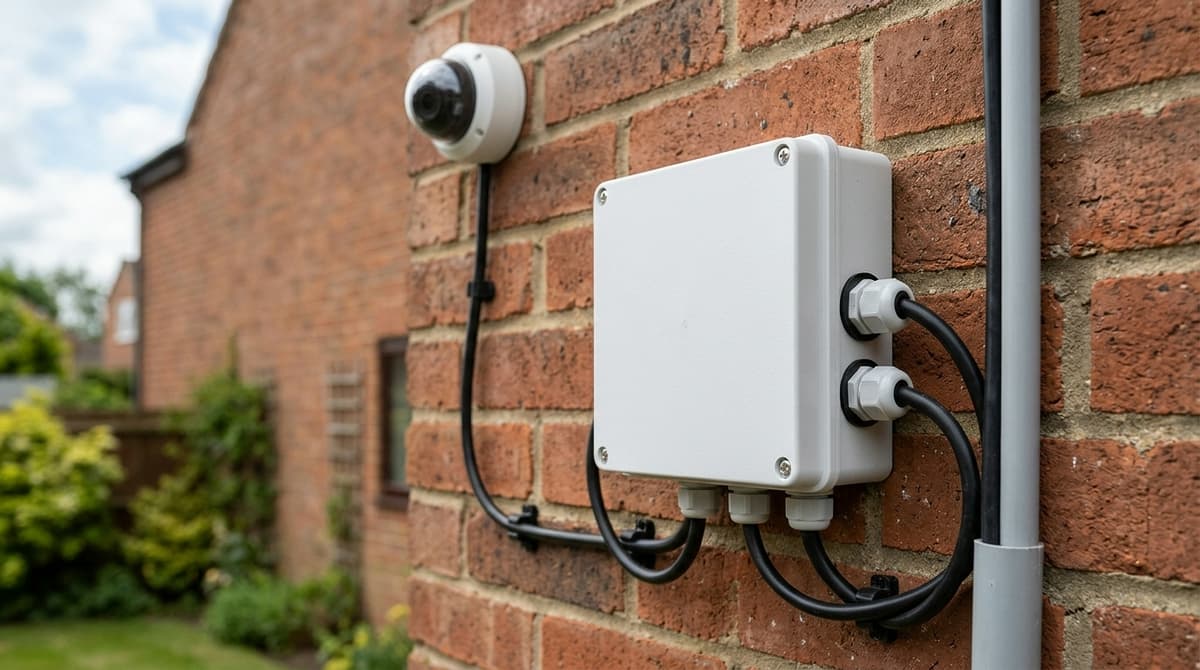
A CCTV junction box is a small enclosure that protects and conceals a cable joint at the camera, and you need one only when a joint can't be avoided. It is neither the larger equipment housing covered in the Cabinet article nor the cable containment covered in the Trunking article.
A box is justified in three situations:
- Extending a coax or power run that falls short of the camera.
- Joining your cable to a camera's pre-terminated tail.
- Hiding the connectors behind a camera fixed to a solid surface such as brick or render.
For the last case, our Universal CCTV Junction Box 120×50mm White is a plastic box for indoor and outdoor use, priced at £3.39 including VAT. Metal options exist too: the Hikvision DS-1280ZJ-XS-Y is an aluminium alloy junction box.
Avoid burying a joint in a wall or leaving it bare to the weather. Where you can, run the cable unbroken from recorder to camera, and check the Cat6 spec article for run-length limits before assuming you need to extend.
Can you use a gang box?
Usually not. A gang or back box is built to hold wiring accessories, not to seal a cable joint, so it isn't a weatherproof enclosure unless its IP rating and lid seal are suitable for the exposure. The same goes for a plain 100x100x70 electrical box. Read the rating on the box itself rather than assuming it.
How big should the junction box be?
Pick a box with room for every termination, the bend of your thickest cable, and enough spare space that the lid closes freely. This is general installer guidance rather than a manufacturer rule, and it works in three steps:
- Count the terminations the box must hold: connectors, joints and any spare loop you want to keep.
- Add the bend radius of the thickest cable, since a stiff cable that can't curve gently pushes against the lid or the seal.
- Add a margin on top, because cramming everything in makes a lid that won't seat properly.
A box that is "just big enough" on paper rarely closes cleanly on site, so don't size to the exact fit.
Sizes we stock
- Compact aluminium: our 105×105×50 mm aluminium alloy box (SKU MOUNT-AL-105X50-WHITE) suits a single camera joint. If you are hunting for a 100x100x70 box, note that this one is a similar footprint but only 50 mm deep.
- Universal plastic: our universal plastic junction box is approximately 120mm diameter × 50mm height, with multiple knockouts and "sufficient internal space to store cable connectors". It costs £3.39 including VAT, shown live on the page.
- Large enclosure: our 300×400×160 mm metal enclosure (SKU IPBOX-METAL-300X400X160) is meant for power supplies and accessories, not a single camera joint.
If you are weighing several connectors in one box, the 50 mm depth of the first two is the figure to check against your cable.
Which IP rating should a waterproof CCTV junction box have?
Choose IP65 as the minimum outdoors, and step up to IP66 or IP67 where the box is exposed to driving rain or sits near ground level. As general guidance under BS EN 60529, the first digit covers dust and the second covers water. A 6 means dust-tight. Going from 5 to 6 moves from water jets to powerful jets, and a 7 adds temporary immersion, which matters at ground level where water can pool.
Three datasheets show how makers describe this:
- The CCTVCameraPros VT-J302 is a 139mm round aluminium box listed as IP66 weatherproof.
- The TP-Link VJB-300 ships with waterproof accessories, but it isn't compatible with every VIGI camera, so check its compatibility list first.
- The Annke JXH001 is aluminium alloy and weighs 515 g.
Our own listings don't state an IP rating, so check the product page or datasheet before relying on one. The Universal CCTV Junction Box 120×50mm is plastic and priced at £3.39. We also list a 105 × 105 × 50 mm aluminium alloy box, and the same check applies.
Plastic or aluminium
Plastic is light and cheap, which suits sheltered walls and soffits. Aluminium costs more and weighs more, but it's tougher against knocks and sunlight. Either way, the rating only holds if the seals are seated and cable entries are closed properly, so follow the datasheet when your installer fits it.
How do cable entries, glands and drip loops work?
Enter from the bottom or side through a gland sized to the cable, and leave a drip loop so water runs off before it reaches the hole.
A top entry lets rain run straight down the cable and pool at the opening, so avoid it. For the drip loop, let the cable hang in a shallow U below the entry before it rises into the gland. Water tracking along the sheath then drips from the bottom of the curve instead of going inside.
Glands, grommets and knockouts
Match the gland or grommet to the cable's outer diameter, measured rather than guessed. The Universal CCTV Junction Box 120×50mm White has knockouts for network, power and video cables. Open only the ones you need and fit a gland or grommet to each. A knocked-out hole with no gland, or with a cable simply pushed through, downgrades the box's weatherproofing. We don't claim a rating for the box, so don't assume it keeps any protection at an unsealed entry.
Mains-side wiring should be done by your own electrician. We sell the kit and don't fit it.
Bend radius and connectors
Follow the cable maker's minimum bend radius, and don't force a tight turn just to close the lid. Don't let a gland clamp the connector body or let the plug press against the lid or wall. For PoE and Cat6 runs, see our PoE Switch and Cat6 articles rather than relying on anything repeated here.
Pre-terminated tails
If the camera has a pre-terminated tail, the connector must fit inside the box with room to bend. If it doesn't, choose a deeper box. A sealed joint inside an enclosure is better than an exposed one hanging on the wall.
How do you install a junction box and keep mains and low voltage apart?
Fix the box, fit the glands, make and test the joints, then seal it, with mains and low voltage in separate boxes or compartments. CCTV Master sells the equipment, so the fitting is done by your own electrician or installer, working from the product's datasheet or installation guide.
General installer practice runs in this order:
- Position and fixings. Pick a spot with a sound, flat surface and check the fixings suit the wall. The Camera Bracket Fitting Guide covers surface checks and fixings.
- Entries. Drill one entry per cable and fit a gland to each, ideally low on the box so water cannot track in.
- Cables. Pass each cable through its gland and leave enough slack to make the joints without strain.
- Joints. Make the connections, then test continuity and polarity before closing up. Keep low-voltage joints (camera, PoE or 12V DC) in a different box or compartment from any 230V joints.
- Seal and check. Seat the gasket, fit the lid, blank off unused entries and look over every gland. The enclosure's IP rating is on its datasheet.
Where mains is present, use an enclosure rated for 230V. This is general guidance under BS 7671, not a rule specific to CCTV. Any mains work should be done by a competent electrician.
For low-voltage-only joints, a compact plastic box such as the Universal CCTV Junction Box 120×50mm White is listed at £3.39 including VAT.
If the camera views anywhere beyond your own property, the ICO's CCTV guidance on UK GDPR and signage may apply. Check it before the system goes live.
This article was researched and written by CodeNest.
