Opening (2-4 sentences)
Most UK small business owners pick a CCTV system by camera count or price and end up with footage they can't access on their phone, storage that fills in weeks, or a system they can't expand without ripping out cables. The real choice isn't between cameras—it's between three architectures: hybrid DVR systems that work with your existing wiring, PoE NVR setups for new builds and offices, and wireless kits for rental spaces where you can't drill. We've tested and compared the top 2026 options across retail, salons, takeaways, and warehouses to show you which system actually scales with your business and keeps costs down in year two.
What actually matters when choosing best small business CCTV system UK
The three decisions that separate a working system from expensive dead footage are where your cameras send data (wired PoE, wireless, or hybrid), what light levels your site demands (lux rating and sensor size), and how long you need to keep footage (storage maths against your premises' size and camera count).
1. Architecture first — wired PoE, wireless, or hybrid
Most small business buyers pick a camera model before deciding how data flows, and end up with a system that either can't scale or costs three times more to install than it should.
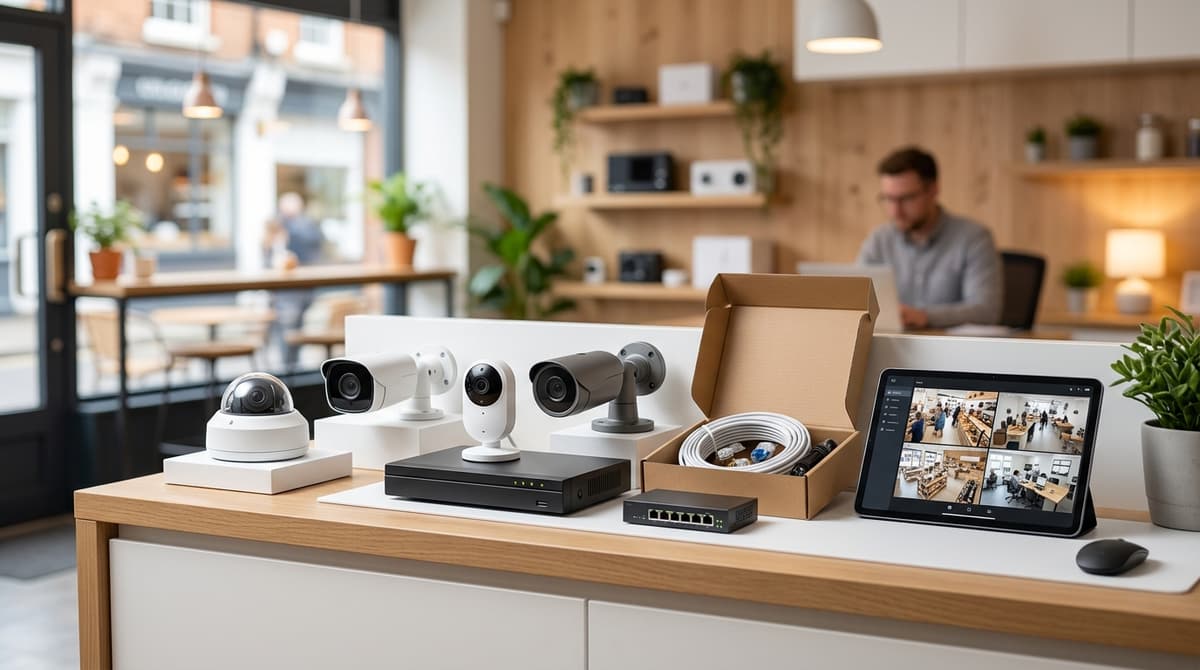
Wired PoE (Power over Ethernet) is the default for fixed retail, offices and warehouses because a single Cat6 cable carries both power and video from the recorder to each camera — no separate power runs, no batteries to replace, and no WiFi congestion. A hybrid DVR like the ANNKE DT81DX 8-Channel 4K Hybrid DVR with AI Detection supports up to 8 PoE cameras plus 4 additional IP cameras over your network, so you can start with a few wired cameras and add wireless or network cameras later without replacing the recorder.
Wireless systems suit temporary deployments or rented premises where running cables isn't an option — but they demand robust WiFi (5 GHz, not 2.4 GHz), battery management, and higher monthly cloud storage costs. Hybrid recorders split the difference: they accept PoE cameras, wireless cameras, and standard IP cameras on the same unit, letting you use wired cameras for permanent coverage (car parks, loading bays) and wireless for temporary or flexible monitoring (stock rooms, temporary sites). This flexibility is why hybrid DVRs dominate small business installs in the UK.
2. Light sensitivity: lux, sensor size, and what you'll actually see
A camera's ability to capture usable footage at night depends on three linked specs: sensor size (1/2.8″ or 1/1.8″ for small business, larger is better), minimum illumination (lux), and whether it has infrared or requires ambient light.
Most small business sites have mixed lighting — bright near the till, dim in stock areas, dark outside at night. A 2MP or 4MP camera rated at 0.1 lux with a 1/2.8″ sensor will struggle in a completely dark car park; the same resolution with a 1/1.8″ sensor and built-in infrared will capture number plates and faces. If your premises has poor exterior lighting, infrared (IR) is non-negotiable — it costs £30–£80 more per camera but delivers the difference between identifying a person and just seeing a silhouette.
For small retail or office spaces with reasonable ambient light, a standard 4MP camera at 0.05–0.1 lux is sufficient. For dark areas (warehouses, loading bays, unlit car parks), specify IR or a larger sensor and test it on-site before committing to the full install.
3. Storage and retention: the maths that stops you running out of space
This is where most small business systems fail operationally. A single 4MP camera recording 24/7 at 25 fps generates roughly 500 GB per month; eight cameras fill a 4 TB hard drive in a week. Your recorder's storage must match both your premises size and your retention requirement — which depends on your business type and UK GDPR compliance obligations.
If you're running a retail shop, you typically need 7–14 days of footage for incident review and staff disputes; a warehouse or high-value stock area may need 30 days. Calculate this before buying: 8 × 4MP cameras, 24/7 recording, 14-day retention = roughly 4 TB of storage. The ANNKE 8MP 4K 8-Channel Hybrid DVR with H.265+ uses H.265+ compression, which halves file sizes compared to older H.264 codecs, so the same 4 TB hard drive now holds 28 days instead of 14.
Don't rely on cloud storage alone for small business. It's expensive (£10–£30/month per camera for continuous backup), depends on your broadband upload speed, and creates a compliance headache if your ISP goes down. Use local storage (a hybrid DVR with 4–8 TB) as your primary archive, then back up critical footage (incidents, thefts, accidents) to cloud or a USB drive for evidence.
4. UK law and signage: GDPR, ICO code, and placement
You must display visible CCTV signage at every entrance and in any area where people have a reasonable expectation of privacy — toilets, changing rooms, and staff-only spaces are off-limits. The ICO's CCTV code of practice requires you to document your retention period, your lawful basis (e.g., crime prevention, asset protection), and who can access footage; small business relief rates don't apply to CCTV compliance, but your recorder's local storage and access controls do.
Position cameras to cover entry points, tills, and high-value stock — not to monitor staff in detail. If you're claiming small business rates relief on your premises, CCTV doesn't affect your eligibility, but your signage and data-handling must be defensible if challenged. Keep your retention policy simple and written: "7 days for incident review, then delete" is compliant; "keep everything forever just in case" is not.
ANNKE DT81DX 8-Channel 4K Hybrid DVR with AI Detection — best for small retail and hospitality premises needing 4K clarity without rewiring
A hybrid DVR that records up to 8MP 4K resolution and supports both legacy BNC cameras and modern IP cameras, making it ideal for businesses expanding their CCTV without replacing existing infrastructure.
- 8MP 4K recording with H.265+ compression cuts storage demand by roughly 50% compared to H.264, stretching your hard drive budget and retention window — critical when small business relief rates and rates relief for small businesses tighten operational costs.
- Hybrid BNC + IP flexibility means you can migrate gradually: run existing analogue cameras alongside new IP units, avoiding the capital spike that forces many small firms to defer security upgrades.
- AI human and vehicle detection filters false alerts from weather, pets, or passing traffic, reducing the noise that makes staff ignore genuine incidents — a practical win in retail loss prevention.
- 8-channel capacity handles most small shopfronts, cafés, and small offices; the modest footprint suits cramped comms cupboards common in older UK commercial properties.
Trade-off: No built-in PoE power supply — you'll need a separate PoE injector or switch if running IP cameras, adding ~£100–200 to your install bill. For premises with heavy IP camera plans, a dedicated PoE-enabled NVR may cost less in labour and cabling.
ANNKE DT81DX 8-Channel 4K Hybrid DVR with AI Detection
ANNKE 8MP 4K 8-Channel Hybrid DVR with H.265+ — best for mixed-camera small business setups
A flexible 8-channel hybrid recorder that accepts both traditional BNC cameras and IP feeds, making it ideal for small businesses expanding surveillance without replacing existing kit.
- 8MP 4K resolution with H.265+ compression keeps storage lean; the codec typically cuts file size by 50% versus H.264, critical when retention budgets are tight on modest premises.
- Hybrid architecture supports up to 8 BNC + 4 IP cameras, letting you mix older analogue cameras with newer IP units — useful if you're upgrading incrementally rather than ripping out a working system.
- 8-channel design covers most small retail, office, or workshop layouts without oversizing; fewer channels than enterprise boxes, but enough for front entrance, till area, stock room, and perimeter.
- H.265+ encoding reduces bandwidth and storage costs, which matters when you're balancing CCTV spend against other overheads — especially relevant if you're eligible for small business rates relief and need to control capex.
The trade-off: this is a DVR, not an NVR, so BNC cameras still require coaxial runs. If your premises lack existing cabling and you're starting fresh, a pure IP system might cost less to install. Also, the 8-channel limit means larger multi-site operations will outgrow it quickly.
ANNKE 8MP 4K 8-Channel Hybrid DVR with H.265+
8CH 4K Hybrid CCTV DVR – 8MP XVR Recorder — best for mixed camera setups on a tight budget
A flexible 8-channel hybrid recorder that bridges analogue and IP cameras in one box, ideal for small businesses upgrading piecemeal without replacing their entire infrastructure.
- Supports five camera standards (HD-TVI, AHD, CVI, CVBS, and IP) so you can mix older coax runs with newer PoE cameras as your budget allows.
- H.265+ compression cuts storage costs by roughly half compared to H.264, stretching your hard drive retention without buying extra capacity.
- 8MP 4K recording at the recorder level means you're not bottlenecked to 1080p if you choose 4K cameras later.
- 8 BNC + 4 IP camera slots gives you breathing room; most small shops need 4–6 cameras total, so this won't force you to buy a second recorder for years.
- Remote mobile viewing via app lets you check the shop floor from your phone — essential if you're managing multiple locations or working off-site.
The trade-off: this is a DVR, not a pure NVR, so it's tied to analogue or hybrid setups rather than all-IP networks. If your premises is already wired for Ethernet throughout, a dedicated NVR might scale more cleanly. For retrofit jobs or mixed-camera sites, though, this recorder cuts the cost of rewiring.
8CH 4K Hybrid CCTV DVR – 8MP XVR Recorder
Hikvision 4-ch 1080p 1U H.265 DVR — best for compact retail or small office monitoring on a tight budget
A compact 1U rackmount DVR with H.265 compression and deep-learning motion detection, ideal for small businesses needing straightforward 1080p surveillance without overspec'd resolution or sprawling infrastructure costs.
- 4-channel hybrid input accepts HDTVI, AHD, CVI, CVBS (coaxial analogue) and IP cameras, letting you mix legacy kit with newer IP gear during a phased upgrade.
- H.265 Pro+/Pro compression cuts storage demand versus H.264, stretching retention on modest hard drives — critical when budget relief on business rates doesn't stretch to enterprise-grade NAS.
- Motion Detection 2.0 with human/vehicle classification filters false alerts from wind, shadows or passing traffic; the deep-learning engine reduces noise-driven false positives that plague cheaper DVRs.
- 1U form factor fits neatly into a server cabinet or wall-mounted bracket, minimising floor space in cramped retail stockrooms or office comms cupboards.
- Audio via coaxial cable simplifies wiring if you need two-way audio or event recording without running separate mic lines.
Trade-off: At 1080p, this is entry-level; if you need facial recognition or number-plate capture beyond 3–4 metres, a 4MP or 8MP hybrid DVR (like the ANNKE DT81DX 8-Channel 4K Hybrid DVR with AI Detection) will outperform it. Also, 4 channels may feel tight if your shopfront or office has more than three or four key zones.
Hikvision 4-ch 1080p 1U H.265 DVR
Which one should you buy?
Pick a system based on your premises' layout and your retention requirement, not just camera count — most small businesses overspend on cameras and underinvest in storage. The ANNKE DT81DX 8-Channel 4K Hybrid DVR with AI Detection suits retail and hospitality sites where you need flexible mixed-camera support (analogue and IP) and human/vehicle detection without a monthly subscription; an 8-channel hybrid DVR lets you start with 4K IP cameras on key entry points and add older analogue feeds from existing infrastructure. If you're tight on capital and your premises is under 1,500 m², a 4-channel 1080p system with local storage (no cloud dependency) and PoE power keeps wiring simple and avoids subscription creep — the trade-off is lower detail at distance, so reserve it for sites where threats are close-range (till points, stockroom doors, reception).
For a multi-site small business or one with business rates relief pressure, a wired PoE system costs less to run than wireless because it eliminates battery replacement and Wi-Fi bandwidth strain; you'll recoup the installation cost within 18–24 months through lower operating overhead. If your premises has solid walls or you're renting and can't run cables, a hybrid approach — PoE cameras where you can, wireless where you can't — splits the difference, though wireless cameras need mains power anyway, so the "wireless saves wiring" pitch often fails in practice.
Storage is where most buyers go wrong. A 2 TB DVR with H.265+ compression typically holds 7–14 days of 4-channel 1080p footage (depending on motion detection settings); if your insurance or the ICO CCTV Code of Practice requires 30-day retention, you need either a 4–8 TB drive or cloud backup — and that's a monthly cost. Work out your retention maths before you buy: footage size = (resolution × frame rate × number of cameras × compression ratio × retention days) ÷ storage capacity in TB. If you can't do that calculation with your supplier, move on — they don't understand your actual need.