
3 in 6 out wire connector
3 in 6 Out Wire Connector: CCTV Power Splitting Guide 2026
A 3-in-6-out wire connector is a lever-style distribution block that takes three incoming conductors and splits them across six outgoing ones, and it suits a…
On this page
- What does a 3-in-6-out wire connector actually do?
- The splice maths
- Related names
- Where does it fit in a CCTV power run, and what do the ratings limit?
- How much voltage drop can a split add on a 12V camera?
- Levers that actually help
- Why should a connector never sit in a PoE Cat6 run?
- What to use instead
- Connector, terminal junction box or soldered joint: which splice suits which job?
- A lever connector is fine when
- Avoid it for
- Better alternatives
A 3-in-6-out wire connector is a lever-style distribution block that takes three incoming conductors and splits them across six outgoing ones, and it suits a low-voltage CCTV power feed inside an enclosure only if its rated current and voltage cover the combined load. Read those ratings from the datasheet for your exact part, because the listing for our Grey 3-in-6-out Lever Wire Connector SPL-3-6 (£1.22) describes the terminals and tool-free lever but does not state them here. It should never be used in a PoE Cat6 data run, where it has no place in the cable path.
What does a 3-in-6-out wire connector actually do?
It joins conductors without tools: three input terminals each feed outgoing wires through six output terminals. You lift the lever, push in a stripped conductor and press the lever down to clamp it. No screwdriver or crimp tool is needed, and because the lever reopens, the connector can be reused when a circuit changes.
The Grey 3-in-6-out Lever Wire Connector SPL-3-6 is listed for solid, stranded and flexible conductors. It has a flame-retardant insulated housing around metal contacts.
The splice maths
Six outputs across three inputs gives two outgoing conductors per incoming one. That assumes each input has its own pair of outputs, so check the datasheet or installation guide for the internal layout. As general guidance, this suits a live/neutral/earth-style trio, or three unrelated feeds that each fan out to two. Whoever fits it, your own electrician or installer, should size the conductors and decide what shares a way.
The listing describes the part for lighting circuits, junction boxes and distribution wiring rather than anything camera-specific. A "cctv wire connector" or "3 in 6 out electrical connector" is therefore a general-purpose splice, and it should be judged as one.
Related names
The 1-in-4-out, 2-in-4-out and 1-in-5-out connectors people search for follow the same principle with fewer terminals. The rest of the checklist applies unchanged.
We also list the SPL-3-6-3, another grey 3-in-6-out lever splice. The SPL-3-6 is £1.22 incl. VAT and the SPL-3-6-3 is £0.58 incl. VAT.
Where does it fit in a CCTV power run, and what do the ratings limit?
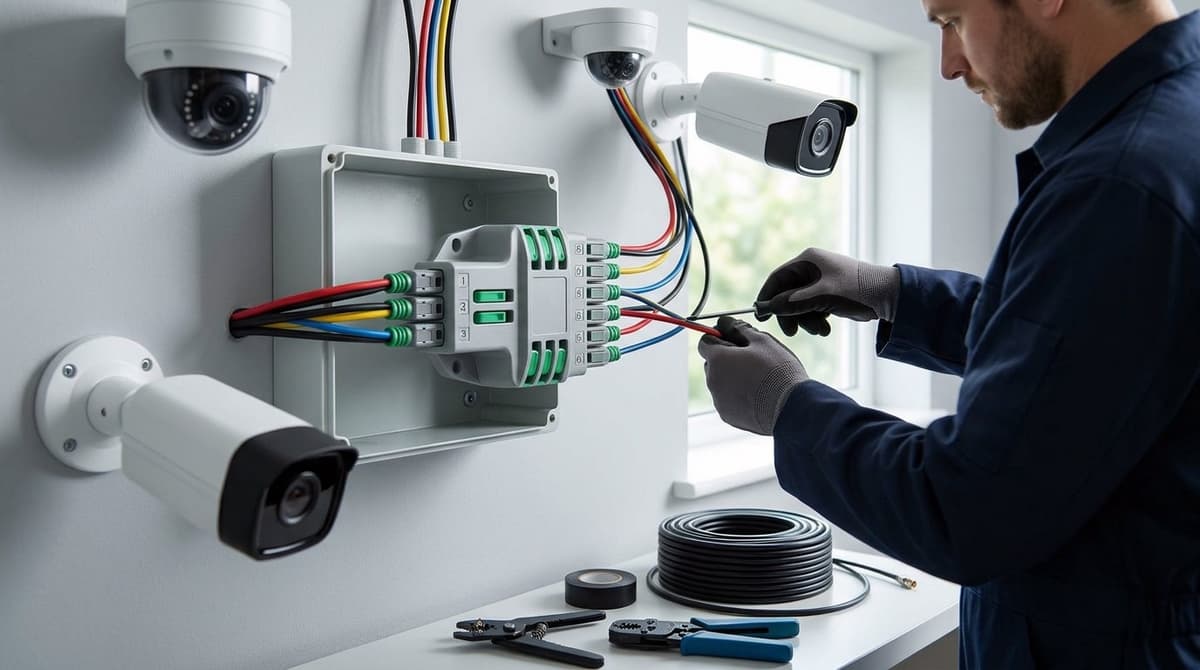
Fit it inside an enclosure or junction box on the 12V DC power side, never in open air or in a video or data path. The same part also suits lighting-style mains distribution, again inside a box. It splits one supply into several legs, so it has no place on BNC coax or network cable.
The ratings then set the limits. Read four items on the label or datasheet: voltage, amps, the conductor range in mm², and whether that range is for solid, stranded or flexible wire. Published parts vary a lot:
- The Synergy 21 listing gives 250V, 32A, rigid 0.08–4 mm², flexible 0.08–2.5 mm², and -40°C to 105°C. Its page text says 3 inputs and 3 outputs despite the 3in-6out title, so use it for the ratings only.
- The VXB 3-in-6-out listing gives 41A and 450V, with a 0.5–6 mm² (10–20 AWG) range and a PA flame-retardant housing.
At 12V, the voltage rating is rarely what limits you. Check the total current of every camera on the connector against the amp rating, then check each conductor against the range. A conductor thinner than 0.5 mm² falls below the VXB stated minimum, and 4 mm² flex would not fit the Synergy 21 flexible limit.
Our Grey 3-in-6-out Lever Wire Connector (SPL-3-6) is £1.22 and described as suitable for solid, stranded and flexible conductors. Confirm its voltage, current and conductor range on the product page or packaging before your installer or electrician specifies it.
How much voltage drop can a split add on a 12V camera?
Every splice and extra metre of cable adds resistance, and a 12V camera feels that loss far more than mains equipment does. The same few tenths of a volt is a much bigger share of 12V than of 230V.
The calculation is the same each time:
voltage drop (V) = camera current (A) × (loop cable resistance (Ω) + contact resistance at each terminal (Ω), summed)
loop cable resistance = 2 × run length (m) × cable resistance per metre (Ω/m)
voltage at camera = supply voltage at source − voltage drop
Three figures need reading from real documents: the camera's current from its datasheet (use the worst-case figure, usually with IR on), the cable's resistance per metre from the cable datasheet, and the supply voltage measured at the source under load. Where several cameras share a trunk, that trunk carries their combined current.
Levers that actually help
- Shorten the branches. Loop resistance scales with length, so cutting a leg helps more than any connector choice.
- Upsize the longest leg. A heavier conductor lowers resistance per metre on the run that loses the most.
- Split close to the cameras. One distribution point near the cameras keeps the long run as a single heavy trunk, with short tails beyond it.
- Check the voltage window. Read the camera's accepted input voltage range in its datasheet, then compare it with a multimeter reading taken at the camera while it is running.
A lever block such as the Grey 3-in-6-out Lever Wire Connector does not fix a long, thin cable. It only moves where the split happens.
Why should a connector never sit in a PoE Cat6 run?
A lever block breaks a PoE Cat6 channel because it untwists and separates the pairs and has no network category rating. As general guidance, it is not a Cat6 component and shouldn't be used as one.
A 3-in-6-out block such as the SPL-3-6 grey lever connector (£1.22 including VAT) is described for lighting circuits, junction boxes and general distribution wiring. A comparable block's published specification lists current, voltage and a wire-size range of 0.5-6 mm², not a data category. Twisted pairs depend on staying twisted, and a block pulls them apart.
What to use instead
- Keystone jacks: one at each end of the fixed cable, joined to the camera and switch by patch leads.
- Patch panel: the tidy choice where several runs land in one cabinet.
- Cat6-rated coupler: for a repair or extension you can't avoid, as a proper inline part and not a screw or lever terminal.
PoE adds a second reason. Power travels over the same copper, so a poor joint carries current as well as data, and resistance at that point can turn into heat.
Connector, terminal junction box or soldered joint: which splice suits which job?
A lever connector suits tidy low-voltage power splices inside an enclosure; a terminal-block junction box suits permanent or higher-current work; solder suits repairs where nothing else fits. These are general guidance, so check the datasheet for the exact part.
A lever connector is fine when
- the feed is low-voltage power distribution inside an enclosure
- the conductors fall within the stated mm² range, and the total current stays well below the rating
- you expect to modify the wiring later, since the levers are reusable
The SPL-3-6 lever connector is £1.22 including VAT and takes solid, stranded and flexible conductors. Ranges differ between makes: one published 3-in-6-out listing quotes 0.5-6 mm² and 41A at 450V, but that is a different product, so confirm the figures for the one you buy.
Avoid it for
- Cat6 or coax video, where a bulk power splice is the wrong tool
- anything outdoors without an enclosure
- conductors outside the stated range
- circuits running near the rating limit
Better alternatives
- Junction box with terminal blocks: mixed or higher-current feeds, permanent installations, and anywhere an inspector or later engineer needs to trace each joint.
- Soldered, heat-shrunk joint: a low-voltage cable repair where a terminal block won't fit. Adhesive-lined heat-shrink gives better outdoor resilience.
- Distribution box for power: several cameras fed from one supply, where a dedicated, labelled box is easier to maintain than a chain of small splices.
This article was researched and written by code-nest.dev.
